Carl R. Woese Institute for Genomic Biology, University of Illinois Urbana-Champaign, Urbana, Illinois, USA and University of Illinois Urbana-Champaign, Urbana, Illinois, USA.
Department of Microbiology, University of Illinois Urbana-Champaign, Urbana, Illinois, USA.
CRISPR J. 2023 Aug;6(4):386-400. doi: 10.1089/crispr.2022.0080. Epub 2023 Jul 17.
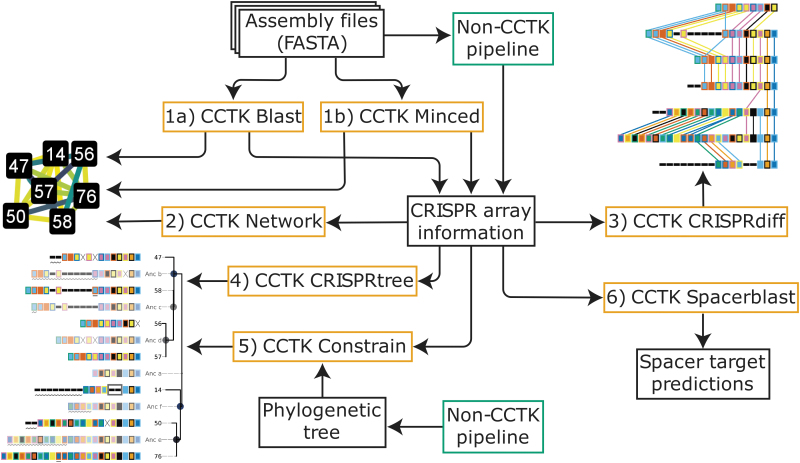
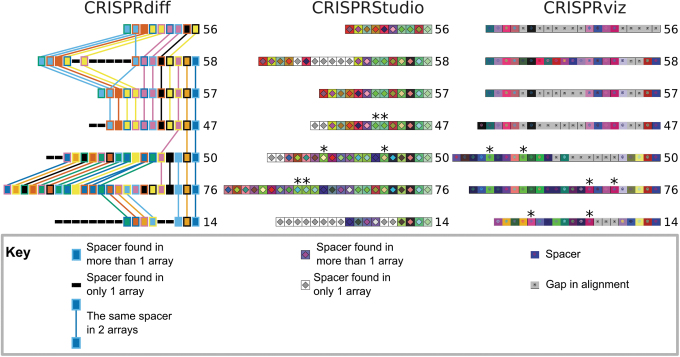
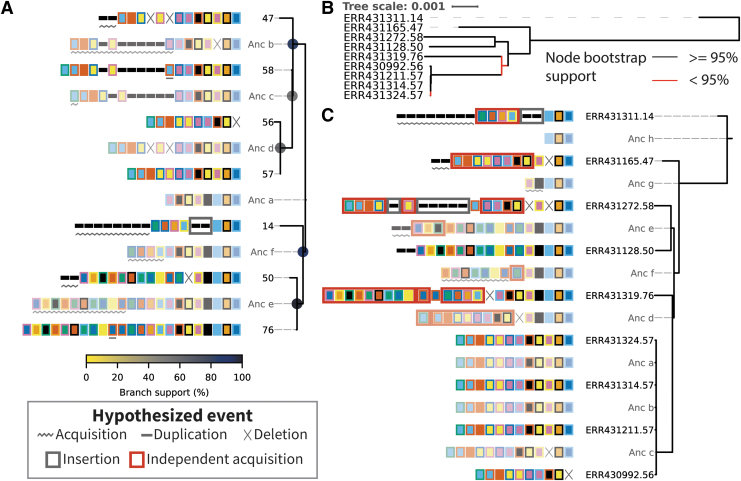
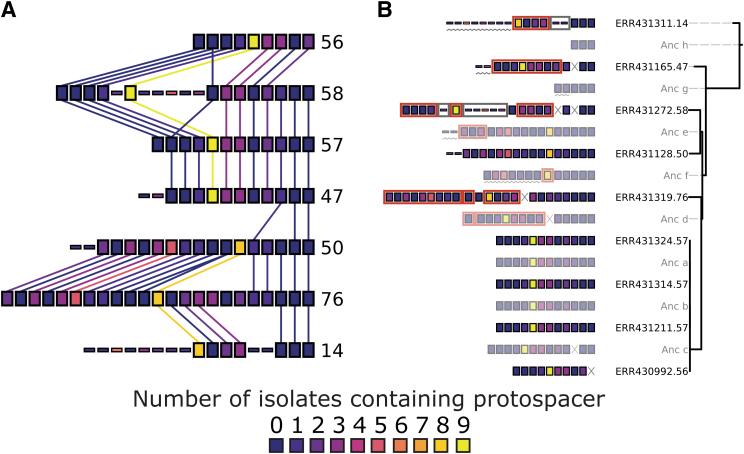
CRISPR-Cas systems provide immunity against mobile genetic elements (MGEs) through sequence-specific targeting by spacer sequences encoded in CRISPR arrays. Spacers are highly variable between microbial strains and can be acquired rapidly, making them well suited for use in strain typing of closely related organisms. However, no tools are currently available to automate the process of reconstructing strain histories using CRISPR spacers. We therefore developed the CRISPR Comparison Toolkit (CCTK) to enable analyses of array relationships. The CCTK includes tools to identify arrays, analyze relationships between arrays using CRISPRdiff and CRISPRtree, and predict targets of spacers. CRISPRdiff visualizes arrays and highlights the similarities between them. CRISPRtree infers a phylogenetic tree from array relationships and presents a hypothesis of the evolutionary history of the arrays. The CCTK unifies several CRISPR analysis tools into a single command line application, including the first tool to infer phylogenies from array relationships.
CRISPR-Cas 系统通过 CRISPR 阵列中编码的间隔序列对移动遗传元件 (MGE) 进行特异性靶向,从而提供对其的免疫。间隔序列在微生物菌株之间高度可变,并且可以快速获得,这使得它们非常适合用于密切相关的生物体的菌株分型。然而,目前尚无工具可用于使用 CRISPR 间隔序列自动重建菌株历史的过程。因此,我们开发了 CRISPR 比较工具包 (CCTK) 以支持对数组关系的分析。CCTK 包括用于识别数组、使用 CRISPRdiff 和 CRISPRtree 分析数组之间关系以及预测间隔子目标的工具。CRISPRdiff 可视化数组并突出显示它们之间的相似之处。CRISPRtree 从数组关系推断出系统发育树,并提出数组进化历史的假设。CCTK 将几种 CRISPR 分析工具统一到一个命令行应用程序中,包括第一个从数组关系推断系统发育的工具。