Comprehensive Cancer Center, The Ohio State University, Columbus, OH.
Knight Cancer Institute, Oregon Health and Science University, Portland, OR.
Blood Adv. 2023 Oct 24;7(20):6048-6054. doi: 10.1182/bloodadvances.2022009008.
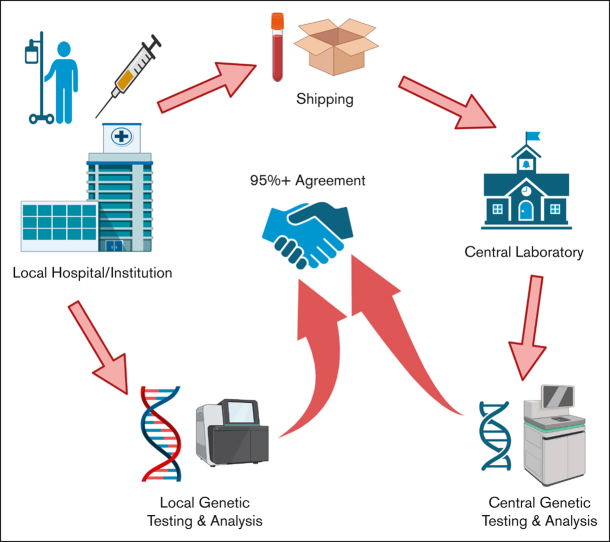
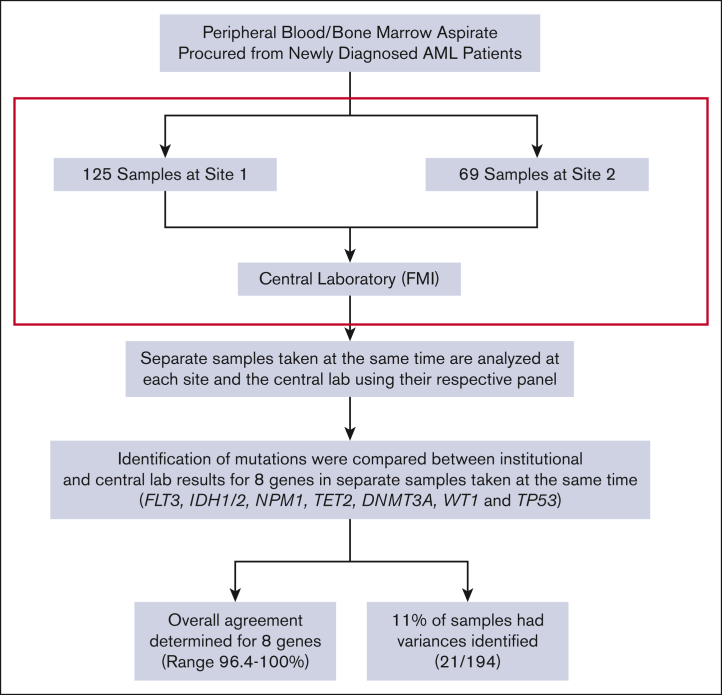
Next-generation sequencing (NGS) to identify pathogenic mutations is an integral part of acute myeloid leukemia (AML) therapeutic decision-making. The concordance in identifying pathogenic mutations among different NGS platforms at different diagnostic laboratories has been studied in solid tumors but not in myeloid malignancies to date. To determine this interlaboratory concordance, we collected a total of 194 AML bone marrow or peripheral blood samples from newly diagnosed patients with AML enrolled in the Beat AML Master Trial (BAMT) at 2 academic institutions. We analyzed the diagnostic samples from patients with AML for the detection of pathogenic myeloid mutations in 8 genes (DNMT3A, FLT3, IDH1, IDH2, NPM1, TET2, TP53, and WT1) locally using the Hematologic Neoplasm Mutation Panel (50-gene myeloid indication filter) (site 1) or the GeneTrails Comprehensive Heme Panel (site 2) at the 2 institutions and compared them with the central results from the diagnostic laboratory for the BAMT, Foundation Medicine, Inc. The overall percent agreement was over 95% each in all 8 genes, with almost perfect agreement (κ > 0.906) in all but WT1, which had substantial agreement (κ = 0.848) when controlling for site. The minimal discrepancies were due to reporting variants of unknown significance (VUS) for the WT1 and TP53 genes. These results indicate that the various NGS methods used to analyze samples from patients with AML enrolled in the BAMT show high concordance, a reassuring finding given the wide use of NGS for therapeutic decision-making in AML.
下一代测序(NGS)用于鉴定致病性突变是急性髓细胞白血病(AML)治疗决策的重要组成部分。在实体瘤中已经研究了不同诊断实验室的不同 NGS 平台在鉴定致病性突变方面的一致性,但迄今为止尚未在髓系恶性肿瘤中进行研究。为了确定这种实验室间的一致性,我们从 2 个学术机构的 Beat AML 主试验(BAMT)中招募的新诊断 AML 患者共收集了 194 个 AML 骨髓或外周血样本。我们使用局部的血液系统肿瘤突变panel(50 基因髓系指示过滤器)(site1)或在这 2 个机构的 GeneTrails Comprehensive Heme Panel(site2)对患者的诊断样本进行分析,以检测 8 个基因(DNMT3A、FLT3、IDH1、IDH2、NPM1、TET2、TP53 和 WT1)中的致病性髓系突变,并与 BAMT、Foundation Medicine,Inc. 的诊断实验室的中央结果进行比较。在所有 8 个基因中,总体一致性均超过 95%,除 WT1 外,几乎所有基因的一致性均非常好(κ>0.906),当控制 site 时,WT1 基因的一致性也非常好(κ=0.848)。最小的差异是由于 WT1 和 TP53 基因报告的意义不明的变异(VUS)。这些结果表明,用于分析 BAMT 入组的 AML 患者样本的各种 NGS 方法具有高度一致性,鉴于 NGS 在 AML 治疗决策中的广泛应用,这是一个令人放心的发现。