Instituto René Rachou, Fiocruz Minas, Belo Horizonte, Minas Gerais, Brazil.
Departamento de Computação, Centro Federal de Educação Tecnológica de Minas Gerais, Brazil.
PLoS Negl Trop Dis. 2023 Jul 17;17(7):e0010804. doi: 10.1371/journal.pntd.0010804. eCollection 2023 Jul.
Over seven decades, Brazil has made admirable progress in controlling schistosomiasis, and a frequent question about the explanation for this reduction refers to the effect of improving environmental factors in the country. This article seeks to identify factors related to the change in the epidemiological situation of schistosomiasis mansoni infection by analyzing three national prevalence surveys conducted since 1950.
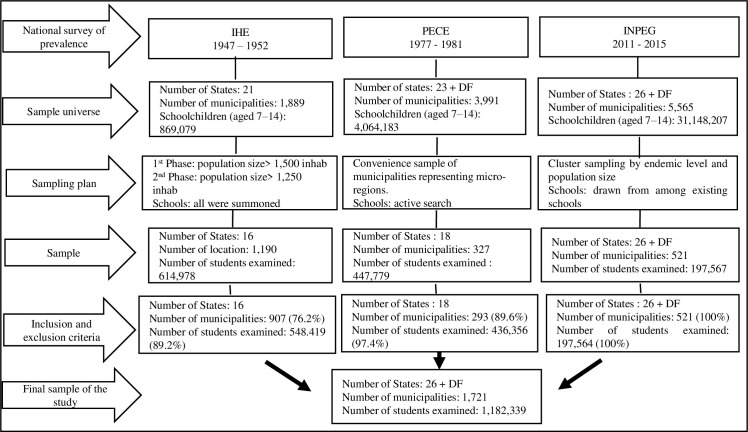
METHODOLOGY/PRINCIPAL FINDINGS: This is an ecological study analyzing an unbalanced panel of data based on national surveys and considering the municipality as the unit of analysis. The sample consisted of 1,721 Brazilian municipalities, in which a total of 1,182,339 schoolchildren aged 7-14 were examined during the three periods corresponding to each survey (1947-1953, 1975-1979, and 2010-2015). The percentage of municipalities with zero cases of schistosomiasis was: 45.4%, 54.2% and 73.7%, respectively for those periods. A zero-inflated Poisson regression model, with fixed and random effects, was fitted to assess the association between candidate factors and disease prevalence using a significance level of 5%. There was a significant decrease in disease prevalence between the first and last periods analyzed (RR 0.214, CI 0.184-0.249), with a protective association with access to sanitation (RR 0.996, CI 0.994-0.998), urbanization (RR 0.991, CI 0.989-0.993), and living in own households (RR 0.986, CI 0.983-0.989); and an inverse association with piped water supply (RR 1.010, CI 1.008-1.011).
The findings of this study indicate a decrease in the prevalence of schistosomiasis over seven decades in schoolchildren from the analyzed Brazilian municipalities, associated with environmental factors and social conditions. The increased access to piped water in the municipalities apparently triggers other ways of contact with unsafe water bodies, generating new transmission routes and suggesting the need for a systemic approach concerning contact with water.
在过去的 70 多年里,巴西在控制血吸虫病方面取得了令人瞩目的进展。人们经常询问这种减少的原因,这涉及到改善国家环境因素的效果。本文旨在通过分析自 1950 年以来进行的三次全国流行情况调查,确定与曼氏血吸虫感染的流行病学状况变化相关的因素。
方法/主要发现:这是一项生态研究,基于全国性调查,对不平衡面板数据进行分析,并将市作为分析单位。样本由 1721 个巴西市组成,在这三个时期,共有 1182339 名 7-14 岁的在校学生接受了检查,这三个时期分别对应于每个调查(1947-1953、1975-1979 和 2010-2015)。相应时期的零病例市比例分别为:45.4%、54.2%和 73.7%。采用固定和随机效应的零膨胀泊松回归模型,以 5%的显著性水平评估候选因素与疾病流行率之间的关联。在分析的第一个和最后一个时期之间,疾病流行率显著下降(RR 0.214,CI 0.184-0.249),与获得卫生设施(RR 0.996,CI 0.994-0.998)、城市化(RR 0.991,CI 0.989-0.993)和居住在自有房屋(RR 0.986,CI 0.983-0.989)呈保护关联;与供水管网(RR 1.010,CI 1.008-1.011)呈负相关。
本研究结果表明,在过去的 70 多年里,分析的巴西市的学生中,血吸虫病的流行率有所下降,这与环境因素和社会条件有关。市中的自来水供应增加显然会引发与不安全水体的其他接触方式,产生新的传播途径,并表明需要采取系统的方法来解决与水的接触问题。