Kataoka Kunio, Ohno Eizaburo, Ishikawa Takuya, Yamao Kentaro, Mizutani Yasuyuki, Iida Tadashi, Takami Hideki, Maeda Osamu, Yamaguchi Junpei, Yokoyama Yukihiro, Ebata Tomoki, Kodera Yasuhiro, Kawashima Hiroki
Department of Gastroenterology and Hepatology, Nagoya University Graduate School of Medicine, Nagoya, Japan.
Department of Gastroenterological Surgery, Nagoya University Graduate School of Medicine, Nagoya, Japan.
Clin Endosc. 2024 Jan;57(1):112-121. doi: 10.5946/ce.2022.278. Epub 2023 Jul 18.
BACKGROUND/AIMS: Since the usefulness of neoadjuvant chemo(radiation) therapy (NAT) for pancreatic cancer has been demonstrated, recurrent biliary obstruction (RBO) in patients with pancreatic cancer with a fully covered self-expandable metal stent (FCSEMS) during NAT is expected to increase. This study investigated the impact of sarcopenia on RBO in this setting.
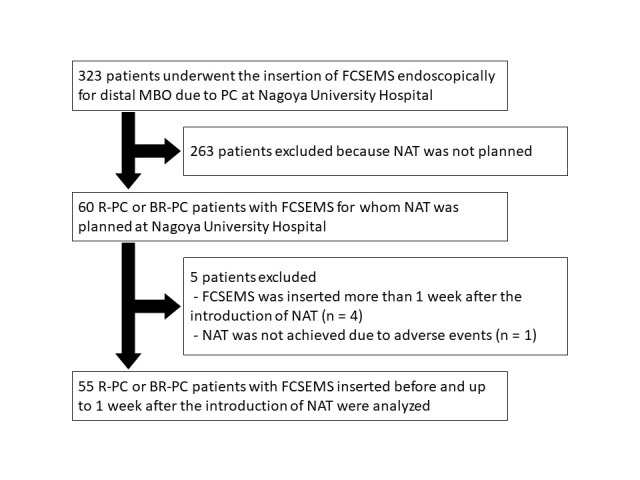
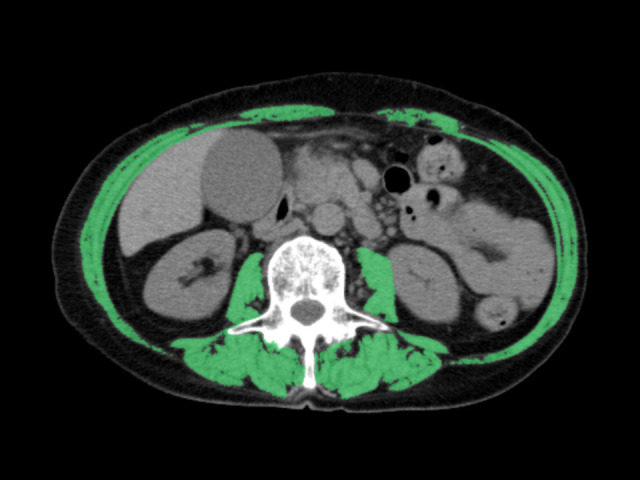
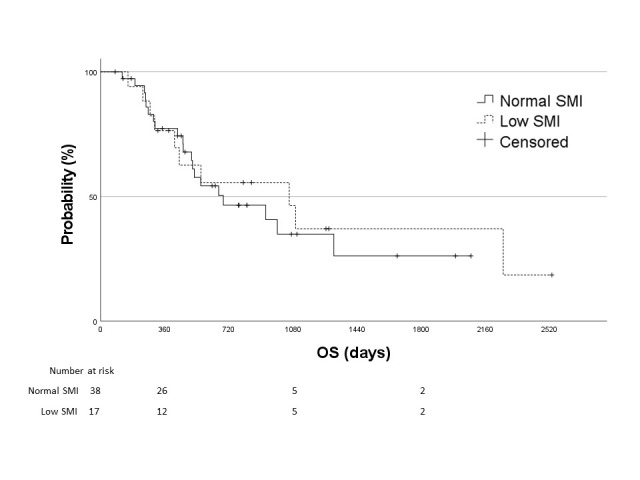
Patients were divided into normal and low skeletal muscle index (SMI) groups and retrospectively analyzed. Patient characteristics, overall survival, time to RBO (TRBO), stent-related adverse events, and postoperative complications were compared between the two groups. A Cox proportional hazard model was used to identify the risk factors for short TRBO.
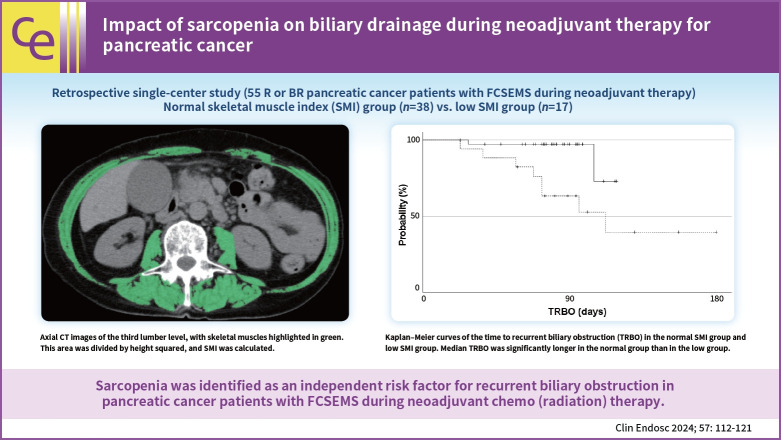
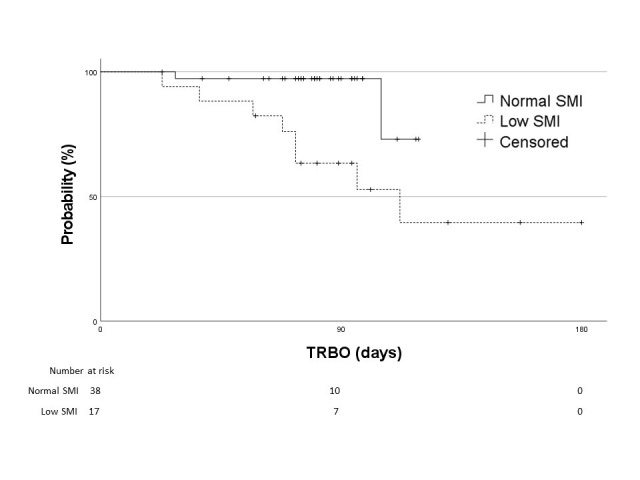
A few significant differences were observed in patient characteristics, overall survival, stent-related adverse events, and postoperative complications between 38 patients in the normal SMI group and 17 in the low SMI group. The median TRBO was not reached in the normal SMI group and was 112 days in the low SMI group (p=0.004). In multivariate analysis, low SMI was the only risk factor for short TRBO, with a hazard ratio of 5.707 (95% confidence interval, 1.148-28.381; p=0.033).
Sarcopenia was identified as an independent risk factor for RBO in patients with pancreatic cancer with FCSEMS during NAT.
背景/目的:由于新辅助化疗(放疗)(NAT)对胰腺癌的有效性已得到证实,预计在NAT期间使用全覆膜自膨式金属支架(FCSEMS)的胰腺癌患者复发性胆管梗阻(RBO)会增加。本研究调查了在这种情况下肌肉减少症对RBO的影响。
将患者分为正常骨骼肌指数(SMI)组和低SMI组并进行回顾性分析。比较两组患者的特征、总生存期、RBO发生时间(TRBO)、支架相关不良事件和术后并发症。采用Cox比例风险模型确定短TRBO的危险因素。
正常SMI组的38例患者与低SMI组的17例患者在患者特征、总生存期、支架相关不良事件和术后并发症方面观察到一些显著差异。正常SMI组未达到TRBO中位数,低SMI组为112天(p = 0.004)。在多变量分析中,低SMI是短TRBO的唯一危险因素,风险比为5.707(95%置信区间,1.148 - 28.381;p = 0.033)。
肌肉减少症被确定为NAT期间使用FCSEMS的胰腺癌患者RBO的独立危险因素。