
中国成年人数字排斥与认知障碍之间的关系。
Relationship between digital exclusion and cognitive impairment in Chinese adults.
作者信息
Liu Xiaoli, Wang Xiaoxiao, Zhang Hua, Pei Minyue, Li Nan
机构信息
Research Center of Clinical Epidemiology, Peking University Third Hospital, Beijing, China.
Department of Hernia and Abdominal Wall Surgery, Beijing Chaoyang Hospital, Capital Medical University, Beijing, China.
出版信息
Front Aging Neurosci. 2023 Jul 3;15:1194348. doi: 10.3389/fnagi.2023.1194348. eCollection 2023.
OBJECTIVE
We aimed to evaluate the relationship between digital exclusion, such as neither mobile payments nor WeChat use, and cognitive impairment in Chinese individuals aged 45 and older.
METHODS
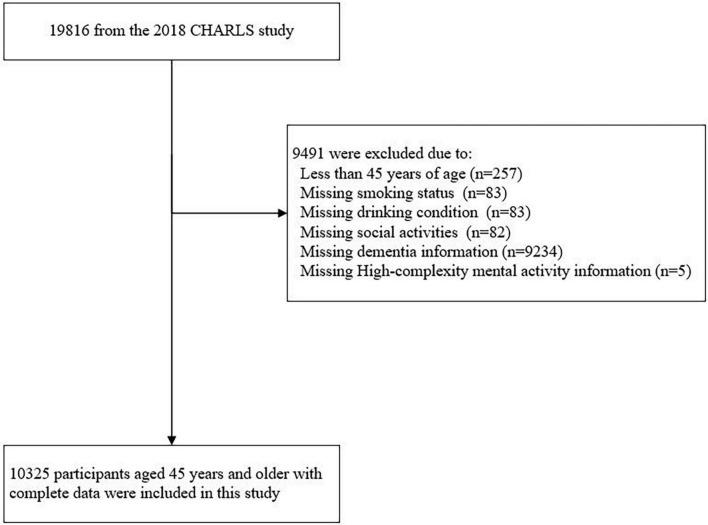
A population-based cross-sectional study utilizing data from the fourth national survey of the China Health and Retirement Longitudinal Study (CHARLS). In the fourth wave of CHARLS, 10,325 participants aged 45 and older with complete information were included in this analysis. Self-reported mobile payments and WeChat usage constituted our exposure. Cognitive impairment was the primary outcome. Univariate and multivariate logistic regression were used to assess the relationships between cognitive impairment risk and digital exclusion.
RESULTS
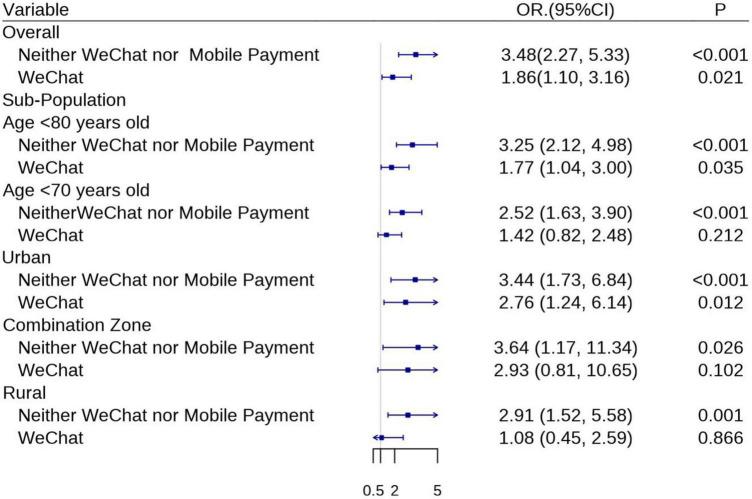
Data were analyzed from 10,325 participants [mean (SD) age, 60.3 (9.1) years; 44.8% women], including 1,232 individuals with cognitive impairment and 9,093 cognitively normal individuals. The overall proportion of users who did not use either mobile payment or WeChat and those who only used WeChat were 81.3 and 6.7%, for cognitively impaired individuals 95.0 and 3.1%, and for cognitively normal individuals 79.5 and 7.2% [neither WeChat nor mobile payments vs. control unadjusted odds ratio (OR), 8.16; < 0.001; only WeChat use vs. control unadjusted OR, 2.91; < 0.001]. Participants who did not use either WeChat or mobile payments had an elevated risk for cognitive impairment after adjusting for a number of covariates (neither WeChat nor mobile payments vs. control adjusted OR, 3.48; < 0.001; only WeChat use vs. control adjusted OR, 1.86; = 0.021).
CONCLUSION
Our study reveals a positive correlation between digital exclusion and cognitive impairment in Chinese adults, providing insights for promoting active digital integration among older adults. Further longitudinal research is needed to further validate this hypothesis.
目的
我们旨在评估数字排斥(如既不使用移动支付也不使用微信)与45岁及以上中国人群认知障碍之间的关系。
方法
一项基于人群的横断面研究,利用中国健康与养老追踪调查(CHARLS)第四次全国调查的数据。在CHARLS的第四轮调查中,本分析纳入了10325名年龄在45岁及以上且信息完整的参与者。自我报告的移动支付和微信使用情况为我们的暴露因素。认知障碍是主要结局。采用单因素和多因素逻辑回归来评估认知障碍风险与数字排斥之间的关系。
结果
对10325名参与者[平均(标准差)年龄,60.3(9.1)岁;44.8%为女性]的数据进行了分析,其中包括1232名认知障碍个体和9093名认知正常个体。既不使用移动支付也不使用微信的用户以及仅使用微信的用户的总体比例分别为81.3%和6.7%,认知障碍个体中分别为95.0%和3.1%,认知正常个体中分别为79.5%和7.2%[既不使用微信也不使用移动支付与对照组未调整比值比(OR),8.16;<0.001;仅使用微信与对照组未调整OR,2.91;<0.001]。在调整了多个协变量后,既不使用微信也不使用移动支付的参与者发生认知障碍的风险升高(既不使用微信也不使用移动支付与对照组调整后OR,3.48;<0.001;仅使用微信与对照组调整后OR,1.86;=0.021)。
结论
我们的研究揭示了中国成年人数字排斥与认知障碍之间存在正相关,为促进老年人积极融入数字生活提供了见解。需要进一步的纵向研究来进一步验证这一假设。
 Zotero 插件