Rigattieri Stefano, Marino Gaetano, Giovannelli Francesca, Tommasino Antonella, Berni Andrea
Department of Clinical and Molecular Medicine, Sapienza University of Rome, Sant' Andrea Hospital, Rome, Italy.
Postepy Kardiol Interwencyjnej. 2023 Jun;19(2):158-162. doi: 10.5114/aic.2023.129215. Epub 2023 Jun 30.
Technological advancements in transcatheter heart valve platforms are essential in order to achieve high standards of efficacy and safety in transcatheter aortic valve replacement (TAVR).
To evaluate the performance of the new version of the Portico valve delivery system (FlexNav) as compared to the first-generation device.
In this single-center, observational study consecutive patients undergoing Portico valve implantation with the new FlexNav delivery system (DS) were compared with patients treated with the first-generation delivery system (1 gen DS). In-hospital outcomes were self-adjudicated according to the Valve Academic Research Consortium-3 definition.
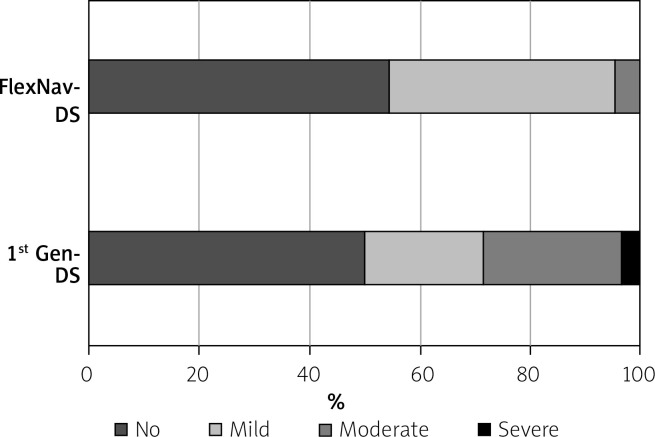
Fifty patients were included in this study; 22 were treated with the FlexNav DS and the remaining patients with the 1 gen DS. Clinical characteristics were similar between groups, except for older age (82.6 ±3.6 vs. 80.7 ±3.8; = 0.07) and higher prevalence of female gender (68.2% vs. 39.3%; = 0.04) in the FlexNav DS group as compared to the 1 gen DS group, respectively. We observed similar rates of procedural success but higher rate of moderate-to-severe paravalvular leak in the 1 gen DS as compared to FlexNav DS group (28.6% vs. 4.6%; = 0.03); major vascular complications were reduced, although not significantly, in the FlexNav DS as compared to the 1 gen DS group (4.5% vs. 10.7%; = 0.64).
Our data suggest that the FlexNav DS, thanks to its lower profile and enhanced stability during valve deployment, might be associated with reduced rates of vascular complications and moderate to severe paravalvular leak, thus improving procedural results.
经导管心脏瓣膜平台的技术进步对于在经导管主动脉瓣置换术(TAVR)中实现高标准的疗效和安全性至关重要。
评估Portico瓣膜输送系统新版本(FlexNav)与第一代装置相比的性能。
在这项单中心观察性研究中,将连续使用新型FlexNav输送系统(DS)进行Portico瓣膜植入的患者与使用第一代输送系统(1代DS)治疗的患者进行比较。住院结局根据瓣膜学术研究联盟-3的定义进行自我判定。
本研究纳入了50例患者;22例接受FlexNav DS治疗,其余患者接受1代DS治疗。两组的临床特征相似,但与1代DS组相比,FlexNav DS组年龄更大(82.6±3.6岁对80.7±3.8岁;P = 0.07),女性患病率更高(68.2%对39.3%;P = 0.04)。我们观察到手术成功率相似,但与FlexNav DS组相比,1代DS组中至重度瓣周漏的发生率更高(28.6%对4.6%;P = 0.03);与1代DS组相比,FlexNav DS组的主要血管并发症有所减少,尽管差异不显著(4.5%对10.7%;P = 0.64)。
我们的数据表明,FlexNav DS由于其较低的外形和瓣膜展开过程中增强的稳定性,可能与血管并发症和中至重度瓣周漏发生率降低相关,从而改善手术结果。