Brazdzionis James, Savla Paras, Oppenheim Rachel, Kim Grace J, Conrad-Schnetz Kristen, Burns Bracken, Beier Alexandra, Connett David A, Miulli Dan E
Neurosurgery, Riverside University Health System Medical Center, Moreno Valley, USA.
General Surgery, Cleveland Clinic South Pointe Hospital, Warrensville Heights, USA.
Cureus. 2023 Jun 17;15(6):e40566. doi: 10.7759/cureus.40566. eCollection 2023 Jun.
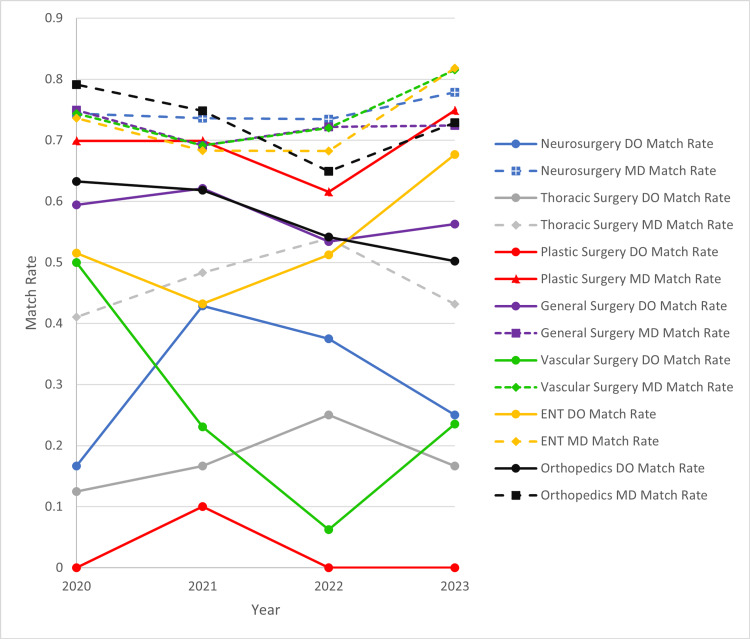
Context Medical students and graduates apply for post-graduate year-one positions every year through the Single Accreditation System (SAS) National Residency Match Program (NRMP). New opportunities have arisen for osteopathic graduates through the transition to a single match. There is a paucity of information evaluating the effects of this single match on osteopathic (DO) and allopathic (MD) candidates in relation to match rates in competitive surgical sub-specialties such as neurosurgery, thoracic surgery, vascular surgery, otolaryngology (ENT), plastic surgery, orthopedic surgery, and general surgery. Objectives This paper utilizes published data to accomplish three tasks. Firstly, it investigates the effects of the SAS on DO and MD match rates in surgical subspecialties of neurosurgery, thoracic surgery, vascular surgery, ENT, plastic surgery, orthopedic surgery, and general surgery. Secondly, it investigates whether program director credentials and impressions correlate with the match rates of DO or MD candidates in each of these specialties. Finally, it discusses solutions for addressing ways to improve match outcomes for all candidates. Methods Previously published NRMP, National Matching Services, and Accreditation Council for Graduate Medical Education websites were queried for the number of DO and MD senior applicants for each position, match success rates, program director impressions, and program director credentials for the years 2018-2023. Match success rates were defined as a ratio of the number of candidates that applied to the number who successfully matched. Data were analyzed using descriptive statistics, chi-squared testing, student t-tests, and linear regression where appropriate. A p-value of less than 0.05 was considered significant. Results From 2020-2023, an increasing proportion of DO residents applied for the selected surgical subspecialties, increasing from 599 applicants in 2020 to 743 candidates in 2023. Overall match rates for DOs remain significantly lower than MD match rates for each of these specialties as well as overall (p-values all <0.05) with summative match rates of 52.89% for DOs compared to 73.61% for MDs in 2023 for the selected surgical subspecialties. From 2020 to 2023 match rates were 30.88% for DOs compared to 74.82% for MDs in neurosurgery, 16.67% versus 46.45% (DO vs MD) in thoracic surgery, 4.17% vs 68.84% (DO vs MD) in plastic surgery, 57.62% vs 73.18% (DO vs MD) in general surgery, 23.21% vs 74.18% (DO vs MD) in vascular surgery, 53.10% vs 72.57% (DO vs MD) for ENT, and 56.92% vs 72.51% (DO vs MD) for orthopedics. There was a statistically significant correlation between the proportion of DO program directors with the rate of DOs matching in the associated specialty (p=0.012). Conclusion There were significantly lower rates for DO candidates compared to MD candidates matching into selected surgical subspecialties of neurosurgery, thoracic surgery, vascular surgery, ENT, plastic surgery, orthopedic surgery, and general surgery. This may be addressed through increasing advocacy at local and national levels, improving mentorship, increasing DO medical student exposure to surgical subspecialties, and ensuring increasing selected surgical subspecialty involvement in teaching these diverse DO applicants in order to strengthen medicine and continue to address predicted growing physician shortages.
医学生和毕业生每年通过单一认证系统(SAS)国家住院医师匹配计划(NRMP)申请研究生一年级职位。随着向单一匹配的转变,整骨疗法毕业生出现了新的机会。关于这种单一匹配对整骨疗法(DO)和西医(MD)候选人在神经外科、胸外科、血管外科、耳鼻喉科(ENT)、整形外科、骨科手术和普通外科等竞争激烈的外科亚专业匹配率的影响,相关信息匮乏。
本文利用已发表的数据完成三项任务。首先,调查SAS对神经外科、胸外科、血管外科、耳鼻喉科、整形外科、骨科手术和普通外科等外科亚专业中DO和MD匹配率的影响。其次,调查项目主任的资质和印象是否与这些专业中DO或MD候选人的匹配率相关。最后,讨论改善所有候选人匹配结果的解决方法。
查询之前发表的NRMP、国家匹配服务机构和研究生医学教育认证委员会网站,获取2018 - 2023年每个职位的DO和MD高级申请人数量、匹配成功率、项目主任印象以及项目主任资质。匹配成功率定义为申请人数与成功匹配人数的比率。在适当情况下,使用描述性统计、卡方检验、学生t检验和线性回归分析数据。p值小于0.05被认为具有统计学意义。
从2020年到2023年,申请所选外科亚专业的DO住院医师比例不断增加,从2020年的599名申请人增加到2023年的743名候选人。在这些专业以及总体上,DO的总体匹配率仍显著低于MD的匹配率(所有p值均<0.05),2023年所选外科亚专业中DO的总体匹配率为52.89%,而MD为73.61%。2020年至2023年,神经外科中DO的匹配率为30.88%,而MD为74.82%;胸外科中分别为16.67%和46.45%(DO对MD);整形外科中为4.17%和68.84%(DO对MD);普通外科中为57.62%和73.18%(DO对MD);血管外科中为23.21%和74.18%(DO对MD);耳鼻喉科中为53.10%和72.57%(DO对MD);骨科中为56.92%和72.51%(DO对MD)。DO项目主任的比例与相关专业中DO的匹配率之间存在统计学显著相关性(p = 0.012)。
与MD候选人相比,DO候选人在神经外科、胸外科、血管外科、耳鼻喉科、整形外科、骨科手术和普通外科等所选外科亚专业的匹配率显著较低。这可以通过在地方和国家层面加强宣传、改善指导、增加DO医学生对外科亚专业的接触,并确保所选外科亚专业更多地参与教授这些不同的DO申请人来解决,以加强医学并继续应对预计不断增加的医生短缺问题。