Kavli Institute for Cosmology, University of Cambridge, Cambridge, UK.
Cavendish Laboratory, University of Cambridge, Cambridge, UK.
Nature. 2023 Sep;621(7978):267-270. doi: 10.1038/s41586-023-06413-w. Epub 2023 Jul 19.
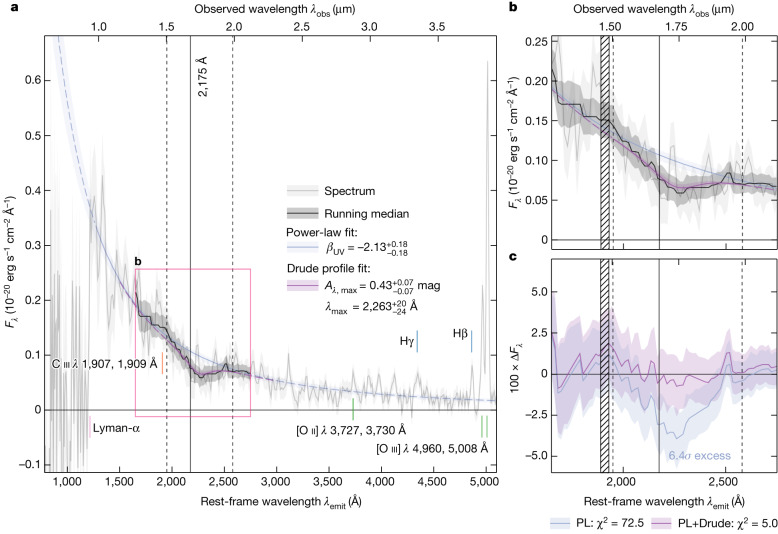
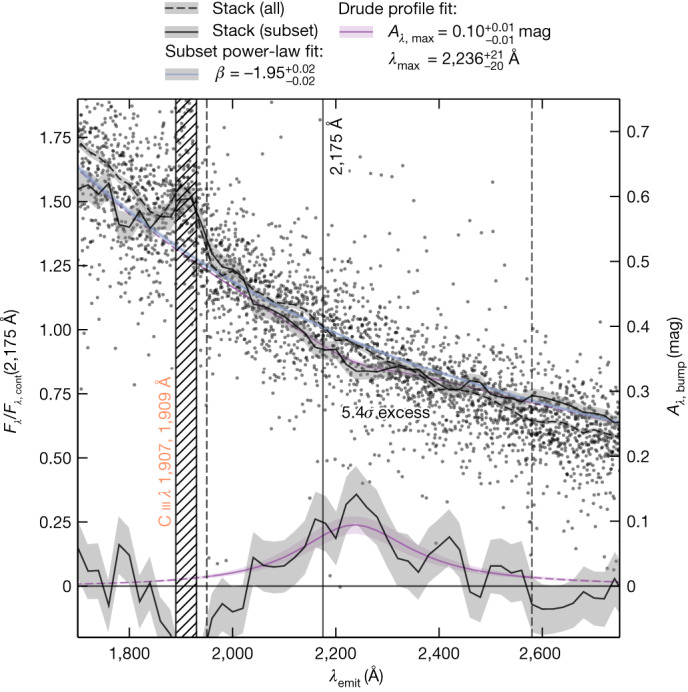
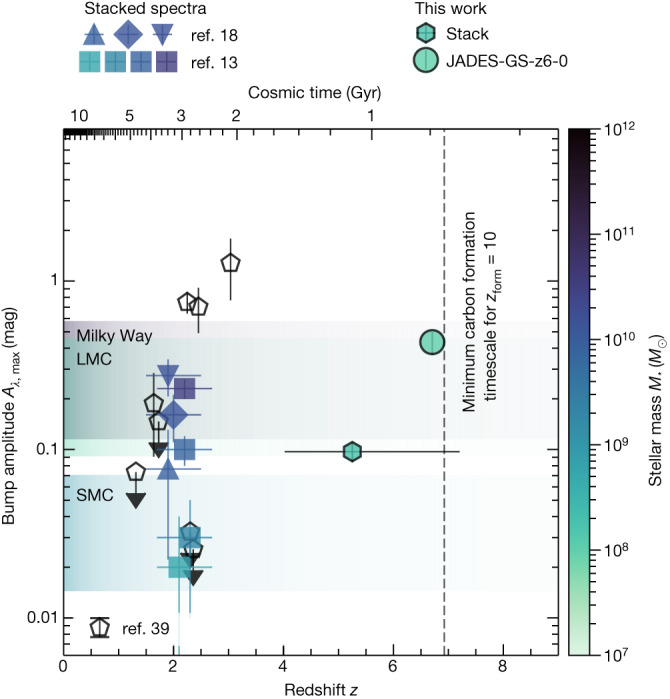
Large dust reservoirs (up to approximately 10M) have been detected in galaxies out to redshift z ≃ 8, when the age of the Universe was only about 600 Myr. Generating substantial amounts of dust within such a short timescale has proven challenging for theories of dust formation and has prompted the revision of the modelling of potential sites of dust production, such as the atmospheres of asymptotic giant branch stars in low-metallicity environments, supernova ejecta and the accelerated growth of grains in the interstellar medium. However, degeneracies between different evolutionary pathways remain when the total dust mass of galaxies is the only available observable. Here we report observations of the 2,175 Å dust attenuation feature, which is well known in the Milky Way and galaxies at z ≲ 3 (refs. ), in the near-infrared spectra of galaxies up to z ≃ 7, corresponding to the first billion years of cosmic time. The relatively short timescale implied for the formation of carbonaceous grains giving rise to this feature suggests a rapid production process, possibly in Wolf-Rayet stars or supernova ejecta.
已经在红移 z ≃ 8 的星系中探测到了大型尘埃库(最大约为 10M),而此时宇宙的年龄仅约为 600Myr。在如此短的时间内产生大量尘埃,这对尘埃形成理论来说是一个挑战,并促使人们对潜在尘埃产生的地点进行建模,例如低金属环境中的渐近巨星支恒星的大气、超新星喷出物和星际介质中尘埃颗粒的加速生长。然而,当星系的总尘埃质量是唯一可用的可观测量时,不同演化途径之间仍然存在不确定性。在这里,我们报告了在近红外光谱中对高达 z ≃ 7 的星系中 2175Å 尘埃消光特征的观测结果,该特征在银河系和 z ≲ 3 的星系中是众所周知的(参考文献)。这与宇宙时间的前十亿年相对应。导致这种特征的碳质颗粒的形成所暗示的相对较短的时间尺度表明存在一种快速的产生过程,可能发生在沃尔夫-拉叶星或超新星喷出物中。