Research Department 2, Potsdam Institute for Climate Impact Research (PIK), Member of the Leibniz Association, Potsdam, Germany.
Heidelberg Institute of Global Health, Heidelberg University, Heidelberg, Germany.
Orphanet J Rare Dis. 2023 Jul 19;18(1):192. doi: 10.1186/s13023-023-02821-3.
Inherited blood disorders affect 7% of the population worldwide, with higher prevalences in countries in the "thalassemia belt," which includes Bangladesh. Clinical management options for severely affected individuals are expensive; thus, targeted government policies are needed to support prevention and treatment programs. In Bangladesh, there is a lack of data, in particular community-based estimates, to determine population prevalence. This study aims to estimate the prevalence of a wide range of hemoglobinopathies and their associations with anemia in a community-based sample of women and young children in rural Sylhet, Bangladesh.
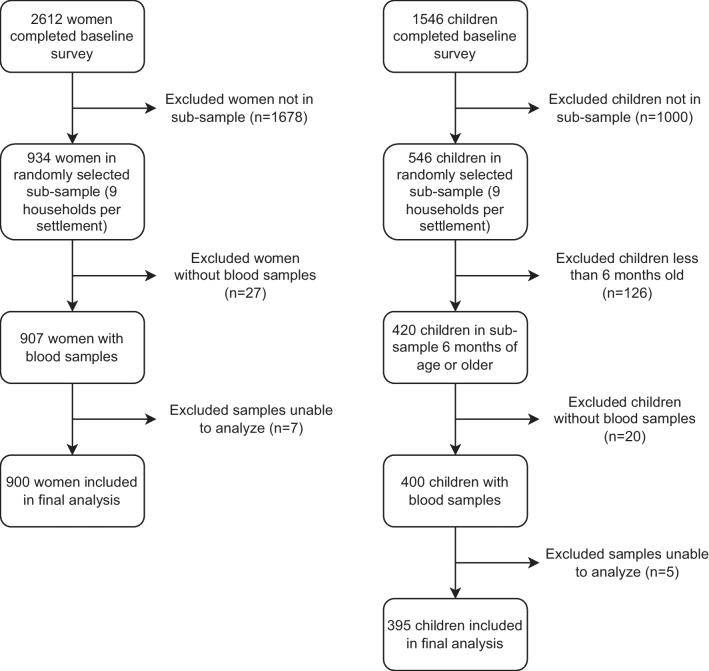
Capillary blood samples from 900 reproductive-aged women and 395 children (aged 6-37 months) participating in the Food and Agricultural Approaches to Reducing Malnutrition (FAARM) trial in two sub-districts of Habiganj, Sylhet Division, Bangladesh were analyzed for alpha thalassemia, beta thalassemia, and other hemoglobinopathies. We examined the association of each inherited blood disorder with hemoglobin concentration and anemia using linear and logistic regression.
We identified at least one inherited blood disorder in 11% of women and 10% of children. Alpha thalassemia was most prevalent, identified in 7% of women and 5% of children, followed by beta thalassemia and hemoglobin E in 2-3%. We also identified cases of hemoglobin S and hemoglobin D in this population. Having any of the identified inherited blood disorders was associated with lower hemoglobin values among non-pregnant women, largely driven by alpha and beta thalassemia. Pregnant women with beta thalassemia were also more likely to have lower hemoglobin concentrations. Among children, we found weak evidence for a relationship between hemoglobinopathy and lower hemoglobin concentrations.
We found a high prevalence of alpha thalassemia among both women and children in rural Sylhet, Bangladesh-higher than all other identified hemoglobinopathies combined. Community-based estimates of alpha thalassemia prevalence in Bangladesh are scarce, yet our findings suggest that alpha thalassemia may comprise the majority of inherited blood disorders in some regions of the country. We recommend that future research on inherited blood disorders in Bangladesh include estimates of alpha thalassemia in their reporting for public health awareness and to facilitate couples counseling.
遗传性血液疾病影响全球 7%的人口,在包括孟加拉国在内的“地中海贫血带”国家中,患病率更高。严重受影响个体的临床管理选择较为昂贵;因此,需要有针对性的政府政策来支持预防和治疗计划。在孟加拉国,缺乏数据,特别是社区为基础的估计数据,以确定人口患病率。本研究旨在估计广泛的血红蛋白病在孟加拉国锡尔赫特农村地区的一个基于社区的育龄妇女和幼儿样本中的流行率及其与贫血的关系。
对参加孟加拉国锡尔赫特哈比甘杰两个分区的食品和农业减少营养不良方法(FAARM)试验的 900 名育龄妇女和 395 名儿童(6-37 个月)的毛细血管血样进行了α地中海贫血、β地中海贫血和其他血红蛋白病的分析。我们使用线性和逻辑回归检验了每种遗传性血液疾病与血红蛋白浓度和贫血的关系。
我们在 11%的妇女和 10%的儿童中发现了至少一种遗传性血液疾病。最常见的是α地中海贫血,在 7%的妇女和 5%的儿童中发现,其次是β地中海贫血和血红蛋白 E,占 2-3%。在这一人群中,我们还发现了血红蛋白 S 和血红蛋白 D 的病例。在非孕妇中,任何一种已确定的遗传性血液疾病都与较低的血红蛋白值有关,这主要是由α和β地中海贫血引起的。患有β地中海贫血的孕妇也更有可能血红蛋白浓度较低。在儿童中,我们发现血红蛋白病与较低的血红蛋白浓度之间存在微弱的关系。
我们发现孟加拉国农村锡尔赫特的妇女和儿童中α地中海贫血的患病率很高-高于所有其他已确定的血红蛋白病的总和。孟加拉国基于社区的α地中海贫血患病率估计数据很少,但我们的研究结果表明,在该国的一些地区,α地中海贫血可能构成大多数遗传性血液疾病。我们建议,今后在孟加拉国开展的遗传性血液疾病研究应包括其报告中的α地中海贫血估计值,以提高公众意识并为夫妇咨询提供便利。