Nguyen Dung, Dionyssiou Dimitrios, Zaitseva Tatiana S, Zhou Anna T, Sue Gloria, Deptula Peter, Moroz Maxim A, Tabada Peter, Rockson Stanley G, Paukshto Michael V, Cheng Ming-Huei, Huang Ngan F
Department of Plastic and Reconstructive Surgery, Stanford University, Stanford, CA, United States.
Department of Plastic Surgery, Aristotle University of Thessaloniki, Greece.
Front Cardiovasc Med. 2023 Jul 4;10:1214116. doi: 10.3389/fcvm.2023.1214116. eCollection 2023.
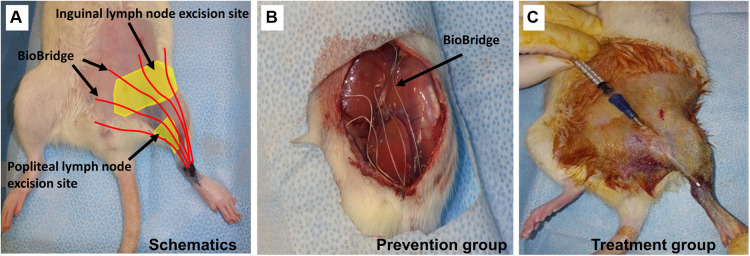
Secondary lymphedema is a common condition among cancer survivors, and treatment strategies to prevent or treat lymphedema are in high demand. The development of novel strategies to diagnose or treat lymphedema would benefit from a robust experimental animal model of secondary lymphedema. The purpose of this methods paper is to describe and summarize our experience in developing and characterizing a rat hindlimb model of lymphedema. Here we describe a protocol to induce secondary lymphedema that takes advantage of micro computed tomography imaging for limb volume measurements and visualization of lymph drainage with near infrared imaging. To demonstrate the utility of this preclinical model for studying the therapeutic benefit of novel devices, we apply this animal model to test the efficacy of a biomaterials-based implantable medical device.
继发性淋巴水肿是癌症幸存者中的常见病症,因此对预防或治疗淋巴水肿的治疗策略有很高的需求。开发用于诊断或治疗淋巴水肿的新策略将受益于强大的继发性淋巴水肿实验动物模型。本方法论文的目的是描述和总结我们在开发和表征淋巴水肿大鼠后肢模型方面的经验。在这里,我们描述了一种诱导继发性淋巴水肿的方案,该方案利用微型计算机断层扫描成像进行肢体体积测量,并通过近红外成像可视化淋巴引流。为了证明这种临床前模型在研究新型设备治疗益处方面的实用性,我们应用此动物模型来测试一种基于生物材料的可植入医疗设备的疗效。