Lu Yan-Hong, Fu Yi, Shu Jin, Yan Li-Yan, Shen Hai-Jian
Geriatric Rehabilitation Department, Shanghai Jing'an District Shibei Hospital, Shanghai 200040, China.
Department of Nursing, Shanghai Jing'an District Shibei Hospital, Shanghai 200040, China.
World J Clin Cases. 2023 Jul 6;11(19):4531-4543. doi: 10.12998/wjcc.v11.i19.4531.
Stroke is a common cause of neurological dysfunction, often resulting in hemiplegia. Thus, rehabilitation of limb function in stroke patients is an important step towards accelerating recovery and improving quality of life.
To investigate whether unilateral strength training in hemiplegic stroke patients could lead to cross-migration, an increase in bilateral muscle strength, and an improvement in lower limb motor function.
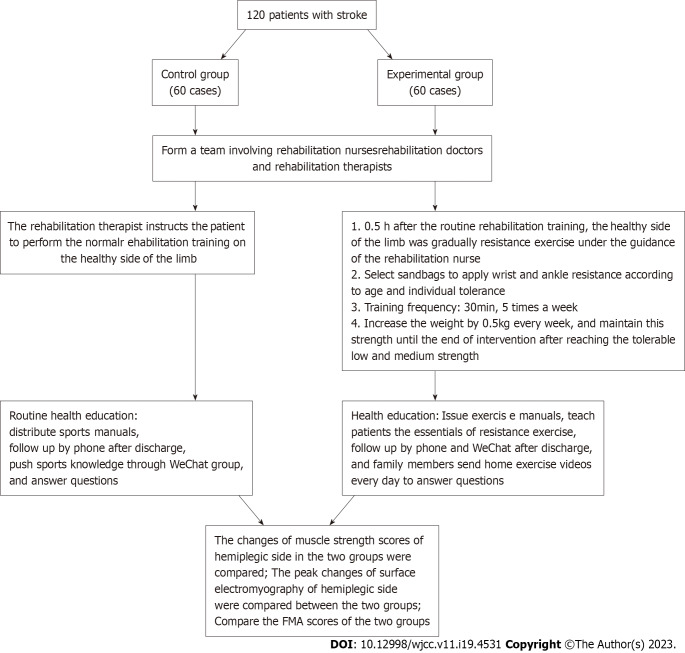
We randomly divided 120 patients with hemiplegic stroke into two groups: Eexperimental and control groups, with 60 patients in each group. Both groups received routine rehabilitation treatment, while the experimental group additionally received ankle dorsiflexion resistance training on the healthy side for 6 wk. We measured the maximum voluntary contract (MVC), changes in surface electromyography (EMG), and the lower limb motor function using the simplified Fugl Meyer Motor Function Assessment Scale (FMA) before and within 1 wk after training.
The FMA score in the experimental group improved significantly compared to both their pre-training score and the control group's post-training score ( < 0.05). The integrated EMG of the anterior tibialis muscle and pulmonary intestine muscle in the experimental group were significantly different after training than before ( < 0.05). Furthermore, the MVC of the anterior tibialis muscle on both the healthy and affected sides and the MVC of the pulmonary intestine muscle on both sides showed significant improvement compared with before training and the control group ( < 0.05).
Our findings suggest that ankle dorsiflexion resistance training on the healthy side in hemiplegic stroke patients can increase strength in the opposite tibialis anterior muscle and antagonist's muscle, indicating a cross-migration phenomenon of strength training. Furthermore, this type of training can also improve lower limb motor function, providing a new exercise method for improving early ankle dorsiflexion dysfunction.
中风是神经功能障碍的常见原因,常导致偏瘫。因此,中风患者肢体功能的康复是加速康复和提高生活质量的重要一步。
探讨偏瘫中风患者的单侧力量训练是否会导致交叉迁移、双侧肌肉力量增加以及下肢运动功能改善。
我们将120例偏瘫中风患者随机分为两组:实验组和对照组,每组60例。两组均接受常规康复治疗,而实验组额外在健康侧进行6周的踝背屈抗阻训练。我们在训练前和训练后1周内使用简化Fugl Meyer运动功能评估量表(FMA)测量最大自主收缩(MVC)、表面肌电图(EMG)变化以及下肢运动功能。
与训练前得分和对照组训练后得分相比,实验组的FMA得分显著提高(<0.05)。训练后,实验组胫前肌和肺肠肌的肌电图积分与训练前相比有显著差异(<0.05)。此外,与训练前和对照组相比,健康侧和患侧胫前肌的MVC以及双侧肺肠肌的MVC均有显著改善(<0.05)。
我们的研究结果表明,偏瘫中风患者在健康侧进行踝背屈抗阻训练可增加对侧胫前肌和拮抗肌的力量,表明存在力量训练的交叉迁移现象。此外,这种类型的训练还可以改善下肢运动功能,为改善早期踝背屈功能障碍提供了一种新的运动方法。