Hui Cassandra K, Chen Nadya, Chakraborty Arunima, Alaasam Valentina, Pieraut Simon, Ouyang Jenny Q
Department of Biology, University of Nevada, Reno, Reno, NV, United States.
Front Neurosci. 2023 Jul 4;17:1194996. doi: 10.3389/fnins.2023.1194996. eCollection 2023.
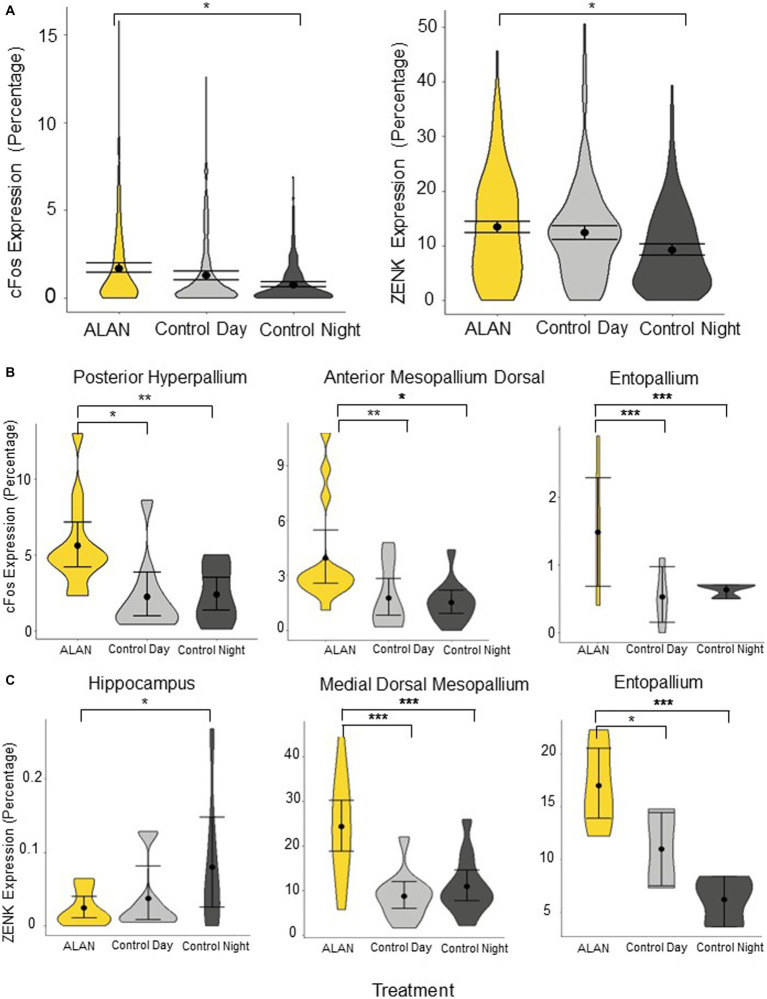
Artificial light at night (ALAN) is a pervasive pollutant that alters physiology and behavior. However, the underlying mechanisms triggering these alterations are unknown, as previous work shows that dim levels of ALAN may have a masking effect, bypassing the central clock. Light stimulates neuronal activity in numerous brain regions which could in turn activate downstream effectors regulating physiological response. In the present study, taking advantage of immediate early gene (IEG) expression as a proxy for neuronal activity, we determined the brain regions activated in response to ALAN. We exposed zebra finches to dim ALAN (1.5 lux) and analyzed 24 regions throughout the brain. We found that the overall expression of two different IEGs, cFos and ZENK, in birds exposed to ALAN were significantly different from birds inactive at night. Additionally, we found that ALAN-exposed birds had significantly different IEG expression from birds inactive at night and active during the day in several brain areas associated with vision, movement, learning and memory, pain processing, and hormone regulation. These results give insight into the mechanistic pathways responding to ALAN that underlie downstream, well-documented behavioral and physiological changes.
夜间人造光(ALAN)是一种普遍存在的污染物,会改变生理和行为。然而,引发这些改变的潜在机制尚不清楚,因为先前的研究表明,低强度的ALAN可能具有掩盖效应,绕过了中枢时钟。光刺激许多脑区的神经元活动,进而可能激活调节生理反应的下游效应器。在本研究中,我们利用即时早期基因(IEG)表达作为神经元活动的指标,确定了对ALAN产生反应而被激活的脑区。我们将斑胸草雀暴露于低强度的ALAN(1.5勒克斯)下,并分析了整个大脑的24个区域。我们发现,暴露于ALAN的鸟类中,两种不同的IEG(cFos和ZENK)的总体表达与夜间不活动的鸟类有显著差异。此外,我们发现,在与视觉、运动、学习和记忆、疼痛处理及激素调节相关的几个脑区中,暴露于ALAN的鸟类与夜间不活动、白天活动的鸟类相比,IEG表达有显著差异。这些结果为响应ALAN的机制途径提供了见解,这些途径是下游有充分记录的行为和生理变化的基础。