Department of Biological Chemistry, The Institute of Life Science, The Hebrew University of Jerusalem, Jerusalem, Israel.
School of Neurobiology, Biochemistry and Biophysics, Tel Aviv University, Tel Aviv-Yafo, Israel.
J Biol Chem. 2023 Sep;299(9):105072. doi: 10.1016/j.jbc.2023.105072. Epub 2023 Jul 18.
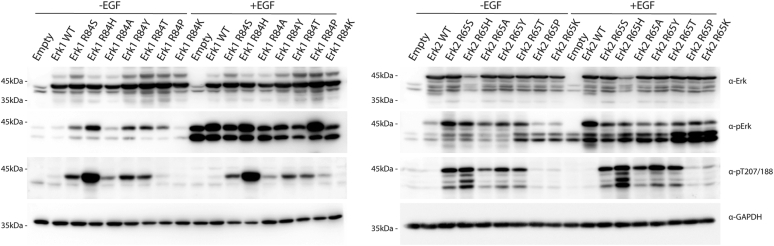
Eukaryotic protein kinases (EPKs) adopt an active conformation following phosphorylation of a particular activation loop residue. Most EPKs spontaneously autophosphorylate this residue. While structure-function relationships of the active conformation are essentially understood, those of the "prone-to-autophosphorylate" conformation are unclear. Here, we propose that a site within the αC-helix of EPKs, occupied by Arg in the mitogen-activated protein kinase (MAPK) Erk1/2 (Arg84/65), impacts spontaneous autophosphorylation. MAPKs lack spontaneous autoactivation, but we found that converting Arg84/65 of Erk1/2 to various residues enables spontaneous autophosphorylation. Furthermore, Erk1 molecules mutated in Arg84 are oncogenic. Arg84/65 thus obstructs the adoption of the "prone-to-autophosphorylate" conformation. All MAPKs harbor an Arg that is equivalent to Arg84/65 of Erks, whereas Arg is rarely found at the equivalent position in other EPKs. We observed that Arg84/65 of Erk1/2 interacts with the DFG motif, suggesting that autophosphorylation may be inhibited by the Arg84/65-DFG interactions. Erk1/2s mutated in Arg84/65 autophosphorylate not only the TEY motif, known as critical for catalysis, but also on Thr207/188. Our MS/MS analysis revealed that a large proportion of the Erk2 population is phosphorylated on Thr188 or on Tyr185 + Thr188, and a small fraction is phosphorylated on the TEY motif. No molecules phosphorylated on Thr183 + Thr188 were detected. Thus, phosphorylation of Thr183 and Thr188 is mutually exclusive suggesting that not only TEY-phosphorylated molecules are active but perhaps also those phosphorylated on Tyr185 + Thr188. The effect of mutating Arg84/65 may mimic a physiological scenario in which allosteric effectors cause Erk1/2 activation by autophosphorylation.
真核蛋白激酶(EPKs)在特定激活环残基磷酸化后采用活性构象。大多数 EPKs 会自发地使该残基磷酸化。虽然活性构象的结构-功能关系基本得到理解,但“易于自发磷酸化”构象的结构-功能关系尚不清楚。在这里,我们提出 EPKs 的 αC-螺旋内的一个位点,该位点被丝裂原活化蛋白激酶(MAPK)Erk1/2 中的精氨酸(Arg84/65)占据,影响自发磷酸化。MAPKs 缺乏自发的自动激活,但我们发现将 Erk1/2 的 Arg84/65 突变为各种残基可实现自发磷酸化。此外,突变 Arg84 的 Erk1 分子具有致癌性。因此,Arg84/65 阻碍了“易于自发磷酸化”构象的采用。所有 MAPKs 都含有一个相当于 Erks 的 Arg84/65 的精氨酸,而其他 EPKs 中很少发现相当于 Arg84/65 的精氨酸。我们观察到 Erk1/2 的 Arg84/65 与 DFG 基序相互作用,这表明自动磷酸化可能受到 Arg84/65-DFG 相互作用的抑制。Arg84/65 突变的 Erk1/2 不仅磷酸化 TEY 基序(已知对催化至关重要),还磷酸化 Thr207/188。我们的 MS/MS 分析显示,Erk2 群体的很大一部分被 Thr188 或 Tyr185+Thr188 磷酸化,一小部分被 TEY 基序磷酸化。未检测到 Thr183+Thr188 磷酸化的分子。因此,Thr183 和 Thr188 的磷酸化相互排斥,这表明不仅 TEY 磷酸化的分子是活性的,而且可能还有那些磷酸化于 Tyr185+Thr188 的分子是活性的。Arg84/65 突变的影响可能模拟了变构效应物通过自发磷酸化使 Erk1/2 激活的生理情况。