State Key Laboratory of Biocontrol/School of Marine Sciences, Sun Yat-Sen University, Guangzhou, People's Republic of China.
School of Life Sciences/China-ASEAN Belt and Road Joint Laboratory On Mariculture Technology, Sun Yat-Sen University, Guangzhou, People's Republic of China.
Microbiome. 2023 Jul 20;11(1):155. doi: 10.1186/s40168-023-01570-6.
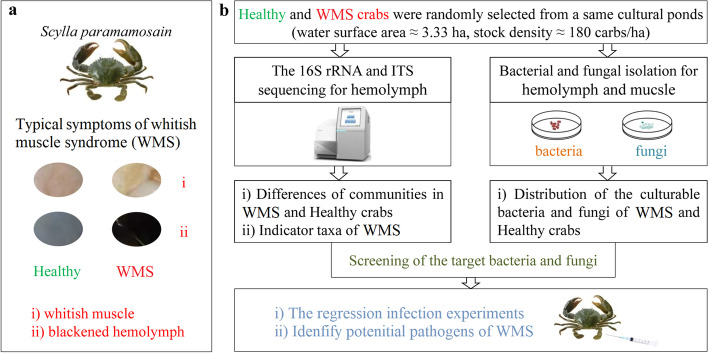
For more than a century, the Koch's postulates have been the golden rule for determining the causative agents in diseases. However, in cases of multiple pathogens-one disease, in which different pathogens can cause the same disease, the selection of microorganisms that regress infection is hard when Koch's postulates are applied. Microbiome approaches can obtain relatively complete information about disease-related microorganisms and can guide the selection of target microorganisms for regression infection. In the present study, whitish muscle syndrome (WMS) of Scylla paramamosain, which has typical symptoms with whitish muscle and blackened hemolymph was used as an example to establish a new research strategy that integrates microbiome approaches and Koch's postulates to determinate causative agents of multiple pathogens-one disease.
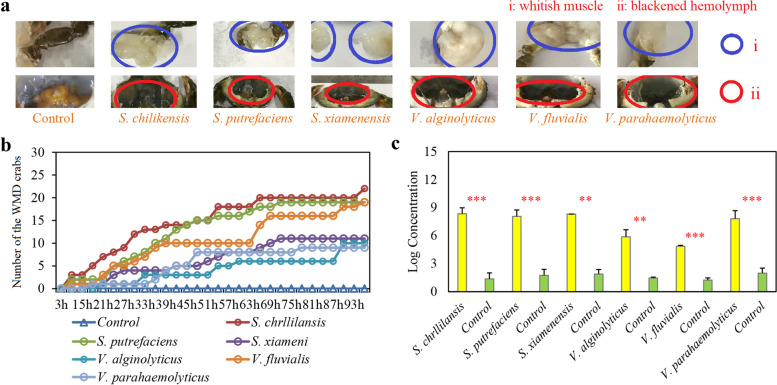
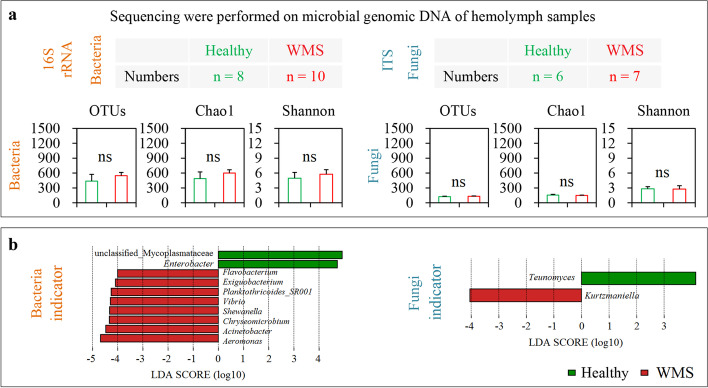
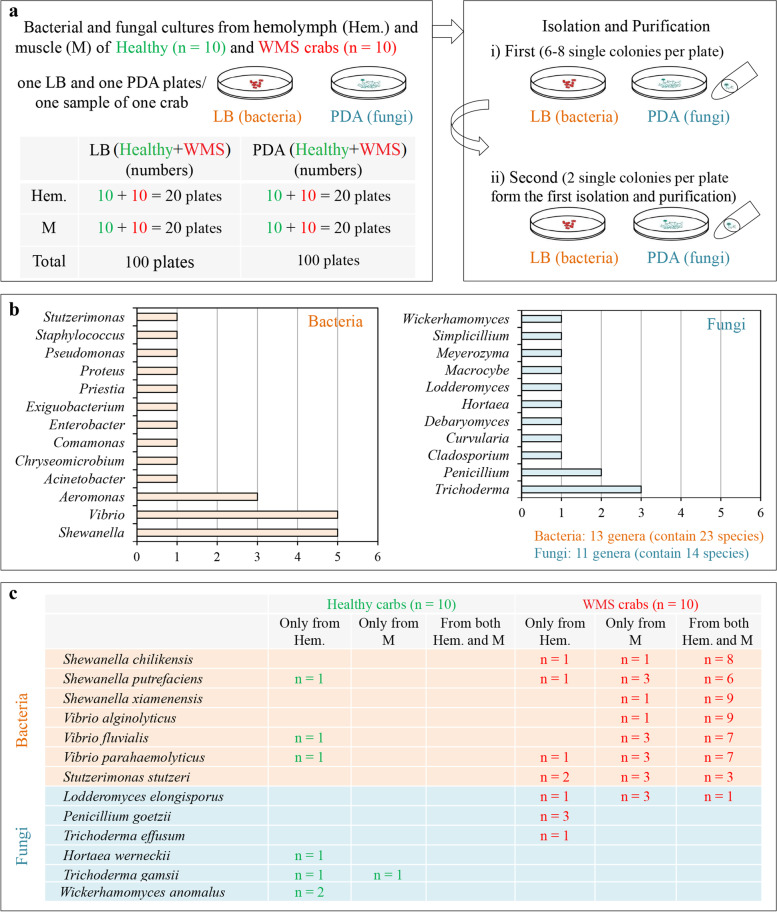
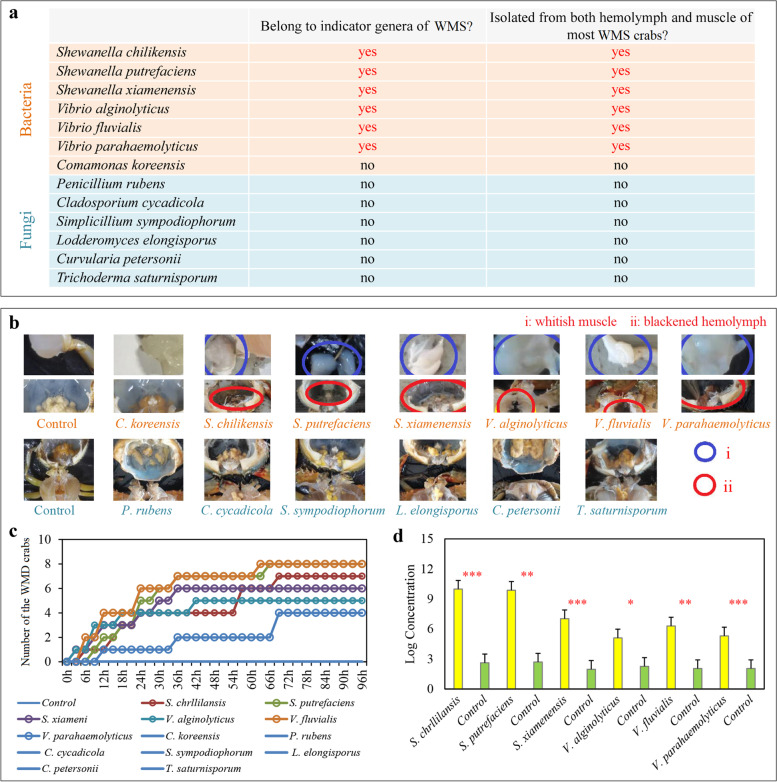
Microbiome results revealed that Aeromonas, Acinetobacter, Shewanella, Chryseomicrobium, Exiguobacterium, Vibrio and Flavobacterium, and Kurtzmaniella in hemolymph were bacterial and fungal indicators for WMS. A total of 23 bacteria and 14 fungi were isolated from hemolymph and muscle tissues, and among the bacteria, Shewanella chilikensis, S. xiamenensis, Vibrio alginolyticus, S. putrefaciens, V. fluvialis, and V. parahaemolyticus were present in hemolymph and/or muscle tissues in each WMS crab, and the last three species were also present in three Healthy crabs. The target bacteria and fungi were further screened to regression infections based on two criteria: whether they belonged to the indicator genera for WMS, whether they were isolated from both hemolymph and muscle tissues in most WMS crabs. Only S. chilikensis, S. putrefaciens, S. xiamenensis, V. alginolyticus, V. fluvialis, and V. parahaemolyticus met both two criteria. The six bacteria that met both two criteria and six fungi and another bacterium that unmatched any of two criteria were used to perform regression infection experiments based on Koch's postulates. S. chilikensis, S. putrefaciens, S. xiamenensis, V. alginolyticus, V. fluvialis, and V. parahaemolyticus met both two criteria, and the results indicate that they cause WMS in crabs independently.
This study fully demonstrated that our research strategy that integrates the microbiome and Koch's postulates can maximize the ability to catch pathogens in one net for the situation of multiple pathogens-one disease. Video Abstract.
一个多世纪以来,科赫法则一直是确定疾病病原体的黄金法则。然而,在多种病原体-一种疾病的情况下,不同的病原体可以导致相同的疾病,当应用科赫法则时,很难选择能使感染消退的微生物。微生物组方法可以获得与疾病相关的微生物的相对完整信息,并可以指导选择目标微生物进行回归感染。本研究以斑节对虾的白肌综合征(WMS)为例,建立了一种新的研究策略,将微生物组方法与科赫法则相结合,以确定多种病原体-一种疾病的病原体。
微生物组结果显示,对虾血液中的气单胞菌、不动杆菌、希瓦氏菌、黄杆菌、微杆菌、弧菌和黄杆菌以及肌肉组织中的库尔茨曼菌是 WMS 的细菌和真菌指标。从血液和肌肉组织中总共分离出 23 种细菌和 14 种真菌,其中希瓦氏菌、厦门希瓦氏菌、溶藻弧菌、腐败希瓦氏菌、弗氏弧菌和副溶血弧菌存在于每只 WMS 蟹的血液和/或肌肉组织中,后三种也存在于 3 只健康蟹中。根据两个标准,进一步筛选目标细菌和真菌进行回归感染:它们是否属于 WMS 的指示属,它们是否从大多数 WMS 蟹的血液和肌肉组织中分离出来。只有希瓦氏菌、腐败希瓦氏菌、厦门希瓦氏菌、溶藻弧菌、弗氏弧菌和副溶血弧菌同时符合这两个标准。同时符合这两个标准的 6 种细菌和 6 种真菌以及另一种不符合任何一个标准的细菌被用于基于科赫法则的回归感染实验。希瓦氏菌、腐败希瓦氏菌、厦门希瓦氏菌、溶藻弧菌、弗氏弧菌和副溶血弧菌同时符合这两个标准,结果表明它们独立地引起蟹的 WMS。
本研究充分证明,我们整合微生物组和科赫法则的研究策略可以最大限度地提高在多种病原体-一种疾病情况下一网打尽病原体的能力。