Discipline of Behavioural Health, College of Medicine and Public Health, Flinders University, Sturt Rd, Bedford, South Australia, 5042, Australia.
Psychological Medicine, Institute of Psychiatry, Psychology & Neuroscience, King's College London, London, SE5 8AB, UK.
Support Care Cancer. 2023 Jul 21;31(8):478. doi: 10.1007/s00520-023-07908-y.
Cancer survivorship in Australia continues to increase due to new methods for early detection and treatment. Cancer survivors face challenges in the survivorship phase and require ongoing support. A telephone-delivered cancer survivorship program (CSP), including health and mental health coaches, was developed, piloted, and evaluated in Eastern Australia.
Cancer survivors' (n = 7), coaches' (n = 7), and hospital staff (n = 3) experiences of the CSP were explored through semi-structured interviews. Quantitative data routinely collected throughout the pilot of the CSP was described (N = 25).
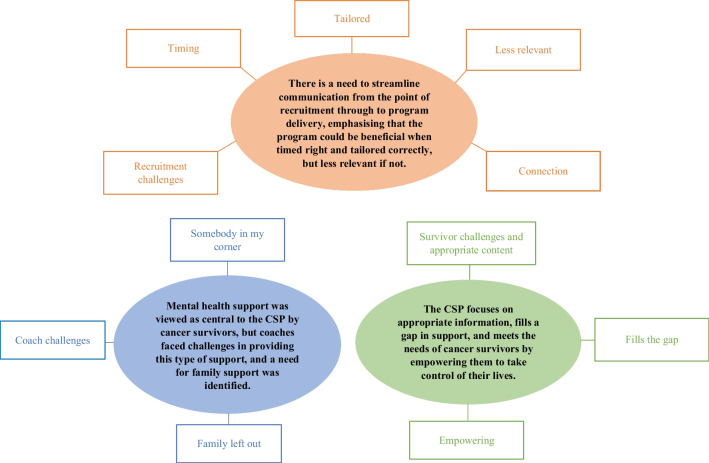
Three syntheses and 11 themes were generated through thematic analysis. The first synthesis centred around operational factors and highlighted a need to streamline communication from the point of recruitment, through to program delivery, emphasising that the program could be beneficial when timed right and tailored correctly. The second synthesis indicated that the CSP focused on appropriate information, filled a gap in support, and met the needs of cancer survivors by empowering them. The third synthesis focussed on the value of mental health support in the CSP, but also highlighted challenges coaches faced in providing this support. Descriptive analysis of quantitative data indicated improvements in self-management, weekly physical activity, and meeting previously unmet needs.
Cancer survivors expressed appreciation for the support they received through the CSP and, in line with other cancer survivorship research, predominantly valued just having somebody in their corner.
Recommendations are made for improving cancer survivorship programs in the future.
由于早期检测和治疗方法的新方法,澳大利亚的癌症存活率持续上升。癌症幸存者在生存阶段面临挑战,需要持续的支持。在澳大利亚东部开发、试点和评估了一种电话式癌症生存项目 (CSP),其中包括健康和心理健康教练。
通过半结构化访谈探讨了癌症幸存者 (n=7)、教练 (n=7) 和医院工作人员 (n=3) 对 CSP 的体验。描述了 CSP 试点过程中定期收集的定量数据 (N=25)。
通过主题分析生成了三个综合和 11 个主题。第一个综合围绕运营因素展开,强调需要简化从招募点到项目交付的沟通,强调当时间正确且调整得当时,该计划可能会有益。第二个综合表明,CSP 侧重于提供适当的信息,填补了支持方面的空白,并通过赋予癌症幸存者权力来满足他们的需求。第三个综合重点关注 CSP 中的心理健康支持的价值,但也强调了教练在提供这种支持方面面临的挑战。对定量数据的描述性分析表明自我管理、每周身体活动和满足以前未满足的需求有所改善。
癌症幸存者对他们通过 CSP 获得的支持表示感谢,并且与其他癌症生存研究一致,他们主要看重的是有人支持他们。
提出了对未来改进癌症生存项目的建议。