Translational Science and Therapeutics Division, Fred Hutchinson Cancer Center, Seattle, Washington, USA.
Department of Laboratory Medicine and Pathology, University of Washington, Seattle, Washington, USA; Department of Medicine, University of Washington, Seattle, Washington, USA.
Mol Cell Proteomics. 2023 Sep;22(9):100621. doi: 10.1016/j.mcpro.2023.100621. Epub 2023 Jul 20.
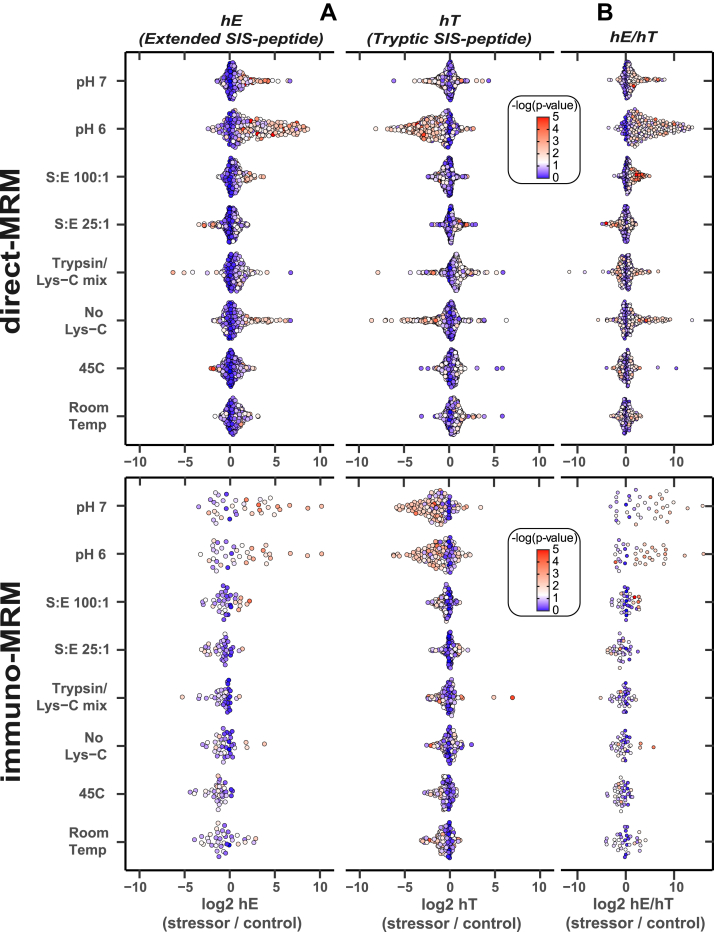
Targeted mass spectrometry (MS)-based proteomic assays, such as multiplexed multiple reaction monitoring (MRM)-MS assays, enable sensitive and specific quantification of proteotypic peptides as stoichiometric surrogates for proteins. Efforts are underway to expand the use of MRM-MS assays in clinical environments, which requires a reliable strategy to monitor proteolytic digestion efficiency within individual samples. Towards this goal, extended stable isotope-labeled standard (SIS) peptides (hE), which incorporate native proteolytic cleavage sites, can be spiked into protein lysates prior to proteolytic (trypsin) digestion, and release of the tryptic SIS peptide (hT) can be monitored. However, hT measurements alone cannot monitor the extent of digestion and may be confounded by matrix effects specific to individual patient samples; therefore, they are not sufficient to monitor sample-to-sample digestion variability. We hypothesized that measuring undigested hE, along with its paired hT, would improve detection of digestion issues compared to only measuring hT. We tested the ratio of the SIS pair measurements, or hE/hT, as a quality control (QC) metric of trypsin digestion for two MRM assays: a direct-MRM (398 targets) and an immuno-MRM (126 targets requiring immunoaffinity peptide enrichment) assay, with extended SIS peptides observable for 54% (216) and 62% (78) of the targets, respectively. We evaluated the quantitative bias for each target in a series of experiments that adversely affected proteolytic digestion (e.g., variable digestion times, pH, and temperature). We identified a subset of SIS pairs (36 for the direct-MRM, 7 for the immuno-MRM assay) for which the hE/hT ratio reliably detected inefficient digestion that resulted in decreased assay sensitivity and unreliable endogenous quantification. The hE/hT ratio was more responsive to a decrease in digestion efficiency than a metric based on hT measurements alone. For clinical-grade MRM-MS assays, this study describes a ready-to-use QC panel and also provides a road map for designing custom QC panels.
靶向质谱(MS)-基于蛋白质组学的分析方法,如多重反应监测(MRM)-MS 分析方法,能够实现对蛋白质特征肽的灵敏和特异性定量,这些肽作为蛋白质的化学计量替代物。目前正在努力将 MRM-MS 分析方法扩展到临床环境中,这需要一种可靠的策略来监测单个样本中的蛋白水解消化效率。为此,可以在蛋白水解(胰蛋白酶)消化之前,向蛋白裂解物中加入包含天然蛋白水解切割位点的扩展稳定同位素标记标准(SIS)肽(hE),并监测释放的胰蛋白酶 SIS 肽(hT)。然而,仅测量 hT 并不能监测消化的程度,并且可能会受到特定于个体患者样本的基质效应的干扰;因此,它们不足以监测样本间消化的变异性。我们假设,与仅测量 hT 相比,测量未消化的 hE 及其配对的 hT 可以提高对消化问题的检测。我们测试了 SIS 对测量的比值,即 hE/hT,作为两种 MRM 分析方法(直接-MRM(398 个靶标)和免疫-MRM(126 个靶标需要免疫亲和肽富集)的胰蛋白酶消化的质量控制(QC)指标,可观察到扩展 SIS 肽分别为 54%(216 个)和 62%(78 个)的靶标。我们在一系列实验中评估了每个靶标在定量时的偏倚,这些实验会对蛋白水解产生不利影响(例如,消化时间、pH 值和温度等变量)。我们确定了一组 SIS 对(直接-MRM 分析的 36 对,免疫-MRM 分析的 7 对),其 hE/hT 比值可可靠地检测到效率低下的消化,从而降低分析的灵敏度和不可靠的内源性定量。与仅基于 hT 测量的指标相比,hE/hT 比值对消化效率的降低更为敏感。对于临床级的 MRM-MS 分析方法,本研究描述了一个即用型 QC 面板,并为设计定制 QC 面板提供了路线图。