Faculty of Natural Sciences and Mathematics, University of Maribor, Maribor, Slovenia.
Faculty of Electrical Engineering and Computer Science, University of Maribor, Maribor, Slovenia.
Front Public Health. 2023 Jul 6;11:1209809. doi: 10.3389/fpubh.2023.1209809. eCollection 2023.
Type 2 diabetes mellitus (T2DM) is a complex, chronic disease affecting multiple organs with varying symptoms and comorbidities. Profiling patients helps identify those with unfavorable disease progression, allowing for tailored therapy and addressing special needs. This study aims to uncover different T2DM profiles based on medication intake records and laboratory measurements, with a focus on how individuals with diabetes move through disease phases.
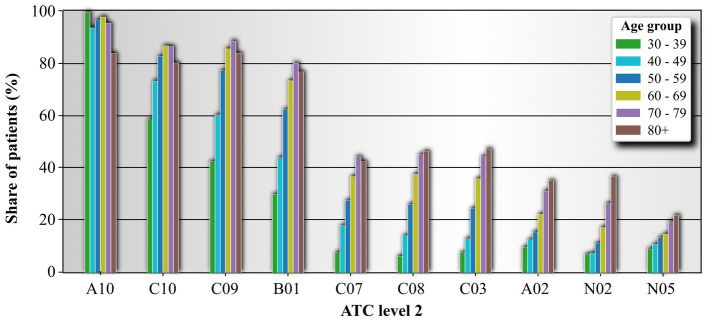
We use medical records from databases of the last 20 years from the Department of Endocrinology and Diabetology of the University Medical Center in Maribor. Using the standard ATC medication classification system, we created a patient-specific drug profile, created using advanced natural language processing methods combined with data mining and hierarchical clustering.
Our results show a well-structured profile distribution characterizing different age groups of individuals with diabetes. Interestingly, only two main profiles characterize the early 40-50 age group, and the same is true for the last 80+ age group. One of these profiles includes individuals with diabetes with very low use of various medications, while the other profile includes individuals with diabetes with much higher use. The number in both groups is reciprocal. Conversely, the middle-aged groups are characterized by several distinct profiles with a wide range of medications that are associated with the distinct concomitant complications of T2DM. It is intuitive that the number of profiles increases in the later age groups, but it is not obvious why it is reduced later in the 80+ age group. In this context, further studies are needed to evaluate the contributions of a range of factors, such as drug development, drug adoption, and the impact of mortality associated with all T2DM-related diseases, which characterize these middle-aged groups, particularly those aged 55-75.
Our approach aligns with existing studies and can be widely implemented without complex or expensive analyses. Treatment and drug use data are readily available in healthcare facilities worldwide, allowing for profiling insights into individuals with diabetes. Integrating data from other departments, such as cardiology and renal disease, may provide a more sophisticated understanding of T2DM patient profiles.
2 型糖尿病(T2DM)是一种影响多个器官的复杂慢性疾病,具有不同的症状和合并症。对患者进行分析有助于识别那些疾病进展不利的患者,从而提供针对性的治疗并满足特殊需求。本研究旨在根据药物摄入记录和实验室测量结果揭示不同的 T2DM 特征,重点关注糖尿病患者如何经历疾病阶段。
我们使用了过去 20 年来自马里博尔大学医学中心内分泌和糖尿病学系数据库中的医疗记录。我们使用标准的 ATC 药物分类系统,创建了一个基于先进自然语言处理方法与数据挖掘和层次聚类相结合的患者特定药物特征。
我们的结果显示,不同年龄组的糖尿病患者的特征分布结构良好。有趣的是,只有两个主要特征描述了 40-50 岁的早期年龄组,80 岁以上的年龄组也是如此。其中一个特征包括糖尿病患者使用各种药物的比例非常低,而另一个特征则包括糖尿病患者使用药物的比例较高。两组的人数是相互的。相反,中年组的特征是几个不同的特征,这些特征与 T2DM 的各种伴随并发症相关,使用的药物范围广泛。随着年龄的增长,特征的数量增加是直观的,但为什么在 80 岁以上的年龄组中减少则不明显。在这种情况下,需要进一步研究评估一系列因素的贡献,例如药物开发、药物采用以及与所有 T2DM 相关疾病相关的死亡率对这些中年组,特别是 55-75 岁的中年组的影响。
我们的方法与现有研究一致,可以广泛实施,而无需进行复杂或昂贵的分析。世界各地的医疗保健机构都可以获得治疗和药物使用数据,从而可以深入了解糖尿病患者的个人特征。整合来自其他部门(如心脏病学和肾脏疾病)的数据可能会提供对 T2DM 患者特征的更复杂的理解。