Aksin O Zeynep, Bilgic Basar, Guner Perihan, Gunes Evrim D, Kuscu Kemal, Ormeci E Lerzan, Sayin Serpil, Eser Hale Yapici
College of Administrative Sciences and Economics, Koc University, Istanbul, Türkiye.
Department of Neurology, Istanbul Faculty of Medicine, Istanbul University, Istanbul, Türkiye.
Front Psychiatry. 2023 Jul 6;14:1208594. doi: 10.3389/fpsyt.2023.1208594. eCollection 2023.
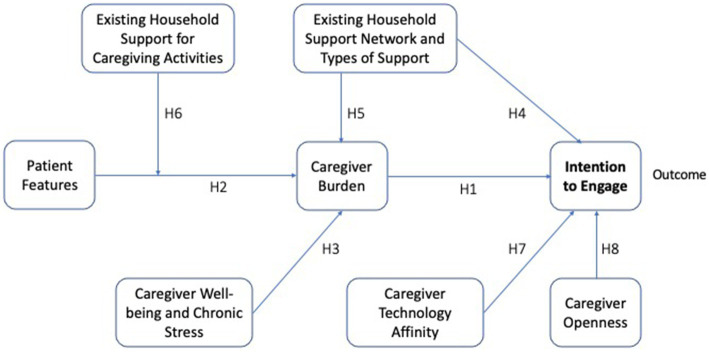
The number of people diagnosed with dementia is increasing, creating significant economic burden globally. With the progression of the disease, patients need a caregiver whose wellbeing is important for continuous care. Providing respite as a service, through sharing the responsibility of caregiving or support for the caregiver, is a costly initiative. A peer-to-peer online support platform for dementia caregivers, motivated by the sharing economy, putting exchange of knowhow, resources, and services at its center, has the potential to balance cost concerns with a search for respite. The aim of this research is to assess caregivers' intention to engage in peer-to-peer exchange.
A survey including sociodemographic, technology use, and caregiving variables, structured questionnaires (Zarit caregiver burden, WHO brief quality of life scale, ADCS-ADL and chronic stress scale) were administered, January 2018-May 2019, in the dementia outpatient clinic of a university hospital, to a convenience sample of = 203 individuals identifying themselves as primary caregivers. A path analysis exploring the drivers of an intention to engage in peer-to-peer service exchange was conducted.
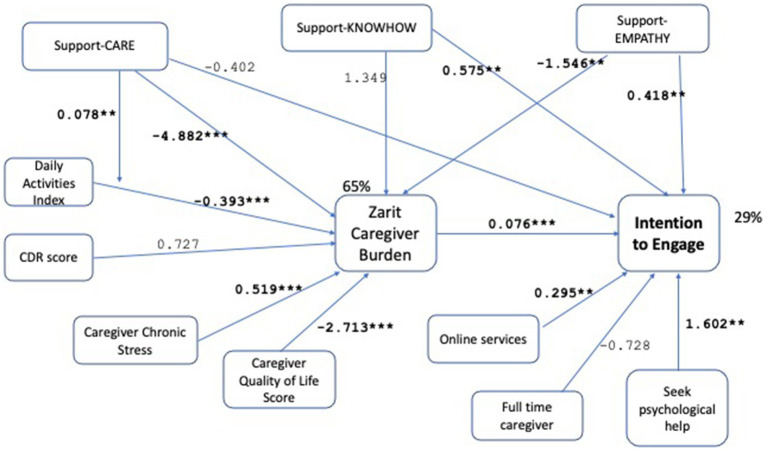
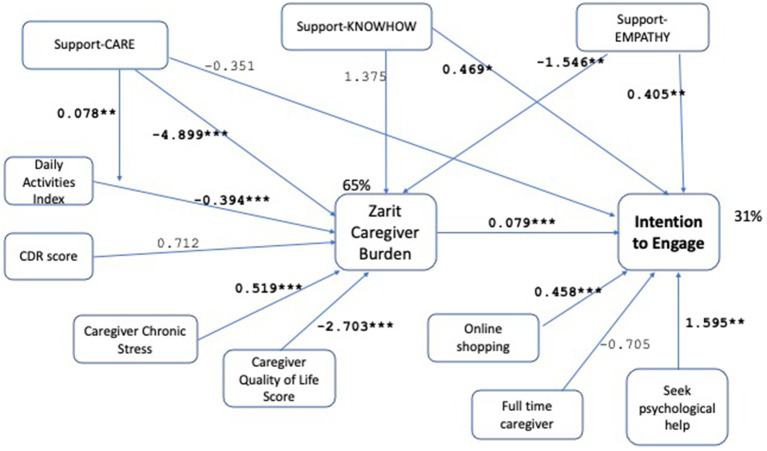
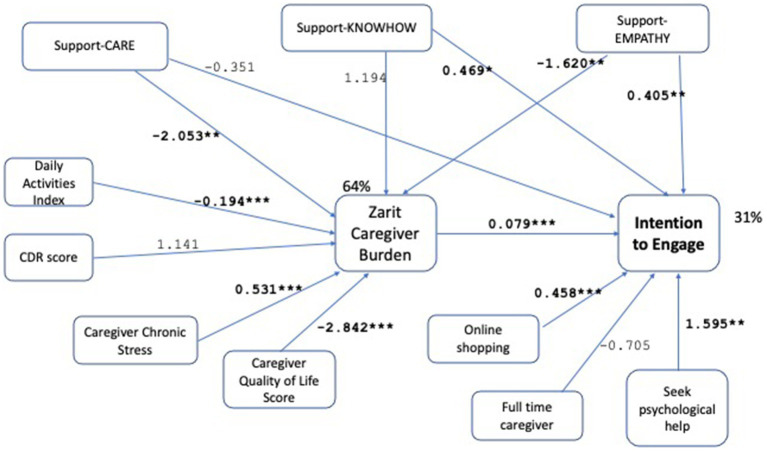
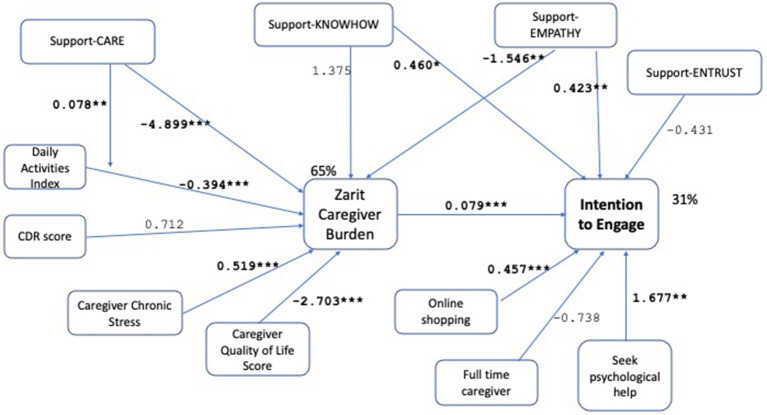
In the path model, caregivers experiencing higher caregiver burden showed higher intention to engage (0.079, < 0.001). Disease stage had no effect while patient activities of daily living, chronic social role related stressors of the caregiver and general quality of life were significant for the effect on the caregiver burden. Existing household support decreased the caregiver burden, affecting the intention to engage. Caregivers who can share more know-how demonstrate a higher intention to engage (0.579, = 0.021). Caregiver technology affinity (0.458, = 0.004) and ability and openness to seek professional help for psychological diagnoses (1.595, = 0.012) also increased intention to engage.
The model shows caregiver burden to be a major driver, along with caregiver characteristics that reflect their technology affinity and openness to the idea of general reciprocity. Existing support for obtaining knowhow and exchanging empathy have a direct effect on the intention to engage. Given the scarcity of caregiver support in the formal care channels, the identified potential of enlarging informal support via a peer-to-peer exchange mechanism holds promise.
被诊断患有痴呆症的人数正在增加,给全球带来了巨大的经济负担。随着疾病的进展,患者需要有护理人员,而护理人员的健康状况对于持续护理至关重要。通过分担护理责任或为护理人员提供支持来提供喘息服务是一项成本高昂的举措。一个受共享经济驱动、以知识、资源和服务交流为核心的痴呆症护理人员对等在线支持平台,有潜力在成本问题与寻求喘息机会之间取得平衡。本研究的目的是评估护理人员参与对等交流的意愿。
2018年1月至2019年5月,在一家大学医院的痴呆症门诊,对203名自认为是主要护理人员的便利样本进行了一项调查,调查内容包括社会人口统计学、技术使用和护理变量,并发放了结构化问卷( Zarit护理负担量表、世界卫生组织简明生活质量量表、ADCS-ADL和慢性压力量表)。进行了路径分析,以探索参与对等服务交流意愿的驱动因素。
在路径模型中,护理负担较重的护理人员参与意愿较高(0.079,<0.001)。疾病阶段没有影响,而患者的日常生活活动、护理人员与慢性社会角色相关的压力源以及总体生活质量对护理人员负担有显著影响。现有的家庭支持减轻了护理人员的负担,影响了参与意愿。能够分享更多知识的护理人员参与意愿更高(0.579,=0.021)。护理人员的技术亲和力(0.458,=0.004)以及为心理诊断寻求专业帮助的能力和开放性(1.595,=0.012)也增加了参与意愿。
该模型表明,护理人员负担是一个主要驱动因素,同时还有反映其技术亲和力和对普遍互惠观念开放性的护理人员特征。现有的获取知识和交流同理心的支持对参与意愿有直接影响。鉴于正式护理渠道中护理人员支持的稀缺性,通过对等交流机制扩大非正式支持的已确定潜力很有前景。