Johnson Jeff A, Athrey Giridhar, Anderson Clifford M, Bell Douglas A, Dixon Andrew, Kumazawa Yoshinori, Maechtle Tom, Meeks Garrett W, Mindell David, Nakajima Keiya, Novak Ben, Talbot Sandra, White Clayton, Zhan Xiangjiang
Department of Biological Sciences University of North Texas Denton Texas USA.
Wolf Creek Operating Foundation Wolf Wyoming USA.
Ecol Evol. 2023 Jul 20;13(7):e10347. doi: 10.1002/ece3.10347. eCollection 2023 Jul.
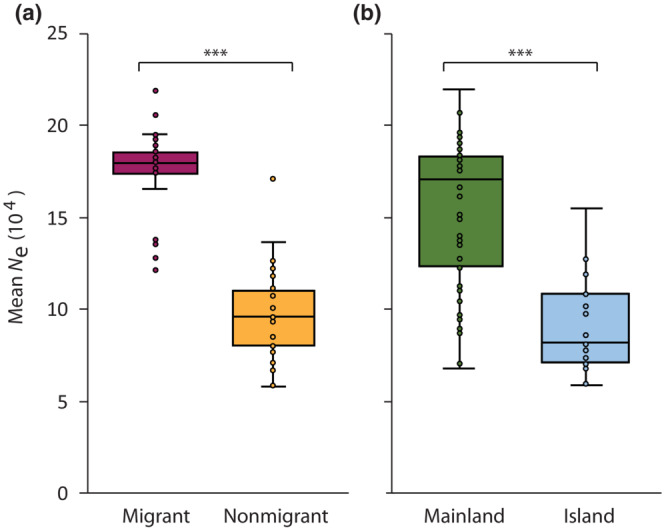
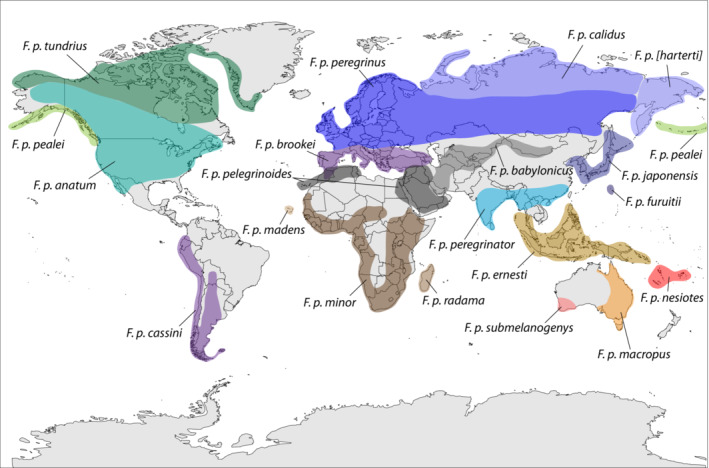
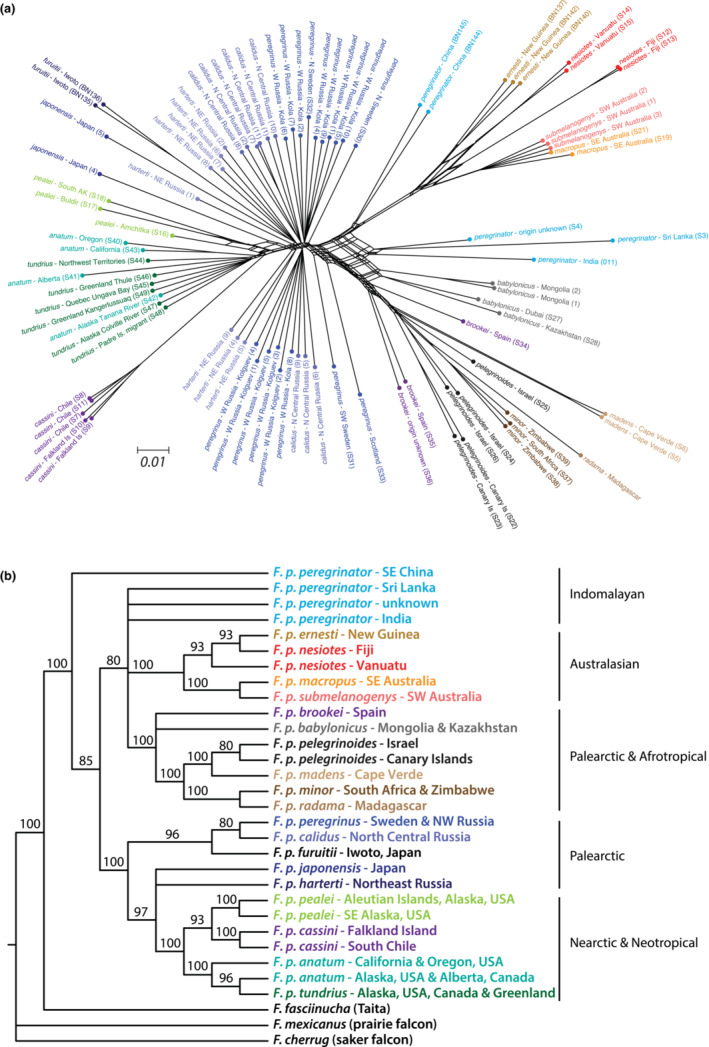
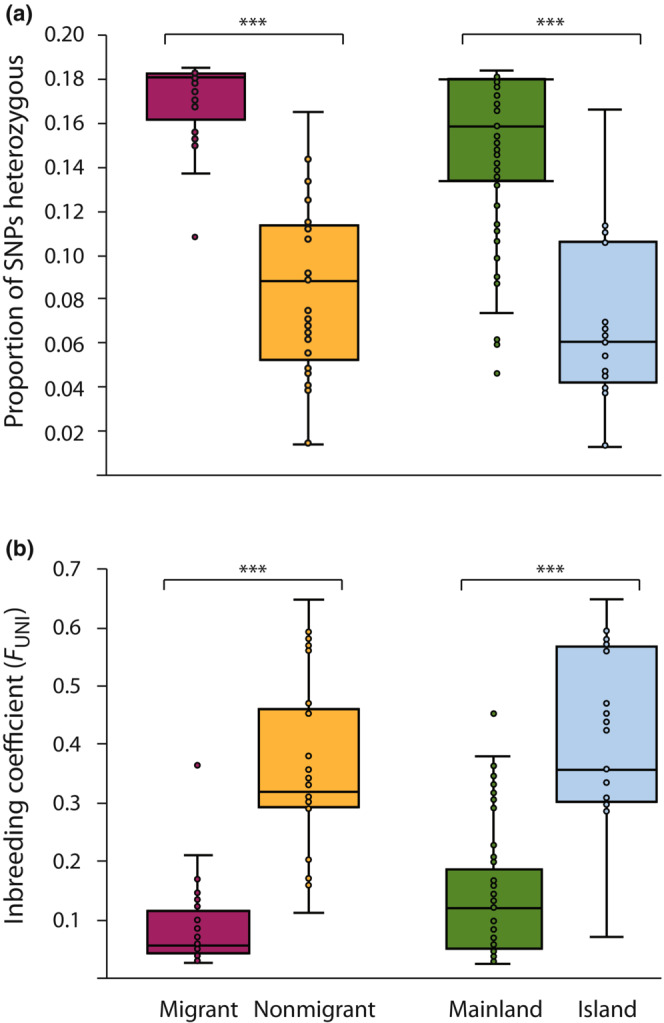
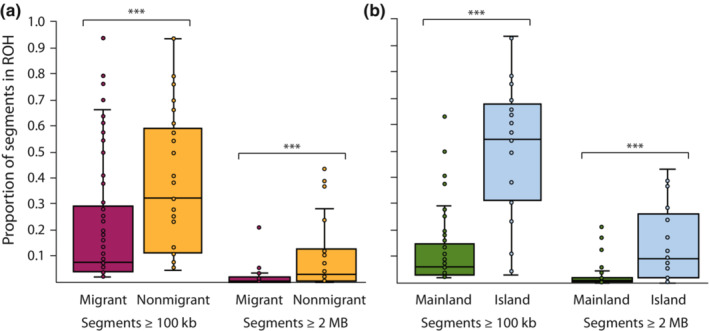
In efforts to prevent extinction, resource managers are often tasked with increasing genetic diversity in a population of concern to prevent inbreeding depression or improve adaptive potential in a changing environment. The assumption that all small populations require measures to increase their genetic diversity may be unwarranted, and limited resources for conservation may be better utilized elsewhere. We test this assumption in a case study focused on the peregrine falcon (), a cosmopolitan circumpolar species with 19 named subspecies. We used whole-genome resequencing to generate over two million single nucleotide polymorphisms (SNPs) from multiple individuals of all peregrine falcon subspecies. Our analyses revealed extensive variation among subspecies, with many island-restricted and nonmigratory populations possessing lower overall genomic diversity, elevated inbreeding coefficients ( )-among the highest reported, and extensive runs of homozygosity (ROH) compared to mainland and migratory populations. Similarly, the majority of subspecies that are either nonmigratory or restricted to islands show a much longer history of low effective population size ( ). While mutational load analyses indicated an increased proportion of homozygous-derived deleterious variants (i.e., drift load) among nonmigrant and island populations compared to those that are migrant or reside on the mainland, no significant differences in the proportion of heterozygous deleterious variants (i.e., inbreeding load) was observed. Our results provide evidence that high levels of inbreeding may not be an existential threat for some populations or taxa. Additional factors such as the timing and severity of population declines are important to consider in management decisions about extinction potential.
为了防止物种灭绝,资源管理者通常肩负着增加目标种群遗传多样性的任务,以防止近亲繁殖衰退或提高在不断变化的环境中的适应潜力。认为所有小种群都需要采取措施增加其遗传多样性的假设可能是没有根据的,有限的保护资源或许可以更好地用于其他地方。我们在一项以游隼(一种分布于世界各地的环极物种,有19个命名亚种)为重点的案例研究中检验了这一假设。我们使用全基因组重测序技术,从所有游隼亚种的多个个体中生成了超过两百万个单核苷酸多态性(SNP)。我们的分析揭示了亚种间存在广泛差异,许多岛屿限制型和非迁徙种群的总体基因组多样性较低,近亲繁殖系数升高(是报告中最高的之一),并且与大陆和迁徙种群相比,纯合子连续片段(ROH)范围更广。同样,大多数非迁徙或局限于岛屿的亚种显示出有效种群规模长期处于低水平的历史。虽然突变负荷分析表明,与迁徙或居住在大陆的种群相比,非迁徙和岛屿种群中纯合子衍生的有害变异比例(即漂变负荷)有所增加,但杂合子有害变异比例(即近亲繁殖负荷)未观察到显著差异。我们的结果提供了证据,表明高水平的近亲繁殖可能对某些种群或分类群并非生存威胁。在关于灭绝可能性的管理决策中,诸如种群数量下降的时间和严重程度等其他因素也很重要,需要加以考虑。