Clarke Derek M, Curtis Katrina L, Wendt Ryan A, Stapley Brendan M, Clark Evan T, Beckett Nathan, Campbell Kennedy M, Arroyo Juan A, Reynolds Paul R
Lung and Placenta Laboratory, Department of Cell Biology and Physiology, Brigham Young University, Provo, UT 84602, USA.
J Dev Biol. 2023 Jul 15;11(3):33. doi: 10.3390/jdb11030033.
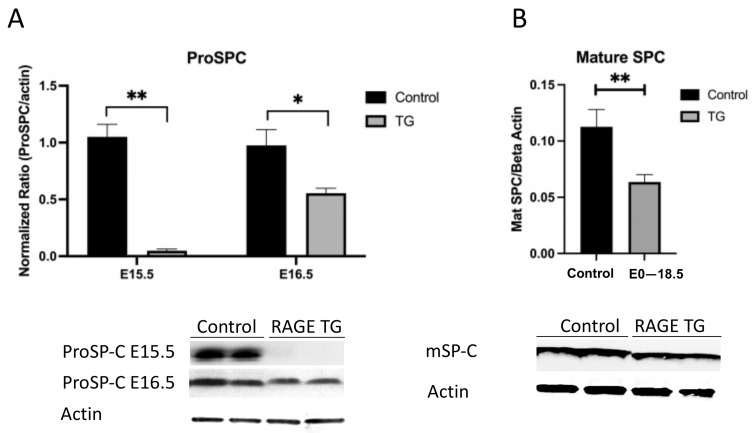
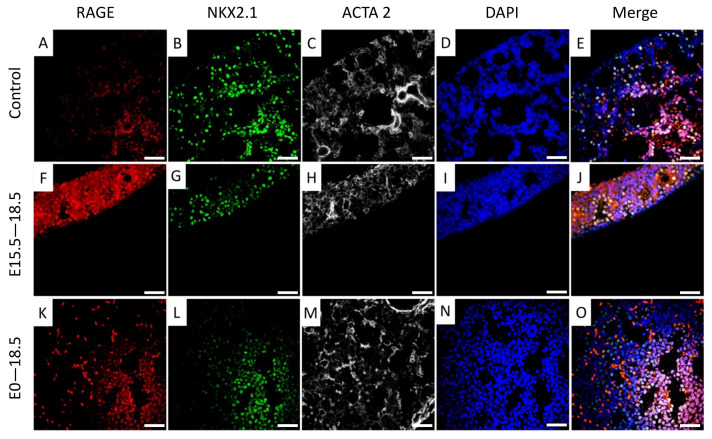
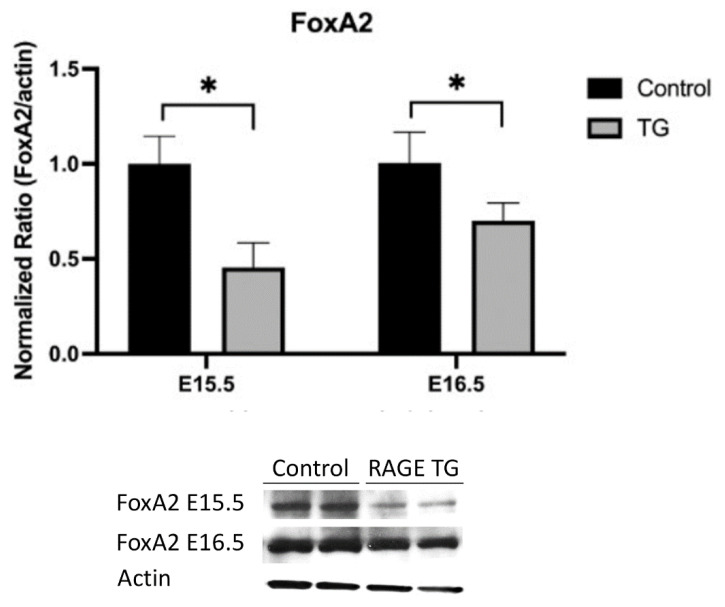
Receptors for advanced glycation end-products (RAGE) are multi-ligand cell surface receptors of the immunoglobin superfamily prominently expressed by lung epithelium. Previous experiments demonstrated that over-expression of RAGE by murine alveolar epithelium throughout embryonic development causes neonatal lethality coincident with significant lung hypoplasia. In the current study, we evaluated the expression of NKX2.1 (also referred to as TTF-1), a homeodomain-containing transcription factor critical for branching morphogenesis, in mice that differentially expressed RAGE. We also contextualized NKX2.1 expression with the abundance of FoxA2, a winged double helix DNA binding protein that influences respiratory epithelial cell differentiation and surfactant protein expression. Conditional RAGE over-expression was induced in mouse lung throughout gestation (embryonic day E0-18.5), as well as during the critical saccular period of development (E15.5-18.5), and analyses were conducted at E18.5. Histology revealed markedly less lung parenchyma beginning in the canalicular stage of lung development and continuing throughout the saccular period. We discovered consistently decreased expression of both NKX2.1 and FoxA2 in lungs from transgenic (TG) mice compared to littermate controls. We also observed diminished surfactant protein C in TG mice, suggesting possible hindered differentiation and/or proliferation of alveolar epithelial cells under the genetic control of these two critical transcription factors. These results demonstrate that RAGE must be specifically regulated during lung formation. Perturbation of epithelial cell differentiation culminating in respiratory distress and perinatal lethality may coincide with elevated RAGE expression in the lung parenchyma.
晚期糖基化终产物受体(RAGE)是免疫球蛋白超家族的多配体细胞表面受体,在肺上皮细胞中显著表达。先前的实验表明,在整个胚胎发育过程中,小鼠肺泡上皮细胞RAGE的过度表达会导致新生小鼠死亡,并伴有明显的肺发育不全。在本研究中,我们评估了NKX2.1(也称为TTF-1)的表达,NKX2.1是一种含同源结构域的转录因子,对分支形态发生至关重要,在差异表达RAGE的小鼠中进行评估。我们还将NKX2.1的表达与FoxA2的丰度进行了关联,FoxA2是一种有翼双螺旋DNA结合蛋白,影响呼吸道上皮细胞分化和表面活性蛋白表达。在整个妊娠期(胚胎期E0-18.5)以及发育的关键囊泡期(E15.5-18.5),在小鼠肺中诱导条件性RAGE过表达,并在E18.5进行分析。组织学显示,从肺发育的小管期开始,肺实质明显减少,并持续到囊泡期。我们发现,与同窝对照相比,转基因(TG)小鼠肺中NKX2.1和FoxA2的表达持续降低。我们还观察到TG小鼠中表面活性蛋白C减少,这表明在这两种关键转录因子的基因控制下,肺泡上皮细胞的分化和/或增殖可能受到阻碍。这些结果表明,在肺形成过程中,RAGE必须受到特异性调节。上皮细胞分化的扰动最终导致呼吸窘迫和围产期死亡,可能与肺实质中RAGE表达升高同时发生。