Fang Jun, Lai Shifa, Yu Haoyang, Ma Lan
Life Science Division, Graduate School at Shenzhen, Tsinghua University, No. 10, Lishan Road, Nanshan District, Shenzhen 518055, China.
BenHealth Biopharmaceutical (Shenzhen) Co., Ltd., No. 10, Gaoxinzhong First Avenue, Nanshan District, Shenzhen 518055, China.
Antibodies (Basel). 2023 Jul 13;12(3):47. doi: 10.3390/antib12030047.
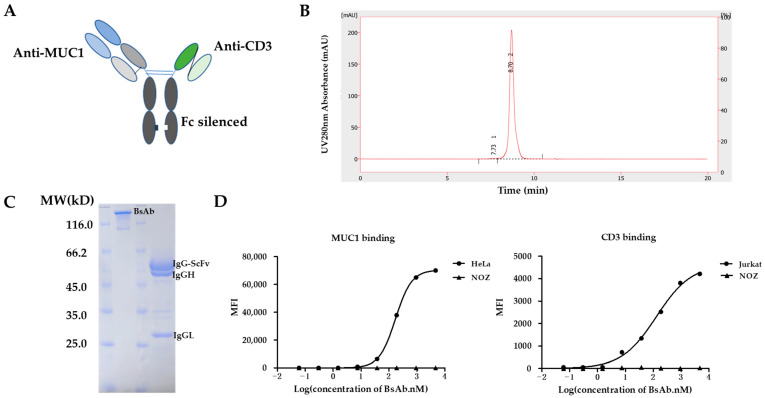
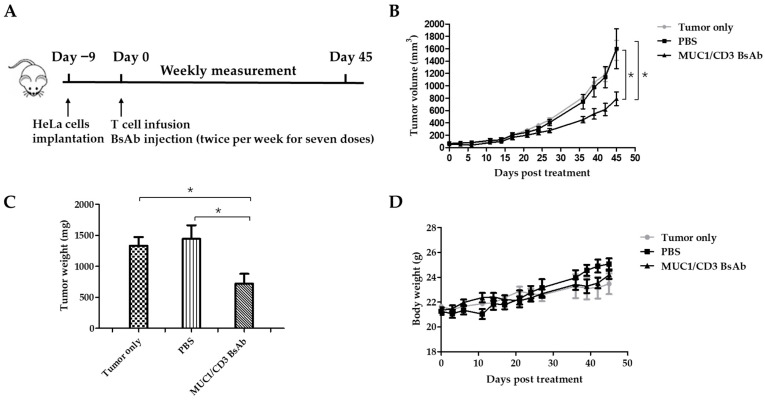
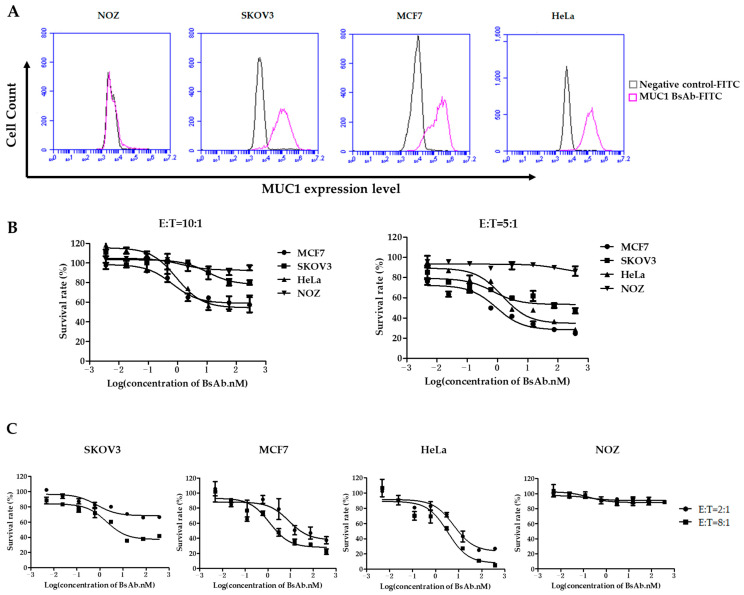
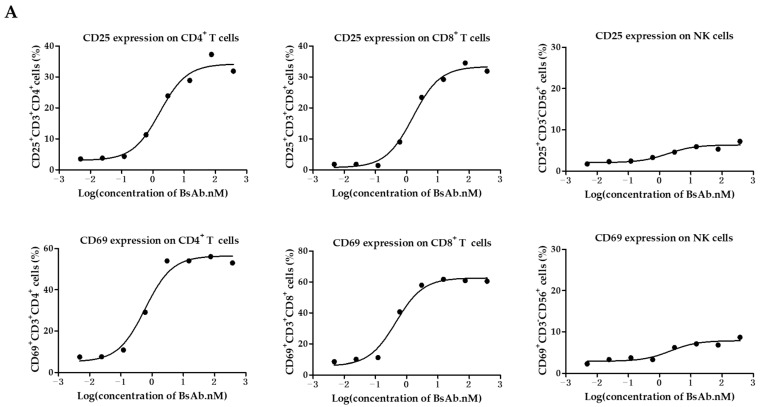
Mucin1 (MUC1) is abnormally glycosylated and overexpressed in a variety of epithelial cancers and plays a critical role in tumor progression. MUC1 has received remark attention as an oncogenic molecule and is considered a valuable tumor target for immunotherapy, while many monoclonal antibodies (mAbs) targeting MUC1-positive cancers in clinical studies lack satisfactory results. It would be highly desirable to develop an effective therapy against MUC1-expressing cancers. In this study, we constructed a novel T cell-engaging bispecific antibody (BsAb) targeting MUC1 and CD3 with the Fab-ScFv-IgG format. A high quality of MUC1-CD3 BsAb can be acquired through a standard method. Our study suggested that this BsAb could specifically bind to MUC1- and CD3-positive cells and efficiently enhance T cell activation, cytokine release, and cytotoxicity. Furthermore, our study demonstrated that this BsAb could potently redirect T cells to eliminate MUC1-expressing tumor cells in vitro and significantly suppress MUC1-positive tumor growth in a xenograft mouse model. Thus, T cell-engaging MUC1/CD3 BsAb could be an effective therapeutic approach to combat MUC1-positive tumors and our MUC1/CD3 BsAb could be a promising candidate in clinical applications for the treatment of MUC1-positive cancer patients.
粘蛋白1(MUC1)在多种上皮癌中存在异常糖基化且过度表达,在肿瘤进展中起关键作用。MUC1作为一种致癌分子受到了显著关注,被认为是免疫治疗的一个有价值的肿瘤靶点,然而许多在临床研究中靶向MUC1阳性癌症的单克隆抗体(mAb)并未取得令人满意的结果。开发针对表达MUC1的癌症的有效治疗方法非常必要。在本研究中,我们构建了一种新型的采用Fab-ScFv-IgG形式靶向MUC1和CD3的T细胞衔接双特异性抗体(BsAb)。通过标准方法可获得高质量的MUC1-CD3 BsAb。我们的研究表明,这种BsAb能够特异性结合MUC1和CD3阳性细胞,并有效增强T细胞活化、细胞因子释放和细胞毒性。此外,我们的研究证明,这种BsAb能够在体外有效地重定向T细胞以消除表达MUC1的肿瘤细胞,并在异种移植小鼠模型中显著抑制MUC1阳性肿瘤的生长。因此,T细胞衔接的MUC1/CD3 BsAb可能是对抗MUC1阳性肿瘤的一种有效治疗方法,并且我们的MUC1/CD3 BsAb可能是治疗MUC1阳性癌症患者临床应用中的一个有前景的候选药物。