Radboud University Medical Center, Radboud Institute for Health Sciences, Orthopaedic Research Laboratory, Nijmegen, The Netherlands.
Polytechnic University of Milan, Department of Biomedical Engineering, Milan, Italy.
PLoS One. 2023 Jul 27;18(7):e0288776. doi: 10.1371/journal.pone.0288776. eCollection 2023.
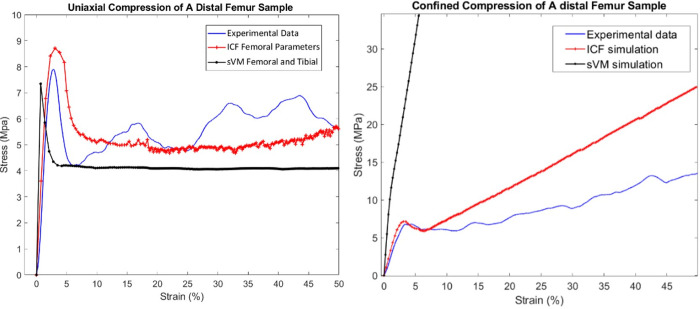
For biomechanical simulations of orthopaedic interventions, it is imperative to implement a material model that can realistically reproduce the nonlinear behavior of the bone structure. However, a proper material model that adequately combines the trabecular and cortical bone response is not yet widely identified. The current paper aims to investigate the possibility of using an isotropic crushable foam (ICF) model dependent on local bone mineral density (BMD) for simulating the femoral fracture risk. The elastoplastic properties of fifty-nine human femoral trabecular cadaveric bone samples were determined and combined with existing cortical bone properties to characterize two forms of the ICF model, a continuous and discontinuous model. Subsequently, the appropriateness of this combined material model was evaluated by simulating femoral fracture experiments, and a comparison with earlier published results of a softening Von-Mises (sVM) material model was made. The obtained mechanical properties of the trabecular bone specimens were comparable to previous findings. Furthermore, the ultimate failure load predicted by the simulations of femoral fractures was on average 79% and 90% for the continuous and discontinuous forms of the ICF model and 82% of the experimental value for the sVM material model. Also, the fracture locations predicted by ICF models were comparable to the experiments. In conclusion, a nonlinear material model dependent on BMD was characterized for human femoral bone. Our findings indicate that the ICF model could predict the femoral bone strength and reproduce the variable fracture locations in the experiments.
对于骨科干预的生物力学模拟,实施能够真实再现骨骼结构非线性行为的材料模型至关重要。然而,尚未广泛确定能够充分结合骨小梁和皮质骨反应的适当材料模型。本文旨在研究使用依赖于局部骨矿物质密度(BMD)的各向同性可压碎泡沫(ICF)模型来模拟股骨骨折风险的可能性。确定了 59 个人类股骨小梁尸体骨样本的弹塑性特性,并将其与现有的皮质骨特性相结合,以表征 ICF 模型的两种形式,即连续模型和不连续模型。随后,通过模拟股骨骨折实验评估了这种组合材料模型的适当性,并与先前发表的软化冯米塞斯(sVM)材料模型的结果进行了比较。小梁骨标本的获得的力学性能与先前的发现相当。此外,股骨骨折模拟预测的极限失效载荷对于 ICF 模型的连续和不连续形式分别为 79%和 90%,对于 sVM 材料模型为实验值的 82%。此外,ICF 模型预测的骨折位置与实验相当。总之,对人类股骨骨的 BMD 依赖的非线性材料模型进行了表征。我们的研究结果表明,ICF 模型可以预测股骨骨强度并再现实验中的可变骨折位置。