Department of Orthopedic Surgery, Xijing Hospital, The Air Force Medical University, Xi'an, Shaanxi, China (mainland).
Department of Orthopedics, Shenzhen Hospital, Southern Medical University, Shenzhen, Guangdong, China (mainland).
Med Sci Monit. 2018 Oct 18;24:7438-7443. doi: 10.12659/MSM.910876.
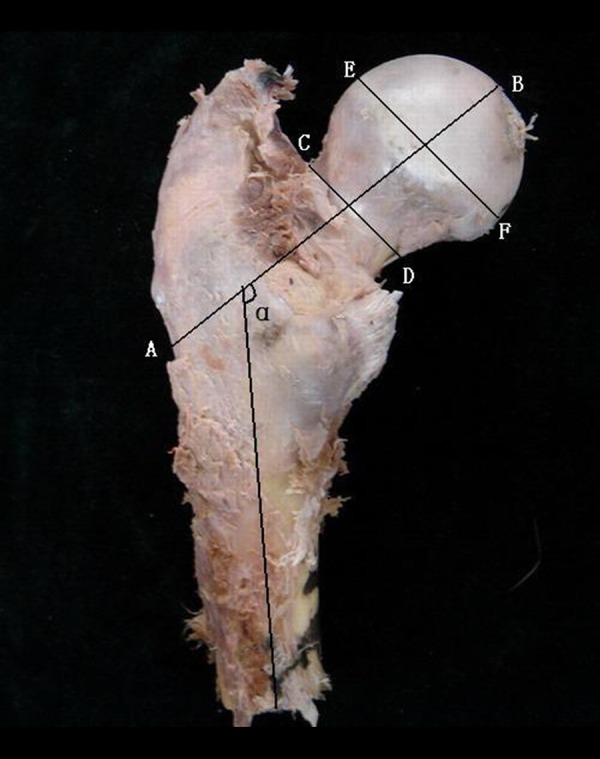
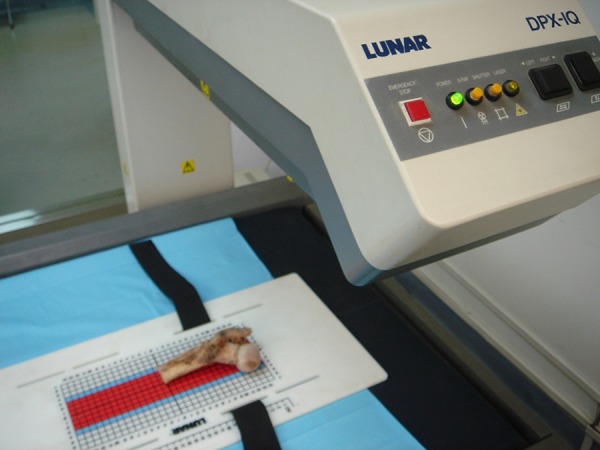
BACKGROUND The incidence of hip fracture is steadily increasing. We aimed to establish a creative approach to precisely estimate the risk of hip fracture by exploring the relationship between hip fracture and bone mineral density (BMD)/femur geometry. MATERIAL AND METHODS Sixteen samples of cadaveric female proximal femora were randomly selected. Experiments were performed experimental measurement of the femoral neck BMD and geometric parameters (including neck length, neck diameter, head diameter, and neck-shaft angle). In addition, the experimental measurements contain the failure load, which represents the mechanical strength of the femoral neck, and we calculated the correlation coefficient among BMD, geometric parameters, and failure load. RESULTS Significant correlations were discovered between femoral mechanical properties and femoral neck BMD (r=0.792, r²=0.628, P<0.001), trochanteric BMD (r=0.749, r²=0.560, P=0.001), and head diameter (r=0.706, r²=0.499, P=0.002). Multiple linear regression analyses indicated that the best predictor of hip fracture was the combination of femoral neck BMD, head diameter, and neck diameter (r²=0.844, P<0.001). CONCLUSIONS The results confirmed that, compared with BMD alone, the combination of BMD and geometric parameters of proximal femur is a better estimation of hip fracture. The geometry of the proximal femur played an important role in assessing the biomechanical strength of femur. This method greatly assists in predicting the risk of hip fracture in clinical trials and will assist studies on why the incidence of hip fracture varies among races.
髋部骨折的发病率正在稳步上升。我们旨在通过探索髋部骨折与骨密度(BMD)/股骨几何形状之间的关系,建立一种精确估计髋部骨折风险的创新方法。
随机选择 16 个女性尸体股骨近端样本。进行了股骨颈 BMD 和几何参数(包括颈长、颈直径、头直径和颈干角)的实验测量。此外,实验测量还包含了代表股骨颈机械强度的失效载荷,并计算了 BMD、几何参数和失效载荷之间的相关系数。
发现股骨机械性能与股骨颈 BMD(r=0.792,r²=0.628,P<0.001)、转子间 BMD(r=0.749,r²=0.560,P=0.001)和头直径(r=0.706,r²=0.499,P=0.002)之间存在显著相关性。多元线性回归分析表明,髋部骨折的最佳预测因子是股骨颈 BMD、头直径和颈直径的组合(r²=0.844,P<0.001)。
结果证实,与单独的 BMD 相比,BMD 与股骨近端几何形状的组合是对髋部骨折更好的估计。股骨近端的几何形状在评估股骨的生物力学强度方面起着重要作用。这种方法极大地有助于在临床试验中预测髋部骨折的风险,并将有助于研究为什么髋部骨折的发病率在不同种族之间存在差异。