
不同单磷酸钙和聚赖氨酸水平对牙科复合树脂性能的影响。
The effect of varying monocalcium phosphate and polylysine levels on dental composite properties.
机构信息
Department of Biomaterials and Tissue Engineering, UCL Eastman Dental Institute, London, NW3 2QG, UK.
Department of Biomaterials and Tissue Engineering, UCL Eastman Dental Institute, London, NW3 2QG, UK.
出版信息
J Mech Behav Biomed Mater. 2023 Sep;145:106039. doi: 10.1016/j.jmbbm.2023.106039. Epub 2023 Jul 22.
OBJECTIVES
The aim was to quantify effects of polylysine (PLS, 2 or 5 wt%) and monocalcium phosphate (MCP, 4 or 8 wt%) on properties of dental composites.
METHODS
Light-activated, lower surface polymerisation kinetics versus sample depth (1-4 mm) of 4 formulations were quantified using ATR-FTIR. Water sorption and solubility (at 1 week) were assessed following ISO/4049. PLS release (over 1 month) and biaxial flexural strength (over 6 months) of fully-cured, water-immersed, 1 mm thick discs were determined. Surface mineral precipitation, following immersion in simulated body fluid (SBF), was assessed by SEM. Z250 was used as a conventional composite comparator.
RESULTS
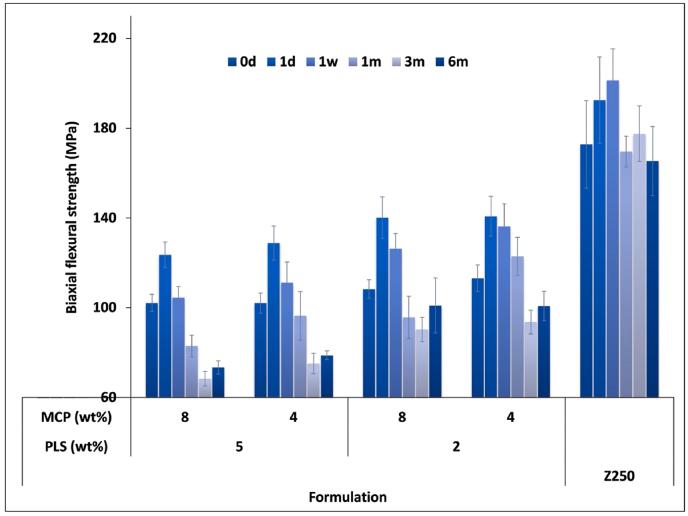
With 40s light exposure, increasing depth (from 1 to 4 mm) led to enhanced delay before polymerisation (from 3 to 17s) and decreased final conversion (72-66%) irrespective of PLS and MCP level. Increasing PLS and MCP raised solubility (4-13 μg/mm). Water sorption (between 32 and 55 μg/mm) and final PLS release (8-13% of disc content) were raised primarily by increasing PLS. Higher PLS also reduced strength. Strength reached minimum values (69-94 MPa) at 3 months. Surface mineral deposition was enhanced by increased MCP. For Z250, polymerisation delays (3-6s) and final conversions (55-54%) at 1-4 mm depth, solubility (0 μg/mm), water sorption (16 μg/mm) and strength (180 MPa) were all significantly different.
CONCLUSION
Delay time increased whilst final conversion decreased with thicker samples. Higher PLS enhances its percentage release, but lower level is required to keep water sorption, solubility and mechanical properties within ISO 4049 recommendations. Doubling MCP raises solubility and enhances minerals reprecipitation with minimal mechanical property compromise.
目的
定量研究多聚赖氨酸(PLS,2 或 5wt%)和单磷酸钙(MCP,4 或 8wt%)对牙科复合材料性能的影响。
方法
采用衰减全反射傅里叶变换红外光谱法(ATR-FTIR)定量检测 4 种配方的光激活下下表面聚合动力学与样本深度(1-4mm)的关系。根据 ISO/4049 标准,检测水吸附和溶胀(1 周后)。测定完全固化、水浸、1mm 厚圆盘的 PLS 释放(1 个月后)和双轴弯曲强度(6 个月后)。采用扫描电子显微镜(SEM)评估模拟体液(SBF)浸泡后表面矿物沉淀情况。Z250 用作传统复合材料比较剂。
结果
曝光 40s 时,无论 PLS 和 MCP 水平如何,随着深度(从 1mm 增加到 4mm)的增加,聚合延迟(从 3s 增加到 17s)增加,最终转化率(从 72%降低到 66%)降低。增加 PLS 和 MCP 会提高溶胀度(4-13μg/mm)。吸水率(32-55μg/mm)和最终 PLS 释放(圆盘含量的 8-13%)主要因 PLS 增加而升高。较高的 PLS 还会降低强度。3 个月时强度达到最低值(69-94MPa)。表面矿物沉积因 MCP 增加而增强。对于 Z250,在 1-4mm 深度处的聚合延迟(3-6s)和最终转化率(55-54%)、溶胀度(0μg/mm)、吸水率(16μg/mm)和强度(180MPa)均显著不同。
结论
随着样本厚度的增加,延迟时间增加,而最终转化率降低。较高的 PLS 会增加其释放百分比,但需要较低的水平才能使吸水率、溶胀度和机械性能符合 ISO 4049 建议。MCP 增加一倍会提高溶胀度,并增强矿物质再沉淀,同时对机械性能的影响最小。


 Zotero 插件