Oloyede Abdulkarim A, Faruk Nasir, Noma Nasir, Tebepah Ebinimi, Nwaulune Augustine K
Department of Telecommunication Science University of Ilorin, Ilorin, Nigeria.
Research and Development Department, Nigerian Communications Commission (NCC), Nigeria.
Heliyon. 2023 Jul 7;9(7):e17654. doi: 10.1016/j.heliyon.2023.e17654. eCollection 2023 Jul.
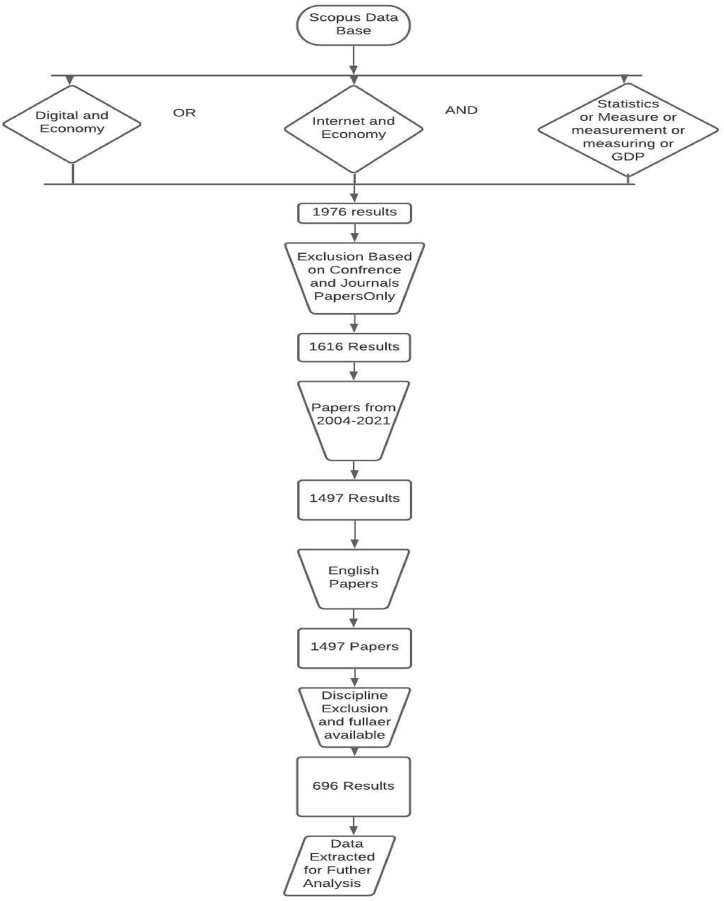
The digital economy, driven by Information and Communication Technology (ICT), has emerged as a significant contributor to economies worldwide. However, accurately defining and measuring its impact on national economies remains a complex endeavor. This paper explores the definition, measurement, role, and impacts of the digital economy across various economies. It also examines the involvement of governments and telecommunication regulators in assessing the digital economy and identifies future directions for developing countries. A systematic literature review utilizing the PRISMA Model is employed to investigate the factors and indices used to measure the digital economy. The findings highlight ongoing efforts to harmonize the definition and metrics; nonetheless, challenges persist due to the scarcity of appropriate datasets and variations in country-specific definitions. Additionally, the effectiveness of existing digital economy indices and toolkits in assessing the level of digitalization in developing countries is evaluated. The paper concludes that despite ongoing efforts to bridge the gaps, the concept of the digital economy remains defined and measured differently, necessitating a new definition that accounts for various contextual peculiarities. Furthermore, a roadmap is proposed to develop a toolkit that ensures comprehensive measurement, thus preventing an underestimation of the digital economy's contribution to the Gross Domestic Product (GDP) in developing countries. The paper underscores the need for international and multi-stakeholder dialogue to establish a common understanding of the digital economy's definition and measurement. Developing countries, such as Nigeria, are urged to develop or adopt new metrics tailored to their unique circumstances, facilitating an accurate and efficient quantification of the digital economy's impact on crucial indicators like GDP. Improved statistical data collection and recording methodologies are recommended for both governments and the private sector. Moreover, the paper advocates for the establishment of a Digital Economy Advisory Board (DEAB) in developing countries to maximize the benefits of the ongoing global transition to the digital economy.
由信息通信技术(ICT)驱动的数字经济已成为全球经济的重要贡献力量。然而,准确界定和衡量其对各国经济的影响仍是一项复杂的工作。本文探讨了数字经济在不同经济体中的定义、衡量方法、作用及影响。它还考察了政府和电信监管机构在评估数字经济方面的参与情况,并确定了发展中国家的未来发展方向。利用PRISMA模型进行了系统的文献综述,以研究用于衡量数字经济的因素和指标。研究结果突出了在统一数字经济定义和指标方面所做的持续努力;尽管如此,由于缺乏合适的数据集以及各国特定定义存在差异,挑战依然存在。此外,还评估了现有数字经济指标和工具包在评估发展中国家数字化水平方面的有效性。本文得出结论,尽管一直在努力弥合差距,但数字经济的概念在定义和衡量上仍存在差异,因此需要一个考虑到各种具体情况特殊性的新定义。此外,还提出了一个路线图,以开发一个确保全面衡量的工具包,从而避免低估数字经济对发展中国家国内生产总值(GDP) 的贡献。本文强调需要开展国际和多方利益相关者对话,以就数字经济的定义和衡量达成共识。敦促尼日利亚等发展中国家制定或采用适合其独特情况的新指标,以便准确、高效地量化数字经济对GDP等关键指标的影响。建议政府和私营部门改进统计数据收集和记录方法。此外,本文主张在发展中国家设立数字经济咨询委员会(DEAB),以最大限度地利用全球向数字经济转型带来的好处。