Zhao Hui, Li Jun-Min, Li Zi-Ran, Zhang Qian, Zhong Ming-Kang, Yan Ming-Ming, Qiu Xiao-Yan
Department of Pharmacy, Huashan Hospital, Fudan University, Shanghai, China.
School of Pharmacy, Fudan University, Shanghai, China.
Front Pharmacol. 2023 Jul 12;14:1182113. doi: 10.3389/fphar.2023.1182113. eCollection 2023.
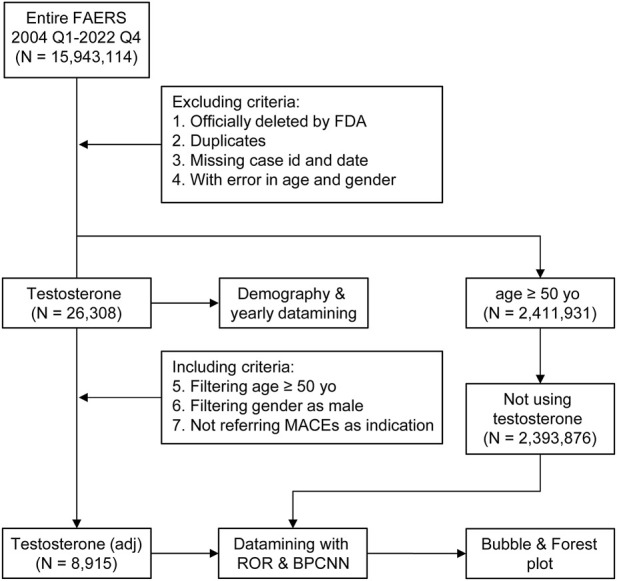
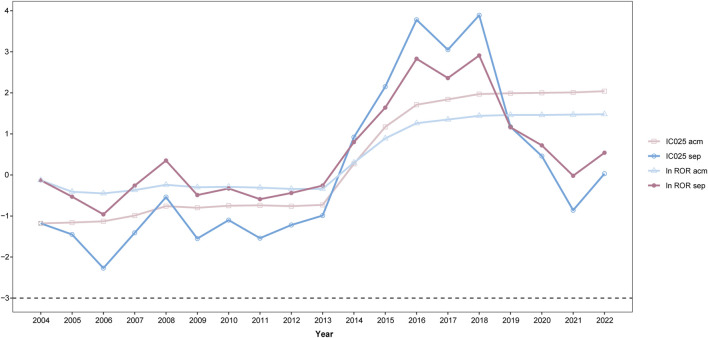
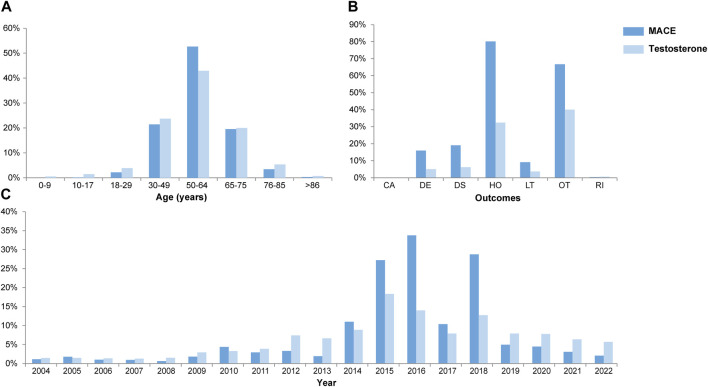
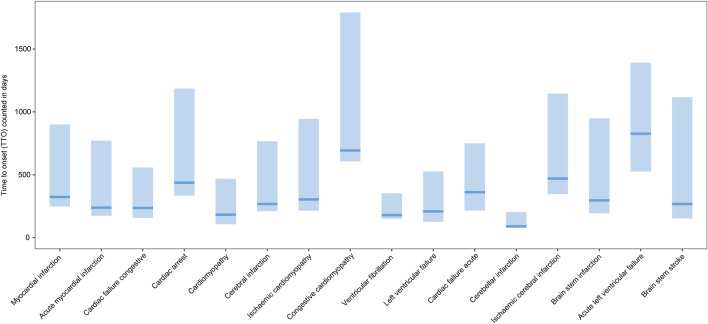
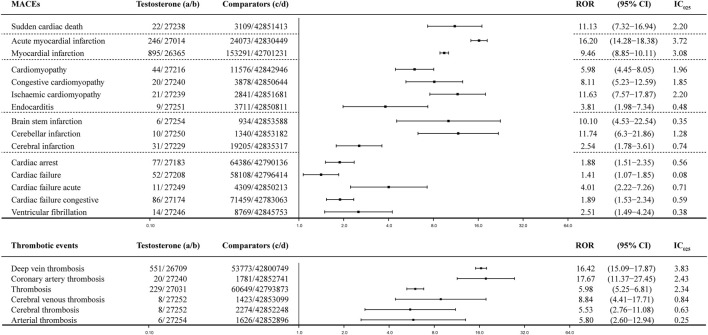
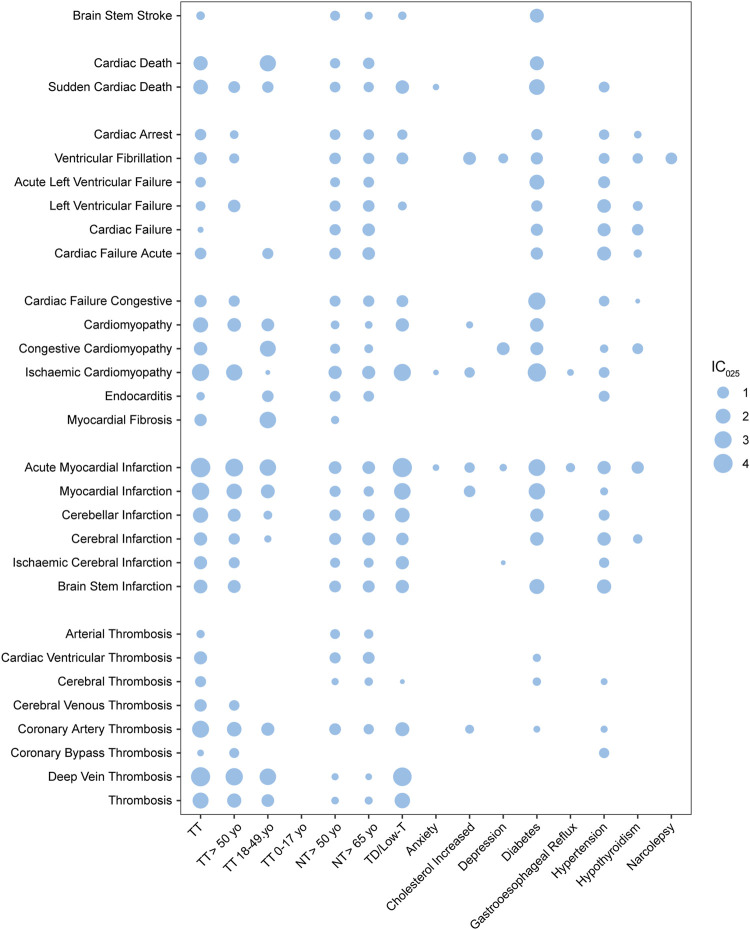
Testosterone is an essential sex hormone in maintaining masculine characteristics, which is prescribed for male hypogonadism as testosterone replacement treatment (TRT). Herein, we investigated long-standing controversies about the association between TRT and major adverse cardiovascular events (MACEs), based on real world adverse event (AE) reports, registered in the Food and Drug Administration Adverse Event Reporting System (FAERS). Publicly available FAERS data from 1 January 2004 to 31 December 2022 were retrieved from the Food and Drug Administration (FDA) website. The data mining protocol including the reporting odds ratio (ROR) and the Bayesian confidence propagation neural network (BCPNN) was applied to analyze overreporting caused by risk factors and MACEs, including TRT, morbidities, and ages. The ROR and the BCPNN were also applied to investigate the annually developing trend of pharmacovigilance (PV) signals in the real world, retrospectively. A total of 3,057 cases referring to MACEs, with a median age of 57 years old (yo), were identified from 28,921 cases of testosterone users. MACEs related to PV signals have emerged since 2014, including cardiac death, non-fatal myocardial infarction, and non-fatal stroke. Myocardial infarction (MI) (ROR: 9.46; IC: 3.08), acute myocardial infarction (AMI) (ROR: 16.20; IC: 3.72), ischemic cardiomyopathy (ROR: 11.63; IC: 2.20), and cardiomyopathy (ROR: 5.98; IC: 1.96) were the most significant signals generated, and weaker signals included cardiac failure acute (ROR: 4.01; IC: 0.71), cardiac arrest (ROR: 1.88; IC: 0.56), and ventricular fibrillation (VF) (ROR: 2.38; IC: 0.38). The time-to-onset (TTO) of MACEs was calculated with a median of 246 days for AMI. For myocardial infarction and cardiomyopathy, TRT statistically tended to increase the risk of MACEs, while for cardiac arrhythmia, cardiac failure, and stroke, TRT demonstrated beneficial effects among the population with morbidities, such as testosterone deficiency (TD), diabetes mellitus (DM), and hypertension. MACEs were rare but led to serious outcomes including significant increase in death and disability. Since 2018, and before 2014, reports referring to TRT associated with MACEs were relatively scarce, which indicated that there might be a considerable number of cases that went unrecorded, due to neglection. Health workers and testosterone users might pay more attention to testosterone-induced MACEs.
睾酮是维持男性特征的一种重要性激素,被用于男性性腺功能减退的睾酮替代治疗(TRT)。在此,我们基于美国食品药品监督管理局不良事件报告系统(FAERS)中登记的真实世界不良事件(AE)报告,调查了关于TRT与主要不良心血管事件(MACEs)之间关联的长期争议。从美国食品药品监督管理局(FDA)网站检索了2004年1月1日至2022年12月31日公开可用的FAERS数据。应用包括报告比值比(ROR)和贝叶斯置信传播神经网络(BCPNN)在内的数据挖掘方案,分析由风险因素和MACEs(包括TRT、疾病和年龄)导致的报告过度情况。ROR和BCPNN还被用于回顾性调查现实世界中药品警戒(PV)信号的年度发展趋势。从28,921例睾酮使用者中识别出总共3057例涉及MACEs的病例,中位年龄为57岁。与PV信号相关的MACEs自2014年以来出现,包括心源性死亡、非致命性心肌梗死和非致命性中风。心肌梗死(MI)(ROR:9.46;IC:3.08)、急性心肌梗死(AMI)(ROR:16.20;IC:3.72)、缺血性心肌病(ROR:11.63;IC:2.20)和心肌病(ROR:5.98;IC:1.96)是产生的最显著信号,较弱的信号包括急性心力衰竭(ROR:4.01;IC:0.71)、心脏骤停(ROR:1.88;IC:0.56)和心室颤动(VF)(ROR:2.38;IC:0.38)。计算出AMI的MACEs发生时间(TTO)中位数为246天。对于心肌梗死和心肌病,TRT在统计学上倾向于增加MACEs的风险,而对于心律失常、心力衰竭和中风,TRT在患有诸如睾酮缺乏(TD)、糖尿病(DM)和高血压等疾病的人群中显示出有益效果。MACEs很少见,但会导致包括死亡和残疾显著增加在内的严重后果。2018年以来以及2014年之前,提及与MACEs相关的TRT的报告相对较少,这表明可能有相当数量的病例因被忽视而未被记录。医护人员和睾酮使用者可能需要更加关注睾酮诱发的MACEs。