Agurto Carla, Cecchi Guillermo, King Sarah, Eyigoz Elif K, Parvaz Muhammad A, Alia-Klein Nelly, Goldstein Rita Z
IBM Research, 1101 Kitchawan Rd, Yorktown Heights, NY, 10598.
Psychiatry and Neuroscience Departments, Icahn School of Medicine at Mount Sinai, 1 Gustave L. Levy Place, New York City, NY, 10029.
bioRxiv. 2023 Jul 19:2023.07.18.549548. doi: 10.1101/2023.07.18.549548.
Valid biomarkers that can predict longitudinal clinical outcomes at low cost are a holy grail in psychiatric research, promising to ultimately be used to optimize and tailor intervention and prevention efforts.
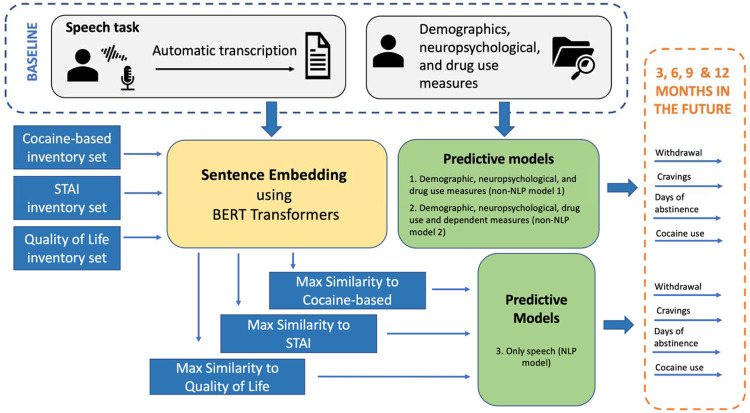
To determine if baseline linguistic markers in natural speech, as compared to non-speech clinical and demographic measures, can predict drug use severity measures at future sessions in initially abstinent individuals with cocaine use disorder (iCUD).
A longitudinal cohort study (August 2017 - March 2020), where baseline measures were used to predict outcomes collected at three-month intervals for up to one year of follow-up.
Eighty-eight initially abstinent iCUD were studied at baseline; 57 (46 male, age 50.7+/-7.9 years) came back for at least another session.
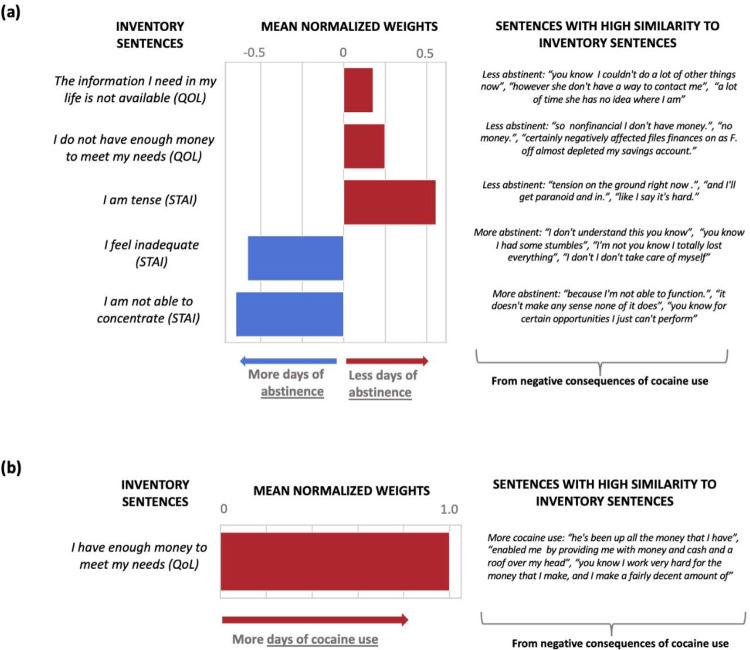
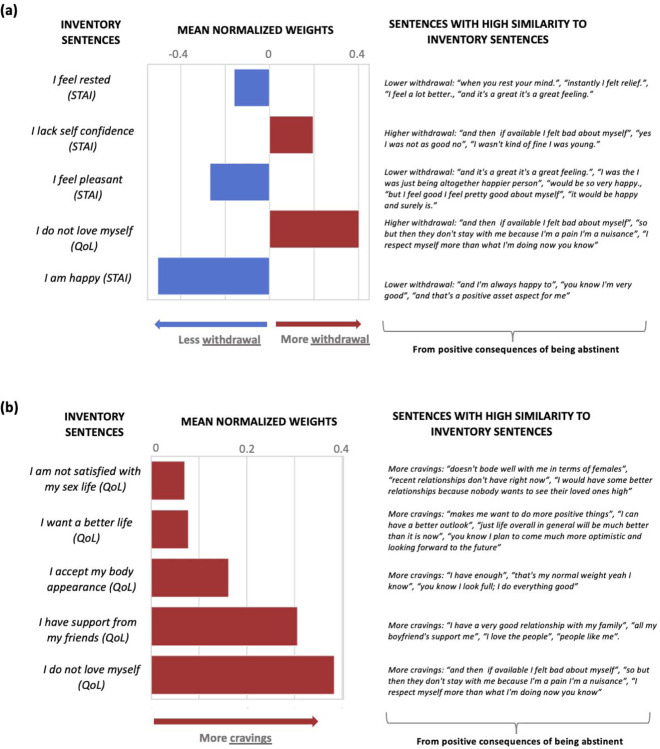
Outcomes were self-reported symptoms of withdrawal, craving, abstinence duration and frequency of cocaine use in the past 90 days at each study session. The predictors were derived from 5-min recordings of vocal descriptions of the positive consequences of abstinence and the negative consequences of using cocaine; the baseline cocaine and other common drug use measures, demographic and neuropsychological variables were used for comparison.
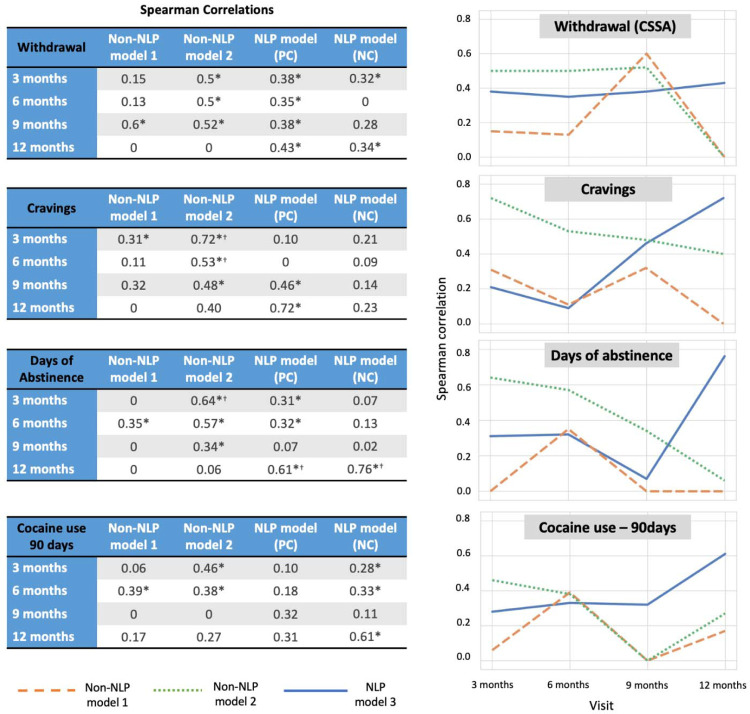
Models using the non-speech variables showed the best predictive performance at three(r>0.45, <2×10) and six months follow-up (r>0.37, <3×10). At 12 months, the natural language processing-based model showed significant correlations with withdrawal (r=0.43, =3×10), craving (r=0.72, =5×10), days of abstinence (r=0.76, =1×10), and cocaine use in the past 90 days (r=0.61, =2×10), significantly outperforming the other models for abstinence prediction.
At short time intervals, maximal predictive power was obtained with models that used baseline drug use (in addition to demographic and neuropsychological) measures, potentially reflecting a slow rate of change in these measures, which could be estimated by linear functions. In contrast, short speech samples predicted longer-term changes in drug use, implying deeper penetrance by potentially capturing non-linear dynamics over longer intervals. Results suggest that, compared to the common outcome measures used in clinical trials, speech-based measures could be leveraged as better predictors of longitudinal drug use outcomes in initially abstinent iCUD, as potentially generalizable to other substance use disorders and related comorbidity.
能够以低成本预测纵向临床结果的有效生物标志物是精神病学研究中的圣杯,有望最终用于优化和定制干预及预防措施。
确定与非言语临床和人口统计学指标相比,自然言语中的基线语言标志物能否预测可卡因使用障碍(iCUD)初戒者未来随访期间的药物使用严重程度指标。
一项纵向队列研究(2017年8月至2020年3月),使用基线指标预测长达一年随访期间每三个月收集一次的结果。
88名初戒的iCUD患者在基线时接受研究;57人(46名男性,年龄50.7±7.9岁)至少返回参加了另一阶段的研究。
结局为每次研究阶段过去90天内自我报告的戒断症状、渴望、戒断持续时间和可卡因使用频率。预测指标来自5分钟的语音记录,内容为对戒断的积极后果和使用可卡因的消极后果的口头描述;将基线可卡因及其他常见药物使用指标、人口统计学和神经心理学变量用于比较。
使用非言语变量的模型在3个月(r>0.45,<2×10)和6个月随访时显示出最佳预测性能(r>0.37,<3×10)。在12个月时,基于自然语言处理的模型与戒断(r=0.43,=3×10)、渴望(r=0.72,=5×10)、戒断天数(r=0.76,=1×10)以及过去90天内的可卡因使用(r=0.61,=2×10)显著相关,在戒断预测方面显著优于其他模型。
在短时间间隔内,使用基线药物使用(以及人口统计学和神经心理学)指标的模型获得了最大预测能力,这可能反映了这些指标的缓慢变化率,可用线性函数估计。相比之下,简短的语音样本预测了药物使用的长期变化,这意味着通过潜在地捕捉更长间隔内的非线性动态,具有更深的穿透力。结果表明,与临床试验中常用的结局指标相比,基于言语的指标可能作为初戒iCUD患者药物使用纵向结局的更好预测指标,可能推广到其他物质使用障碍及相关合并症。