Roy Tyler A, Bubier Jason A, Dickson Price E, Wilcox Troy D, Ndukum Juliet, Clark James W, Rizzo Stacey J Sukoff, Crabbe John C, Denegre James M, Svenson Karen L, Braun Robert E, Kumar Vivek, Murray Stephen A, White Jacqueline K, Philip Vivek M, Chesler Elissa J
The Jackson Laboratory, Bar Harbor, ME.
Joan C Edwards School of Medicine, Marshall University Huntington, WV.
bioRxiv. 2023 Jul 10:2023.07.09.548280. doi: 10.1101/2023.07.09.548280.
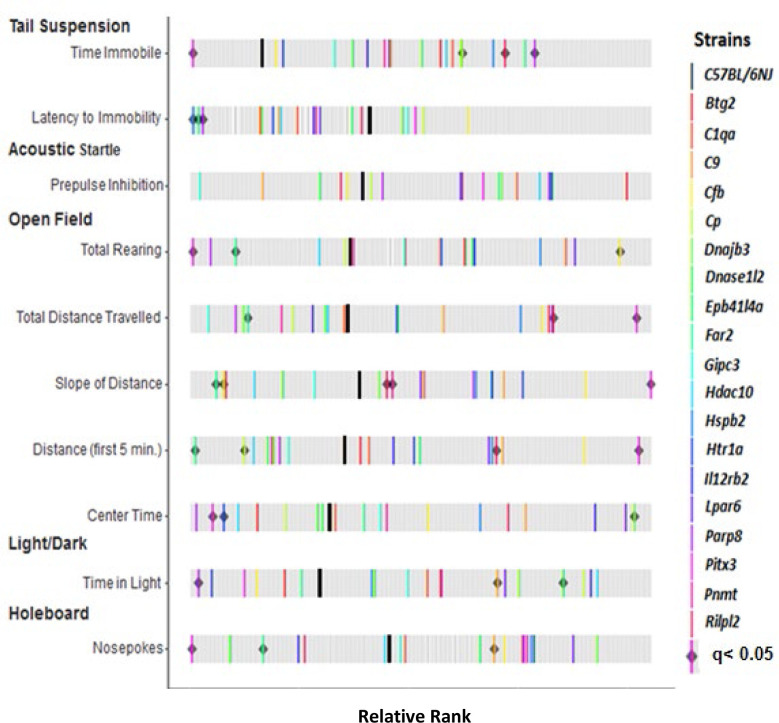
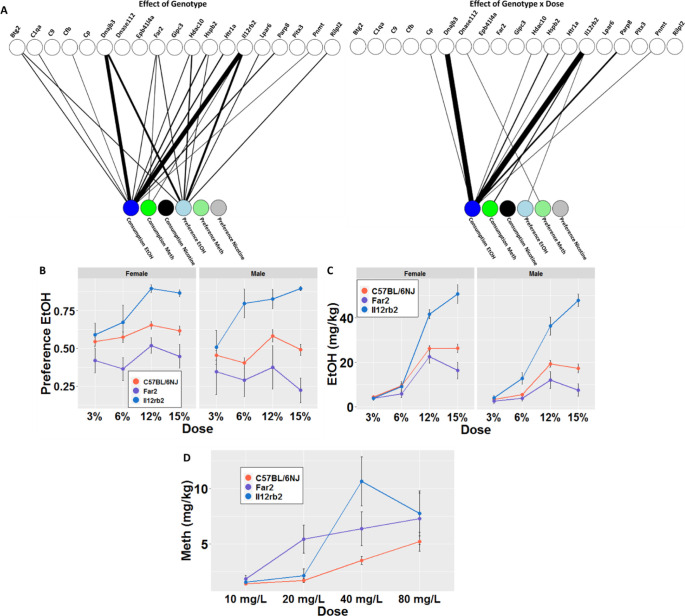
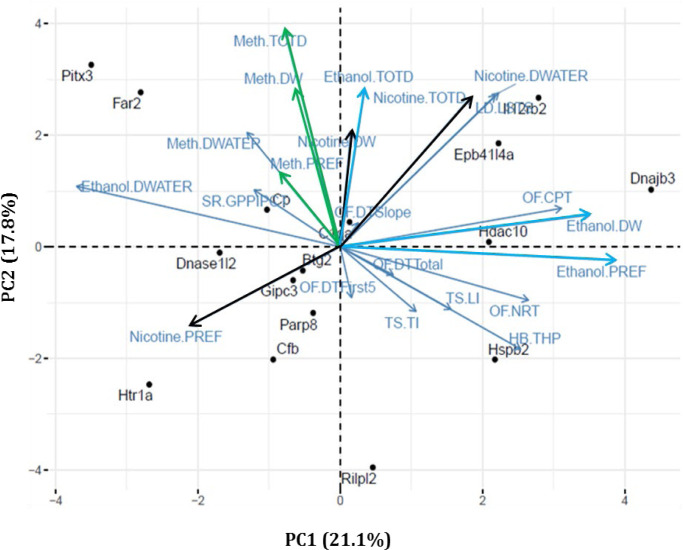
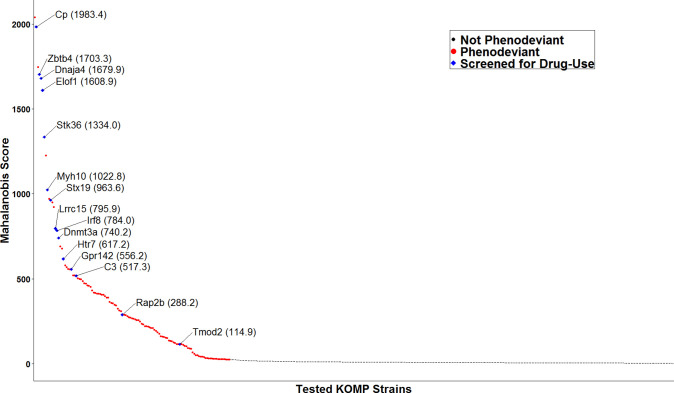
Substance use disorders (SUDs) are heritable disorders characterized by compulsive drug use, but the biological mechanisms driving addiction remain largely unknown. Genetic correlations reveal that predisposing drug-naïve phenotypes, including anxiety, depression, novelty preference, and sensation seeking, are predictive of drug-use phenotypes, implicating shared genetic mechanisms. Because of this relationship, high-throughput behavioral screening of predictive phenotypes in knockout (KO) mice allows efficient discovery of genes likely to be involved in drug use. We used this strategy in two rounds of screening in which we identified 33 drug-use candidate genes and ultimately validated the perturbation of 22 of these genes as causal drivers of substance intake. In our initial round of screening, we employed the two-bottle-choice paradigms to assess alcohol, methamphetamine, and nicotine intake. We identified 19 KO strains that were extreme responders on at least one predictive phenotype. Thirteen of the 19 gene deletions (68%) significantly affected alcohol use three methamphetamine use, and two both. In the second round of screening, we employed a multivariate approach to identify outliers and performed validation using methamphetamine two-bottle choice and ethanol drinking-in-the-dark protocols. We identified 15 KO strains that were extreme responders across the predisposing drug-naïve phenotypes. Eight of the 15 gene deletions (53%) significantly affected intake or preference for three alcohol, eight methamphetamine or three both (3). We observed multiple relations between predisposing behaviors and drug intake, revealing many distinct biobehavioral processes underlying these relationships. The set of mouse models identified in this study can be used to characterize these addiction-related processes further.
物质使用障碍(SUDs)是一种遗传性疾病,其特征为强迫性药物使用,但导致成瘾的生物学机制在很大程度上仍不为人知。遗传相关性研究表明,包括焦虑、抑郁、新奇偏好和寻求刺激等在内的、尚未接触药物的易感性表型可预测药物使用表型,这意味着存在共同的遗传机制。由于这种关系,对基因敲除(KO)小鼠的预测性表型进行高通量行为筛选,能够有效地发现可能参与药物使用的基因。我们在两轮筛选中运用了这一策略,在此过程中我们鉴定出33个药物使用候选基因,并最终验证了其中22个基因的扰动是物质摄入的因果驱动因素。在第一轮筛选中,我们采用双瓶选择范式来评估酒精、甲基苯丙胺和尼古丁的摄入量。我们鉴定出19个KO品系,它们在至少一种预测性表型上是极端反应者。这19个基因缺失中有13个(68%)显著影响酒精使用,3个影响甲基苯丙胺使用,2个对两者均有影响。在第二轮筛选中,我们采用多变量方法来识别异常值,并使用甲基苯丙胺双瓶选择和乙醇黑暗中饮用法进行验证。我们鉴定出15个KO品系,它们在尚未接触药物的易感性表型上是极端反应者。这15个基因缺失中有8个(53%)显著影响酒精、8个影响甲基苯丙胺或3个对两者均有影响(3)。我们观察到易感性行为与药物摄入之间存在多种关系,揭示了这些关系背后许多不同的生物行为过程。本研究中鉴定出的一组小鼠模型可用于进一步表征这些与成瘾相关的过程。