Chakhoyan Ararat, Shkrkova Kristina, Sizdahkhani Saman, Huuskonen Mikko T, Lamorie-Foote Krista, Diaz Arnold, Chen Selena, Liu Qinghai, D'Agostino Carla, Zhang Hongqiao, Mack Wendy J, Sioutas Constantinos, Finch Caleb E, Zlokovic Berislav, Mack William J
Zilkha Neurogenetic Institute, Keck School of Medicine, University of Southern California.
Leonard Davis School of Gerontology, University of Southern California.
Res Sq. 2023 Jul 18:rs.3.rs-3087503. doi: 10.21203/rs.3.rs-3087503/v1.
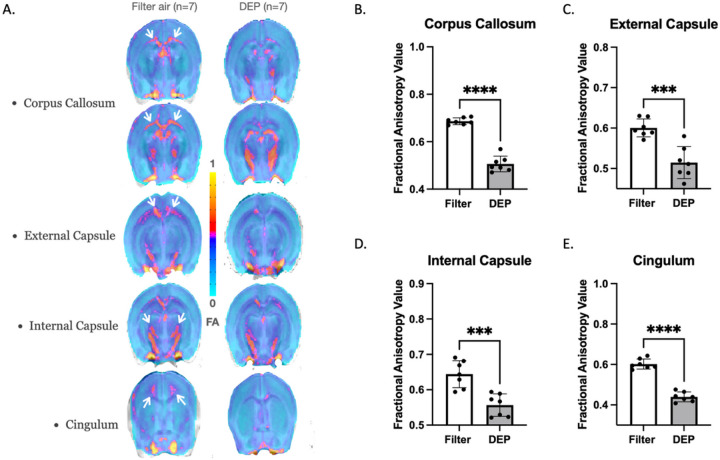
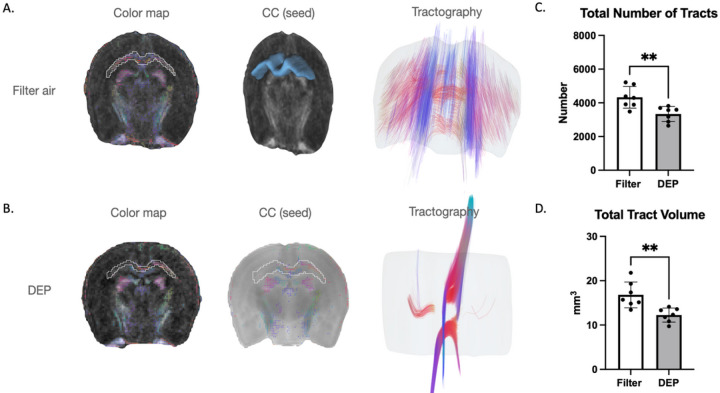
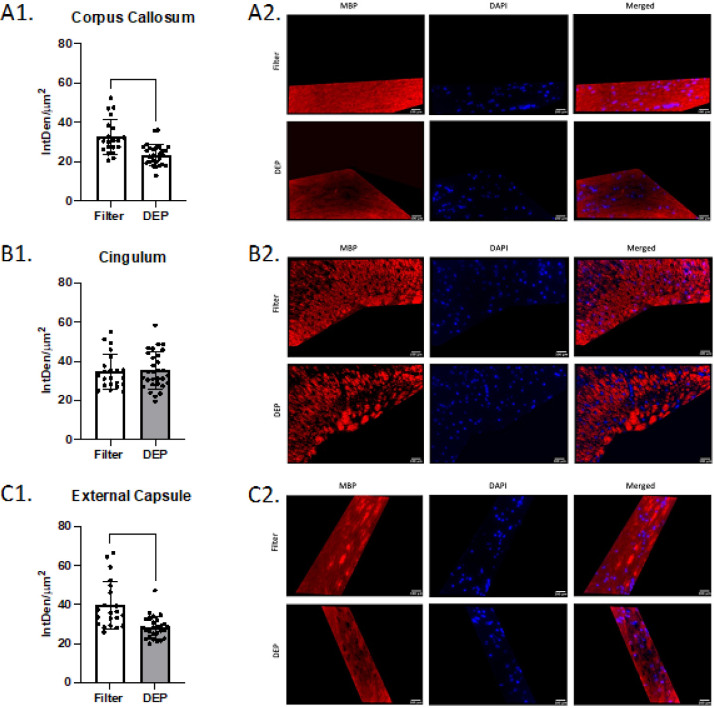
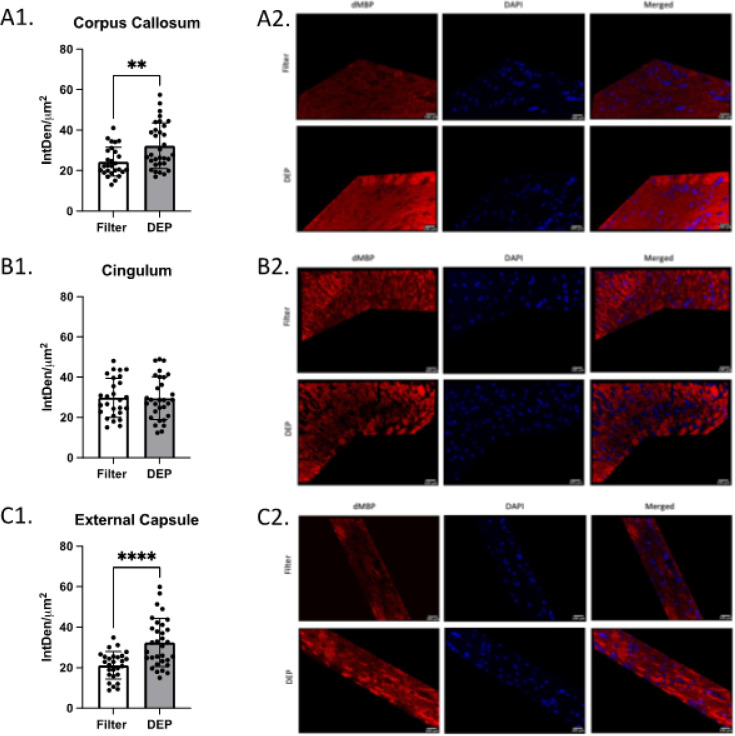
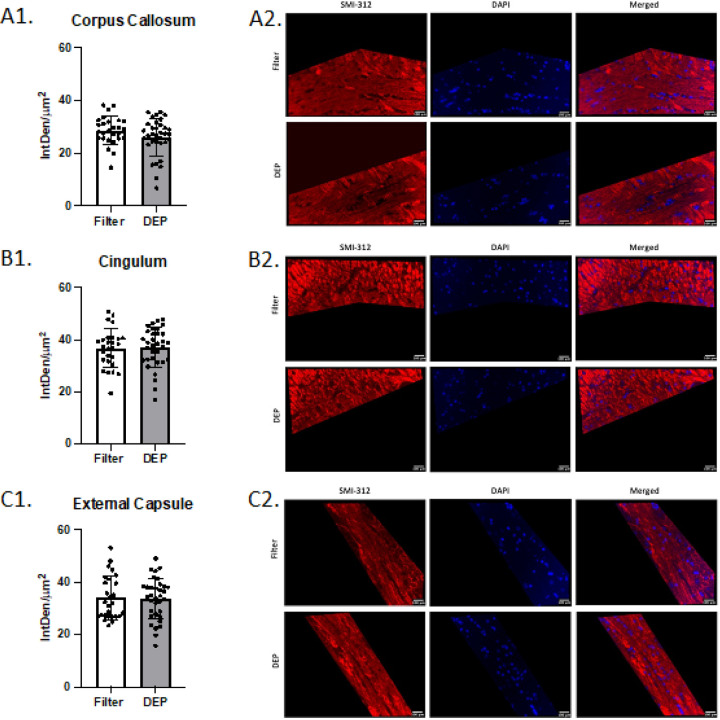
Air pollution is associated with risks of dementia and accelerated cognitive decline. Rodent air pollution models have shown white matter vulnerability. This study uses diffusion tensor imaging (DTI) to quantify changes to white matter microstructure and tractography in multiple myelinated regions after exposure to diesel exhaust particulate (DEP). Adult C57BL/6 male mice were exposed to re-aerosolized DEP (NIST SRM 2975) at a concentration of 100 ug/m for 200 hours. Ex-vivo MRI analysis and fractional anisotropy (FA)-aided white matter tractography were conducted to study the effect of DEP exposure on the brain white matter tracts. Immunohistochemistry was used to assess myelin and axonal structure. DEP exposure for 8 weeks altered myelin composition in multiple regions. Diffusion tensor imaging (DTI) showed decreased FA in the corpus callosum (30%), external capsule (15%), internal capsule (15%), and cingulum (31 %). Separate immunohistochemistry analyses confirmed prior findings. Myelin basic protein (MBP) was decreased (corpus callosum: 28%, external capsule: 29%), and degraded MPB increased (corpus callosum: 32%, external capsule: 53%) in the DEP group. White matter is highly susceptible to chronic DEP exposure. This study demonstrates the utility of DTI as a neuroanatomical tool in the context of air pollution and white matter myelin vulnerability.
空气污染与痴呆症风险及认知能力加速衰退有关。啮齿动物空气污染模型已显示出白质易损性。本研究使用扩散张量成像(DTI)来量化暴露于柴油废气颗粒(DEP)后多个有髓鞘区域白质微观结构和纤维束成像的变化。成年C57BL/6雄性小鼠暴露于浓度为100微克/立方米的再雾化DEP(美国国家标准与技术研究院标准参考物质2975)中200小时。进行离体MRI分析和分数各向异性(FA)辅助的白质纤维束成像,以研究DEP暴露对脑白质纤维束的影响。免疫组织化学用于评估髓鞘和轴突结构。暴露于DEP 8周会改变多个区域的髓鞘组成。扩散张量成像(DTI)显示胼胝体(30%)、外囊(15%)、内囊(15%)和扣带(31%)的FA降低。单独的免疫组织化学分析证实了先前的研究结果。DEP组中髓鞘碱性蛋白(MBP)减少(胼胝体:28%,外囊:29%),而降解的MPB增加(胼胝体:32%,外囊:53%)。白质对慢性DEP暴露高度敏感。本研究证明了DTI作为空气污染和白质髓鞘易损性背景下神经解剖学工具的实用性。