Institute of Biomedical Studies, Baylor University, Waco, TX, 76798, USA.
Division of Infectious Diseases, Johns Hopkins University School of Medicine, Baltimore, MD, 21287, USA.
Sci Rep. 2023 Jul 28;13(1):12227. doi: 10.1038/s41598-023-39486-8.
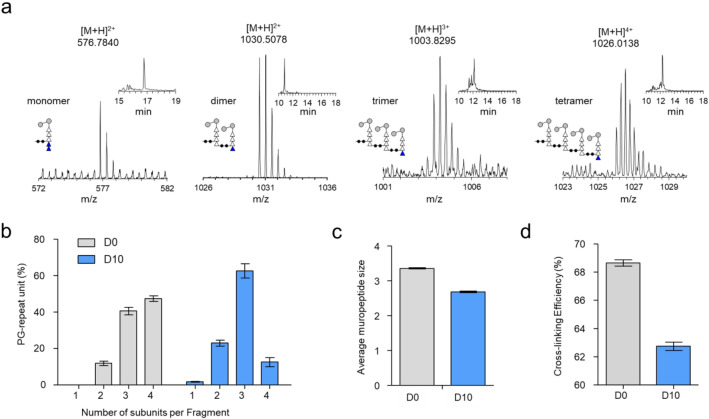
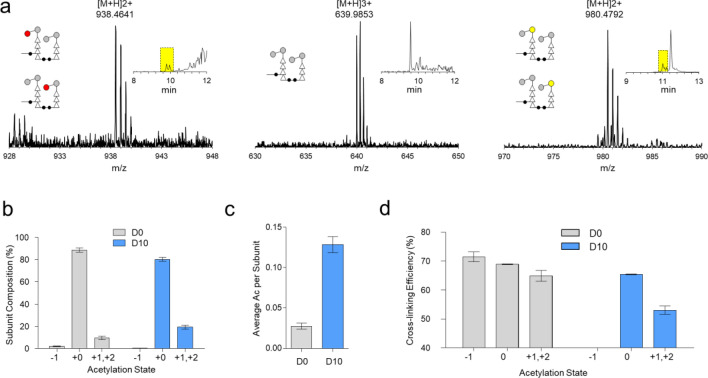
Daptomycin is a cyclic lipodepsipeptide antibiotic reserved for the treatment of serious infections by multidrug-resistant Gram-positive pathogens. Its mode of action is considered to be multifaceted, encompassing the targeting and depolarization of bacterial cell membranes, alongside the inhibition of cell wall biosynthesis. To characterize the daptomycin mode of action, N cross-polarization at magic-angle spinning NMR measurements were performed on intact whole cells of Staphylococcus aureus grown in the presence of a sub-inhibitory concentration of daptomycin in a chemically defined media containing L-[ϵ-N]Lys. Daptomycin-treated cells showed a reduction in the lysyl-ε-amide intensity that was consistent with cell wall thinning. However, the reduced lysyl-ε-amine intensity at 10 ppm indicated that the daptomycin-treated cells did not accumulate in Park's nucleotide, the cytoplasmic peptidoglycan (PG) precursor. Consequently, daptomycin did not inhibit the transglycosylation step of PG biosynthesis. To further elucidate the daptomycin mode of action, the PG composition of daptomycin-susceptible Enterococcus faecalis grown in the presence of daptomycin was analyzed using liquid chromatography-mass spectrometry. Sixty-nine muropeptide ions correspond to PG with varying degrees of modifications including crosslinking, acetylation, alanylation, and 1,6-anhydrous ring formation at MurNAc were quantified. Analysis showed that the cell walls of daptomycin-treated E. faecalis had a significant reduction in PG crosslinking which was accompanied by an increase in lytic transglycosylase activities and a decrease in PG-stem modifications by the carboxypeptidases. The changes in PG composition suggest that daptomycin inhibits cell wall biosynthesis by impeding the incorporation of nascent PG into the cell walls by transpeptidases and maturation by carboxypeptidases. As a result, the newly formed cell walls become highly susceptible to degradation by the autolysins, resulting in thinning of the cell wall.
达托霉素是一种环脂肽抗生素,专用于治疗由多种耐药革兰阳性病原体引起的严重感染。其作用模式被认为是多方面的,包括靶向和去极化细菌细胞膜,以及抑制细胞壁生物合成。为了表征达托霉素的作用模式,在含有 L-[ε-N]Lys 的化学定义培养基中,对生长在亚抑制浓度达托霉素存在下的金黄色葡萄球菌完整细胞进行了 N 交叉极化魔角旋转 NMR 测量。达托霉素处理的细胞显示出赖氨酸-ε-酰胺强度降低,与细胞壁变薄一致。然而,在 10 ppm 处降低的赖氨酸-ε-胺强度表明,达托霉素处理的细胞不会在细胞质肽聚糖 (PG) 前体 Park 核苷酸中积累。因此,达托霉素不会抑制 PG 生物合成的转糖基化步骤。为了进一步阐明达托霉素的作用模式,使用液相色谱-质谱法分析了在达托霉素存在下生长的达托霉素敏感粪肠球菌的 PG 组成。定量了 69 个对应于 PG 的肽聚糖离子,这些 PG 具有不同程度的修饰,包括交联、乙酰化、丙氨酸化和 MurNAc 上的 1,6-无水环形成。分析表明,达托霉素处理的粪肠球菌细胞壁的 PG 交联显著减少,同时溶菌转糖基酶活性增加,PG-干修饰的羧肽酶减少。PG 组成的变化表明,达托霉素通过阻碍转肽酶将新生 PG 掺入细胞壁和羧肽酶的成熟来抑制细胞壁生物合成。结果,新形成的细胞壁变得极易被自溶素降解,导致细胞壁变薄。