Verd Sergio, Porta Roser, Ginovart Gemma, Avila-Alvarez Alejandro, García-Muñoz Rodrigo Fermín, Izquierdo Renau Montserrat, Ventura Paula Sol
Department of Pediatric Care Primary Unit, La Vileta Surgery, Health Sciences Research Institute (IUNICS), Balearic University, 07122 Palma, Spain.
Department of Pediatrics, Division of Neonatology, Hospital Universitari Germans Trias i Pujol, Badalona, Universitat Autònoma de Barcelona, 08193 Bellaterra, Spain.
Children (Basel). 2023 Jul 23;10(7):1267. doi: 10.3390/children10071267.
An increased rate of bronchopulmonary dysplasia (BPD) is reported in extremely preterm infants. A potential role of human milk feeding in protecting against this condition has been suggested.
A retrospective descriptive study was conducted based on data about morbidity in the population of infants born between 22+0 and 26+6 weeks of gestation, included in the Spanish network SEN1500 during the period 2004-2019 and discharged alive. The primary outcome was moderate-severe BPD. Associated conditions were studied, including human milk feeding at discharge. The temporal trends of BPD and human milk feeding rates at discharge were also studied.
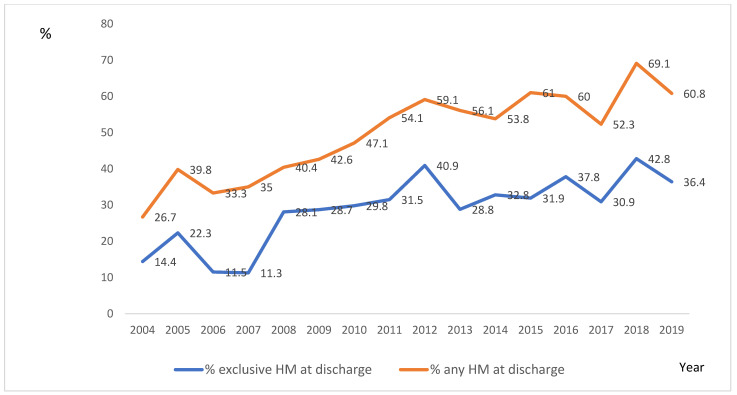
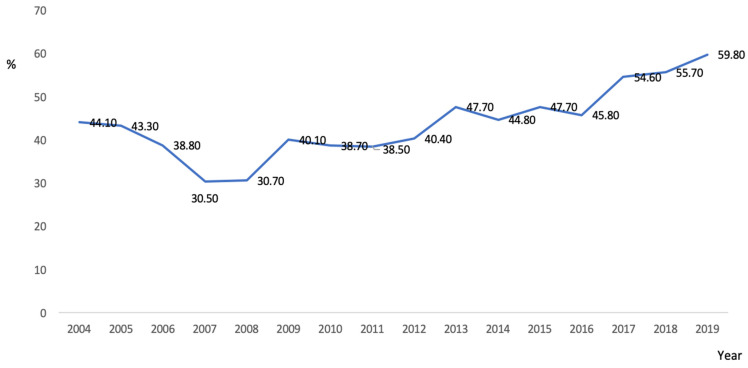
In the study population of 4341 infants, the rate of moderate-severe BPD was 43.7% and it increased to >50% in the last three years. The factors significantly associated with a higher risk of moderate-severe BPD were birth weight, male sex, high-frequency oscillatory ventilation, duration of invasive mechanical ventilation, inhaled nitric oxide, patent ductus arteriosus, and late-onset sepsis. Exclusive human milk feeding and any amount of human milk at discharge were associated with a lower incidence of moderate-severe BPD (OR 0.752, 95% CI 0.629-0.901 and OR 0.714, 95% CI 0.602-0.847, respectively). During the study period, the proportion of infants with moderate-severe BPD fed any amount of human milk at discharge increased more than twofold. And the proportion of infants with moderate-severe BPD who were exclusively fed human milk at discharge increased at the same rate.
Our work shows an inverse relationship between human milk feeding at discharge from the neonatal unit and the occurrence of BPD.
据报道,极早产儿支气管肺发育不良(BPD)的发生率有所增加。有人提出母乳喂养在预防这种疾病方面可能发挥作用。
基于2004年至2019年期间纳入西班牙SEN1500网络且存活出院的妊娠22⁺⁰至26⁺⁶周婴儿群体的发病数据,进行了一项回顾性描述性研究。主要结局是中重度BPD。研究了相关情况,包括出院时的母乳喂养情况。还研究了BPD和出院时母乳喂养率的时间趋势。
在4341名婴儿的研究人群中,中重度BPD的发生率为43.7%,在过去三年中升至>50%。与中重度BPD风险较高显著相关的因素有出生体重、男性、高频振荡通气、有创机械通气持续时间、吸入一氧化氮、动脉导管未闭和晚发性败血症。出院时纯母乳喂养和任何量的母乳喂养均与中重度BPD的发生率较低相关(分别为OR 0.752,95%CI 0.629 - 0.901和OR 0.714,95%CI 0.602 - 0.847)。在研究期间,出院时接受任何量母乳喂养的中重度BPD婴儿比例增加了两倍多。出院时纯母乳喂养的中重度BPD婴儿比例也以相同速度增加。
我们的研究表明,新生儿病房出院时的母乳喂养与BPD的发生呈负相关。