Pranskunas Andrius, Gulbinaite Egle, Navickaite Aiste, Pranskuniene Zivile
Department of Intensive Care Medicine, Lithuanian University of Health Sciences, Eiveniu g. 2, 50161 Kaunas, Lithuania.
Faculty of Medicine, Medical Academy, Lithuanian University of Health Sciences, A. Mickeviciaus g. 9, 44307 Kaunas, Lithuania.
Life (Basel). 2023 Jul 21;13(7):1606. doi: 10.3390/life13071606.
The passive leg-raising (PLR) test was developed to predict fluid responsiveness and reduce fluid overload. However, the hemodynamic response of healthy individuals to the PLR test and how it changes during the day, between the morning and evening, after individuals have consumed food and fluids, has not been profoundly explored. This study aimed to compare the systemic hemodynamic changes in healthy individuals between morning and evening PLR tests.
In this study, the PLR test was performed twice a day. The first PLR test was performed between 08h00 and 09h00 in the morning, while the second PLR test was performed between 20h00 and 21h00 in the evening. Hemodynamic parameters were measured using an impedance cardiography monitor, and a cutoff value of a 10% increase in stroke volume (SV) during the PLR test was used to differentiate between preload responders and non-responders.
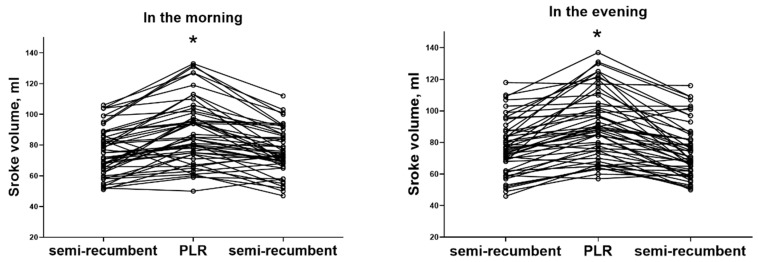
We included 50 healthy volunteers in this study. When comparing the morning and evening PLR test results, we found no PLR-induced differences in heart rate (-3 [-8-2] vs. -2 [-8-4] beats/min, = 0.870), SV (11 [5-22] vs. 12 [4-20] mL, = 0.853) or cardiac output (0.7 [0.2-1.3] vs. 0.8 [0.1-1.4] L/min, = 0.639). We also observed no differences in the proportion of preload responders during the PLR test between the morning and evening (64% vs. 66%, = 0.99). However, there was a moderate agreement between the two PLR tests (morning and evening) (kappa = 0.429, = 0.012). There was a moderate correlation between the changes in SV between the two PLR tests (r = 0.50, < 0.001).
In young, healthy individuals, we observed no change in the systemic hemodynamic responsiveness to the PLR test between the morning and evening, without restriction of fluid and food intake.
被动抬腿(PLR)试验旨在预测液体反应性并减少液体过载。然而,健康个体对PLR试验的血流动力学反应以及在一天中、早晚之间、个体摄入食物和液体后其如何变化,尚未得到深入研究。本研究旨在比较健康个体早晚PLR试验中的全身血流动力学变化。
在本研究中,PLR试验每天进行两次。第一次PLR试验在上午08:00至09:00之间进行,而第二次PLR试验在晚上20:00至21:00之间进行。使用阻抗心动图监测仪测量血流动力学参数,并使用PLR试验期间每搏输出量(SV)增加10%的临界值来区分前负荷反应者和无反应者。
本研究纳入了50名健康志愿者。比较早晚PLR试验结果时,我们发现PLR试验在心率(-3[-8 - 2]次/分钟 vs. -2[-8 - 4]次/分钟,P = 0.870)、SV(11[5 - 22]毫升 vs. 12[4 - 20]毫升,P = 0.853)或心输出量(0.7[0.2 - 1.3]升/分钟 vs. 0.8[0.1 - 1.4]升/分钟,P = 0.639)方面没有引起差异。我们还观察到早晚PLR试验期间前负荷反应者的比例没有差异(64%对66%,P = 0.99)。然而,两次PLR试验(早晚)之间存在中度一致性(kappa = 0.429,P = 0.012)。两次PLR试验之间的SV变化存在中度相关性(r = 0.50,P < 0.001)。
在年轻健康个体中,我们观察到在无液体和食物摄入限制的情况下,早晚对PLR试验的全身血流动力学反应没有变化。