Center of Reproduction, Development & Aging and Institute of Translation Medicine, Faculty of Health Sciences, University of Macau, Room 3057, Building E12, Taipa, Macau SAR 999078, China.
School of pharmacy, Hangzhou Medical College, Hangzhou 310059, China.
Molecules. 2023 Jul 20;28(14):5527. doi: 10.3390/molecules28145527.
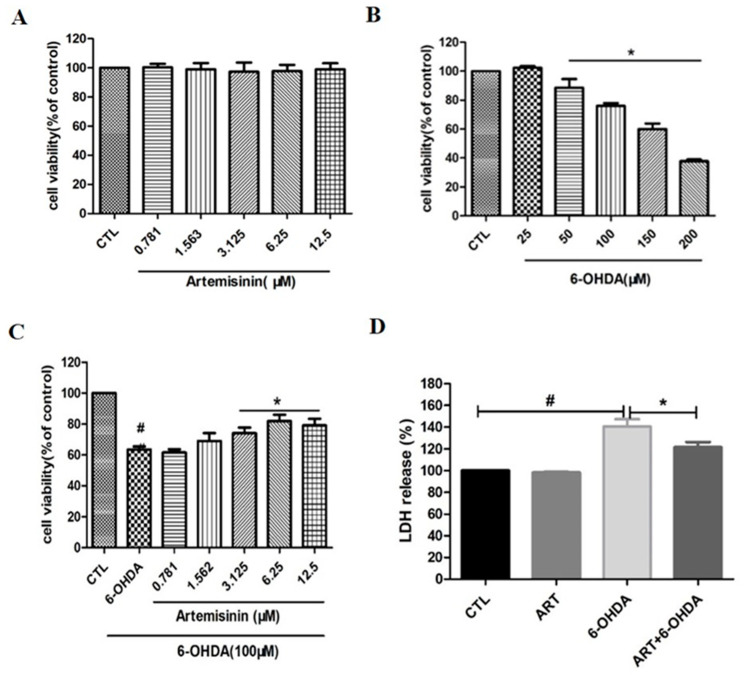
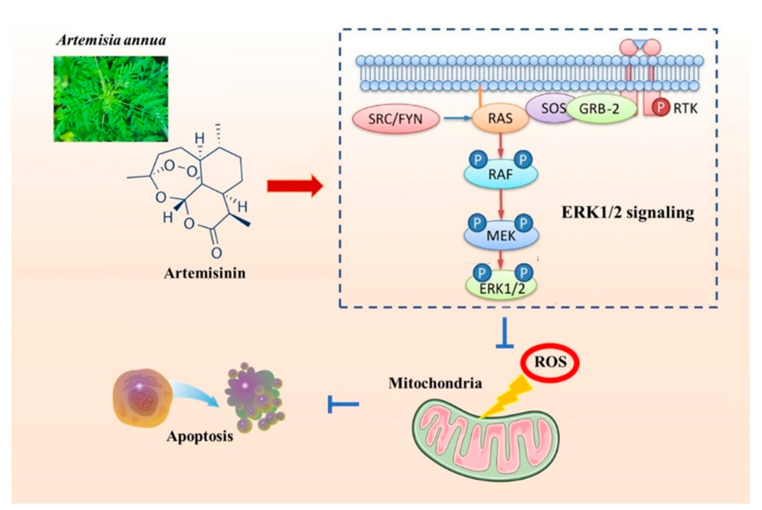
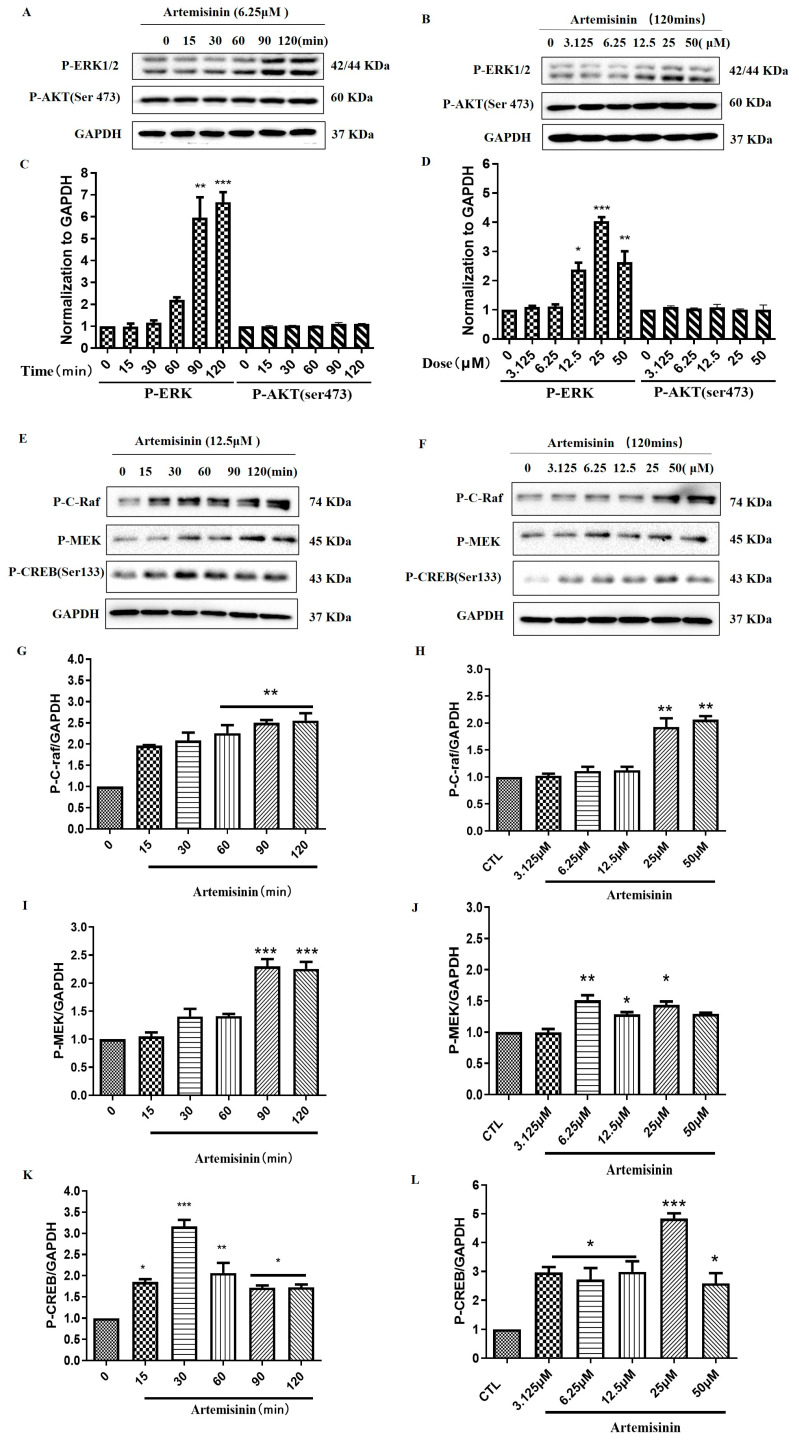
Parkinson's disease (PD) is an age-related, progressive neurodegenerative disease characterized by the gradual and massive loss of dopaminergic neurons in the substantia nigra pars compacta (SNc). We have recently reported that artemisinin, an FDA-approved first-line antimalarial drug, possesses a neuroprotective effect. However, the effects and underlying mechanisms of artemisinin on Parkinson's disease remain to be elucidated. In this study, we investigated the neuroprotective effects of artemisinin on 6-OHDA and MPP in neuronal cells and animal models, as well as the underlying mechanisms. Our results showed that artemisinin significantly attenuated the loss of cell viability, LDH release, elevated levels of reactive oxygen species (ROS), the collapse of the mitochondria trans-membrane potential and cell apoptosis in PC12 cells. Western blot results showed that artemisinin stimulated the phosphorylation of ERK1/2, its upstream signaling proteins c-Raf and MEK and its downstream target CREB in PC12 cells in a time- and concentration-dependent manner. In addition, the protective effect of artemisinin was significantly reduced when the ERK pathway was blocked using the ERK pathway inhibitor PD98059 or when the expression of ERK was knocked down using sgRNA. These results indicate the essential role of ERK in the protective effect of artemisinin. Similar results were obtained in SH-SY5Y cells and primary cultured neurons treated with 6-OHDA, as well as in cellular models of MPP injury. More interestingly, artemisinin attenuated PD-like behavior deficit in mice injected with 6-OHDA evaluated by behavioral tests including swimming test, pole-test, open field exploration and rotarod tests. Moreover, artemisinin also stimulated the phosphorylation of ERK1/2, inhibited apoptosis, and rescued dopaminergic neurons in SNc of these animals. Application of ERK pathway inhibitor PD98059 blocked the protective effect of artemisinin in mice during testing. Taking these results together, it was indicated that artemisinin preserves neuroprotective effects against 6-OHDA and MPP induced injury both in vitro and in vivo by the stimulation of the ERK1/2 signaling pathway. Our findings support the potential therapeutic effect of artemisinin in the prevention and treatment of Parkinson's disease.
帕金森病(PD)是一种与年龄相关的进行性神经退行性疾病,其特征是黑质致密部(SNc)中的多巴胺能神经元逐渐大量丧失。我们最近报道称,青蒿素是一种美国食品药品监督管理局批准的一线抗疟药物,具有神经保护作用。然而,青蒿素对帕金森病的作用及其机制仍有待阐明。在这项研究中,我们研究了青蒿素对 6-OHDA 和 MPP 在神经元细胞和动物模型中的神经保护作用及其潜在机制。我们的结果表明,青蒿素可显著减轻 PC12 细胞活力丧失、LDH 释放、活性氧(ROS)水平升高、线粒体跨膜电位崩溃和细胞凋亡。Western blot 结果表明,青蒿素以时间和浓度依赖的方式刺激 PC12 细胞中 ERK1/2 的磷酸化及其上游信号蛋白 c-Raf 和 MEK 及其下游靶标 CREB。此外,当使用 ERK 通路抑制剂 PD98059 阻断 ERK 通路或使用 sgRNA 敲低 ERK 表达时,青蒿素的保护作用显著降低。这些结果表明 ERK 在青蒿素的保护作用中起关键作用。在 6-OHDA 处理的 SH-SY5Y 细胞和原代培养神经元以及 MPP 损伤的细胞模型中也获得了类似的结果。更有趣的是,青蒿素通过游泳试验、棒试验、旷场探索和转棒试验等行为测试减轻了注射 6-OHDA 的小鼠的 PD 样行为缺陷。此外,青蒿素还刺激 ERK1/2 的磷酸化,抑制细胞凋亡,并挽救这些动物 SNc 中的多巴胺能神经元。ERK 通路抑制剂 PD98059 的应用阻断了青蒿素在小鼠测试中的保护作用。综合这些结果表明,青蒿素通过刺激 ERK1/2 信号通路,在体外和体内均能保护神经免受 6-OHDA 和 MPP 诱导的损伤。我们的发现支持青蒿素在预防和治疗帕金森病方面的潜在治疗效果。