Taghipour Hassan, Ghayebzadeh Mehdi, Mousavi Seyedeh Maryam Seyed, Sharifi Hamze, Payandeh Abolfazl
Health and Environment Research Center, School of Public Health, Tabriz University of Medical Sciences, Tabriz, Islamic Republic of Iran.
Department of Environmental Health Engineering, Health Promotion Research Center, Zahedan University of Medical Sciences, Zahedan, Islamic Republic of Iran.
Toxicol Rep. 2023 Jul 11;11:129-140. doi: 10.1016/j.toxrep.2023.07.003. eCollection 2023 Dec.
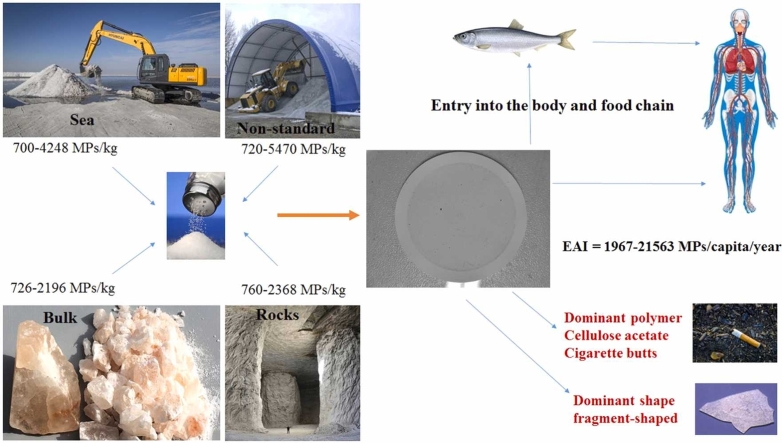
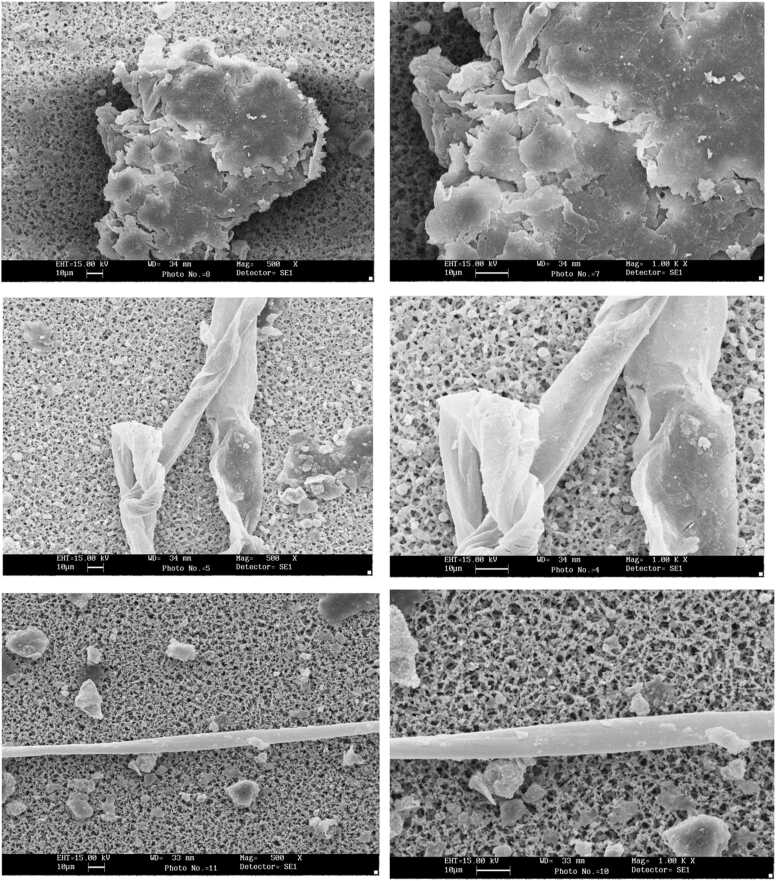
Plastics and microplastics (MPs) are toxic, pervasive and threatening the biotic and abiotic components of the earth, and they threaten food safety and food security by moving in the food chain. In this study, the amounts and characteristics of 40 table salt samples with different brands, including sea salt (No = 13), rock (No = 13), bulk (No = 8) and non-standard (No = 6), were investigated with a combination of sieving, filtration, observation and FTIR, Micro-Raman and SEM techniques. The results showed that all the salts were contaminated with MPs. In general, the abundance range of detected particles was 700-5470 MPs/kg. The abundance of MPs was higher in counterfeit and non-standard salts (1825 ± 1808 MPs/kg). Investigating the relationship between the effect of the purification process (Kruskal-Wallis Test, P = 0.841), the type of packaging (Kruskal-Wallis Test, P = 0.609), and the type of salt (Kruskal-Wallis Test, P = 0.942), on the abundance of MPs using a comparison test Kruskal-Wallis was not significant. However, the numerical difference was recognizable. The most identified polymer in the salts was cellulose acetate, which probably causes by unmanaged plastic litter in the environment (especially cigarette butts). The dominant form of particles was fragment-shaped, which is the most abundant form of identified MPs in the environment. Both environmental pollution and secondary pollution (during production and packaging), respectively, contribute to the contamination of salts with MPs. The estimated human dietary intake (EDI) and the amount of estimated annual intake (EAI) for different ages in Iran were obtained EDI = 5-59 MPs/capita/day and EAI = 1967-21563 MPs/capita/year. The surface morphology of the particles showed that the MPs were affected by continuous weathering, mechanical fracture and oxidation. MPs are a threat to human health due to the absorption and transmission of dangerous pollutants and their inherent toxicity. Therefore, a solution must be thought of to prevent the contamination of the food chain through salts by MPs, (with protective measures at the salt source, and by improving its production processes.
塑料和微塑料对地球的生物和非生物成分具有毒性、广泛存在且构成威胁,它们通过在食物链中的移动威胁食品安全和粮食安全。在本研究中,结合筛分、过滤、观察以及傅里叶变换红外光谱(FTIR)、显微拉曼光谱和扫描电子显微镜(SEM)技术,对40个不同品牌食盐样品的数量和特征进行了调查,这些品牌包括海盐(13个)、岩盐(13个)、散装盐(8个)和非标盐(6个)。结果表明,所有食盐均被微塑料污染。总体而言,检测到的颗粒丰度范围为700 - 5470个微塑料/千克。假冒和非标盐中微塑料的丰度更高(1825 ± 1808个微塑料/千克)。使用Kruskal - Wallis比较检验研究净化过程(Kruskal - Wallis检验,P = 0.841)、包装类型(Kruskal - Wallis检验,P = 0.609)和盐的类型(Kruskal - Wallis检验,P = 0.942)对微塑料丰度的影响之间的关系,结果不显著。然而,数值差异是可识别的。食盐中最常见的聚合物是醋酸纤维素,这可能是由环境中未得到妥善管理的塑料垃圾(尤其是烟头)造成的。颗粒的主要形态是碎片状,这是环境中已识别微塑料中最丰富的形态。环境污染和二次污染(在生产和包装过程中)分别导致食盐被微塑料污染。得出了伊朗不同年龄段人群的估计膳食摄入量(EDI)和估计年摄入量(EAI),EDI = 5 - 59个微塑料/人/天,EAI = 1967 - 21563个微塑料/人/年。颗粒的表面形态表明,微塑料受到持续风化、机械破碎和氧化的影响。微塑料由于吸收和传播危险污染物及其固有毒性,对人类健康构成威胁。因此,必须想出解决办法以防止微塑料通过食盐污染食物链,(在盐源处采取保护措施,并改进其生产工艺)。