Partovi Fariba, Mikkilä Joona, Iyer Siddharth, Mikkilä Jyri, Kontro Jussi, Ojanperä Suvi, Juuti Paxton, Kangasluoma Juha, Shcherbinin Aleksei, Rissanen Matti
Karsa Ltd., A. I. Virtasen aukio 1, Helsinki 00560, Finland.
Aerosol Physics Laboratory, Physics Unit, Faculty of Engineering and Natural Sciences, Tampere University, Tampere 33720, Finland.
ACS Omega. 2023 Jul 15;8(29):25749-25757. doi: 10.1021/acsomega.3c00385. eCollection 2023 Jul 25.
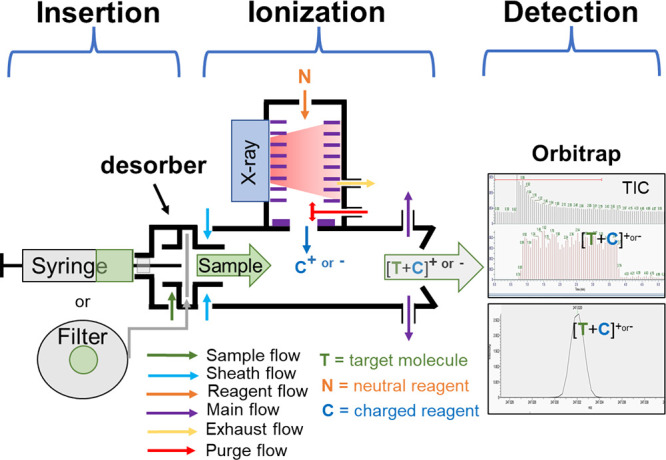
In this work, the detection characteristics of a large group of common pesticides were investigated using a multi-scheme chemical ionization inlet (MION) with a thermal desorption unit (Karsa Ltd.) connected to an Orbitrap (Velos Pro, Thermo Fisher Scientific) mass spectrometer. Standard pesticide mixtures, fruit extracts, untreated fruit juice, and whole fruit samples were inspected. The pesticide mixtures contained 1 ng of each individual target. Altogether, 115 pesticides were detected, with a set of different reagents (i.e., dibromomethane, acetonylacetone, and water) in different polarity modes. The measurement methodology presented was developed to minimize the common bottlenecks originating from sample pretreatments and nonetheless was able to retrieve 92% of the most common pesticides regularly analyzed with standardized UHPLC-MSMS (ultra-high-performance liquid chromatography with tandem mass spectrometry) procedures. The fraction of detected targets of two standard pesticide mixtures generally quantified by GC-MSMS (gas chromatography with tandem mass spectrometry) methodology was much less, equaling 45 and 34%. The pineapple swabbing experiment led to the detection of fludioxonil and diazinon below their respective maximum residue levels (MRLs), whereas measurements of untreated pineapple juice and other fruit extracts led to retrieval of dimethomorph, dinotefuran, imazalil, azoxystrobin, thiabendazole, fludioxonil, and diazinon, also below their MRL. The potential for mutual detection was investigated by mixing two standard solutions and by spiking an extract of fruit with a pesticide's solution, and subsequently, individual compounds were simultaneously detected. For a selected subgroup of compounds, the bromide (Br) chemical ionization characteristics were further inspected using quantum chemical computations to illustrate the structural features leading to their sensitive detection. Importantly, pesticides could be detected in actual extract and fruit samples, which demonstrates the potential of our fast screening method.
在这项工作中,使用配备热脱附单元(Karsa有限公司)的多方案化学电离进样口(MION)连接到Orbitrap(Velos Pro,赛默飞世尔科技)质谱仪,对一大组常见农药的检测特性进行了研究。对标准农药混合物、水果提取物、未处理的果汁和完整水果样品进行了检测。农药混合物中每种目标物的含量为1纳克。总共检测到115种农药,采用了一组不同的试剂(即二溴甲烷、乙酰丙酮和水),处于不同的极性模式。所提出的测量方法旨在尽量减少源自样品预处理的常见瓶颈问题,并且能够找回通过标准化超高效液相色谱 - 串联质谱(UHPLC-MSMS)程序常规分析的92%的最常见农药。通常通过气相色谱 - 串联质谱(GC-MSMS)方法定量的两种标准农药混合物的检测目标比例要低得多,分别为45%和34%。菠萝擦拭实验检测到咯菌腈和二嗪农低于其各自的最大残留限量(MRL),而未处理的菠萝汁和其他水果提取物的测量结果则找回了霜霉威、呋虫胺、抑霉唑、嘧菌酯、噻菌灵、咯菌腈和二嗪农,同样低于其MRL。通过混合两种标准溶液以及用农药溶液对水果提取物进行加标来研究相互检测的可能性,随后同时检测各个化合物。对于选定的一组化合物,使用量子化学计算进一步检查了溴化物(Br)化学电离特性,以说明导致其灵敏检测的结构特征。重要的是,能够在实际提取物和水果样品中检测到农药,这证明了我们快速筛选方法的潜力。