Department of Neurology, University of Arkansas for Medical Sciences, Little Rock, AR, USA.
Department of Biomedical Informatics, University of Arkansas for Medical Sciences, Little Rock, AR, USA.
J Parkinsons Dis. 2023;13(6):961-973. doi: 10.3233/JPD-230020.
Freezing of gait (FOG) is a debilitating, variably expressed motor symptom in people with Parkinson's disease (PwPD) with limited treatments.
To determine if the rate of progression in spatiotemporal gait parameters in people converting from a noFOG to a FOG phenotype (FOGConv) was faster than non-convertors, and determine if gait parameters can help predict this conversion.
PwPD were objectively monitored longitudinally, approximately every 6 months. Non-motor assessments were performed at the initial visit. Steady-state gait in the levodopa ON-state was collected using a gait mat (Protokinetics) at each visit. The rate of progression in 8 spatiotemporal gait parameters was calculated. FOG convertors (FOGConv) were classified if they did not have FOG at initial visit and developed FOG at a subsequent visit.
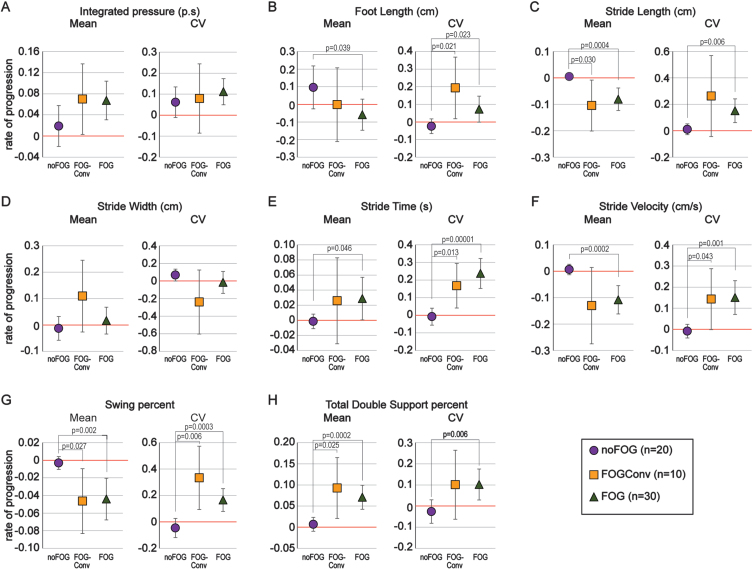
Thirty freezers (FOG) and 30 non-freezers were monitored an average of 3.5 years, with 10 non-freezers developing FOG (FOGConv). FOGConv and FOG had faster decline in mean stride-length, swing-phase-percent, and increase in mean total-double-support percent, coefficient of variability (CV) foot-strike-length and CV swing-phase-percent than the remaining non-freezers (noFOG). On univariate modeling, progression rates of mean stride-length, stride-velocity, swing-phase-percent, total-double-support-percent and of CV swing-phase-percent had high discriminative power (AUC > 0.83) for classification of the FOGConv and noFOG groups.
FOGConv had a faster temporal decline in objectively quantified gait than noFOG, and progression rates of spatiotemporal gait parameters were more predictive of FOG phenotype conversion than initial (static) parameters Objectively monitoring gait in disease prediction models may help define FOG prone groups for testing putative treatments.
冻结步态(FOG)是一种使人虚弱的、表现多样的运动症状,在帕金森病患者(PwPD)中较为常见,且目前治疗手段有限。
确定从不出现冻结步态到出现冻结步态的患者(FOGConv)的时空步态参数进展率是否快于非转化者,并确定步态参数是否有助于预测这种转化。
通过步态垫(Protokinetics)在每个就诊时采集左旋多巴有效状态下的稳态步态,对 PwPD 进行纵向、大约每 6 个月一次的客观监测。在初始就诊时进行非运动评估。如果患者在初始就诊时没有冻结步态,而在随后的就诊时出现了冻结步态,则将其归类为冻结步态转化者(FOGConv)。
30 名冻结步态者(FOG)和 30 名非冻结步态者平均监测了 3.5 年,其中 10 名非冻结步态者发展为冻结步态(FOGConv)。与其余非冻结步态者(noFOG)相比,FOGConv 和 FOG 的平均步长、摆动相百分比和总双支撑百分比的下降速度更快,以及 CV 足击距和 CV 摆动相百分比的增加速度更快。在单变量建模中,平均步长、步速、摆动相百分比、总双支撑百分比和 CV 摆动相百分比的进展率对 FOGConv 和 noFOG 组的分类具有较高的判别力(AUC>0.83)。
与非冻结步态者相比,FOGConv 的步态在客观量化时表现出更快的时间下降,时空步态参数的进展率比初始(静态)参数更能预测冻结步态表型的转化。在疾病预测模型中对步态进行客观监测可能有助于为测试潜在治疗方法定义易出现冻结步态的群体。