Department of Nutrition, School of Public Health, University of São Paulo, São Paulo01246-904, Brazil.
Center for Epidemiological Research in Nutrition and Health, Department of Nutrition, School of Public Health, University of São Paulo, São Paulo, Brazil.
Public Health Nutr. 2023 Nov;26(11):2366-2373. doi: 10.1017/S1368980023001532. Epub 2023 Jul 31.
To assess the prospective association of two diet quality scores based on the Nova food classification with BMI gain.
The NutriNet-Brasil cohort is an ongoing web-based prospective study with continuous recruitment of participants aged ≥ 18 years since January 2020. A short 24-h dietary recall screener including 'yes/no' questions about the consumption of whole plant foods (WPF) and ultra-processed foods (UPF) was completed by participants at baseline. The Nova-WPF and the Nova-UPF scores were computed by adding up positive responses regarding the consumption of thirty-three varieties of WPF and twenty-three varieties of UPF, respectively. Participants reported their height at baseline and their weight at both baseline and after approximately 15 months of follow-up. A 15-month BMI (kg/m) increase of ≥5 % was coded as BMI gain.
Brazil.
9551 participants from the NutriNet-Brasil cohort.
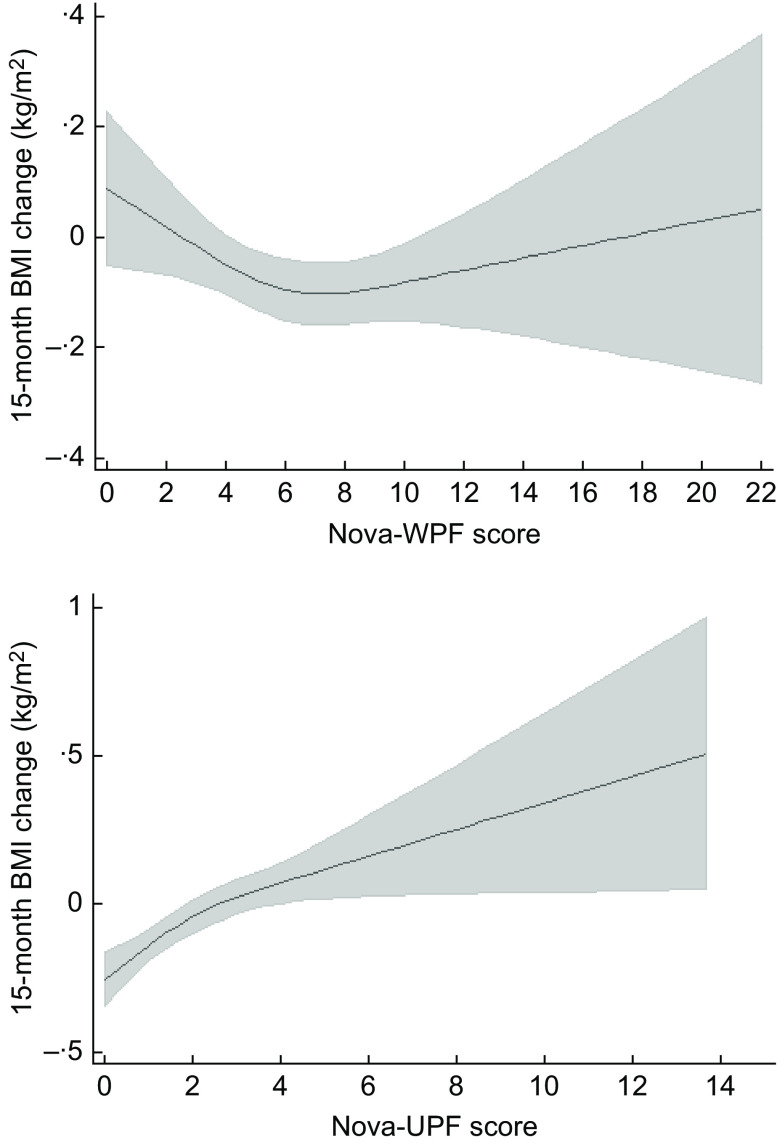
Increasing quintiles of the Nova-UPF score were linearly associated with higher risk of BMI gain (relative risk Q5/Q1 = 1·34; 95 % CI 1·15, 1·56), whereas increasing quintiles of the Nova-WPF score were linearly associated with lower risk (relative risk Q5/Q1 = 0·80; 95 % CI 0·69, 0·94). We identified a moderate inverse correlation between the two scores (-0·33) and a partial mediating effect of the alternative score: 15 % for the total effect of the Nova-UPF score and 25 % for the total effect of the Nova-WPF score.
The Nova-UPF and Nova-WPF scores are independently associated with mid-term BMI gain further justifying their use in diet quality monitoring systems.
评估基于 Nova 食品分类的两种饮食质量评分与 BMI 增长的前瞻性关联。
NutriNet-Brasil 队列是一项正在进行的基于网络的前瞻性研究,自 2020 年 1 月以来持续招募年龄≥18 岁的参与者。参与者在基线时完成了一个简短的 24 小时饮食回忆筛查器,其中包括关于全植物食品(WPF)和超加工食品(UPF)消费的“是/否”问题。通过加总关于三十三种类 WPF 和二十三种 UPF 的消费的阳性回答,计算出 Nova-WPF 和 Nova-UPF 评分。参与者在基线时报告了他们的身高,在基线和大约 15 个月的随访后报告了他们的体重。BMI(kg/m)增加≥5%被编码为 BMI 增加。
巴西。
NutriNet-Brasil 队列的 9551 名参与者。
Nova-UPF 评分的递增五分位数与 BMI 增加的风险呈线性相关(相对风险 Q5/Q1=1.34;95%CI 1.15,1.56),而 Nova-WPF 评分的递增五分位数与风险呈线性相关降低(相对风险 Q5/Q1=0.80;95%CI 0.69,0.94)。我们发现这两个评分之间存在中度负相关(-0.33)和替代评分的部分中介效应:Nova-UPF 评分总效应的 15%和 Nova-WPF 评分总效应的 25%。
Nova-UPF 和 Nova-WPF 评分与中期 BMI 增长独立相关,进一步证明它们可用于饮食质量监测系统。