Lee Jae-Hong, An Hyun-Wook, Im Jae-Seung, Kim Woo-Joo, Lee Dong-Won, Yun Jeong-Ho
Department of Periodontology, College of Dentistry and Institute of Oral Bioscience, Jeonbuk National University, Jeonju, Korea.
Research Institute of Clinical Medicine of Jeonbuk National University-Biomedical Research Institute of Jeonbuk National University Hospital, Jeonju, Korea.
J Periodontal Implant Sci. 2023 Aug;53(4):306-317. doi: 10.5051/jpis.2300640032. Epub 2023 Jun 9.
Biphasic calcium phosphate (BCP), a widely used biomaterial for bone regeneration, contains synthetic hydroxyapatite (HA) and β-tricalcium phosphate (β-TCP), the ratio of which can be adjusted to modulate the rate of degradation. The aim of this study was to evaluate the clinical and radiographic benefits of reconstructing peri-implant bone defects with a newly developed BCP consisting of 40% β-TCP and 60% HA compared to demineralized bovine bone mineral (DBBM).
This prospective, multicenter, parallel, single-blind randomized controlled trial was conducted at the periodontology departments of 3 different dental hospitals. Changes in clinical (defect width and height) and radiographic (augmented horizontal bone thickness) parameters were measured between implant surgery with guided bone regeneration (GBR) and re-entry surgery. Postoperative discomfort (severity and duration of pain and swelling) and early soft-tissue wound healing (dehiscence and inflammation) were also assessed. Data were compared between the BCP (test) and DBBM (control) groups using the independent -test and the χ² test.
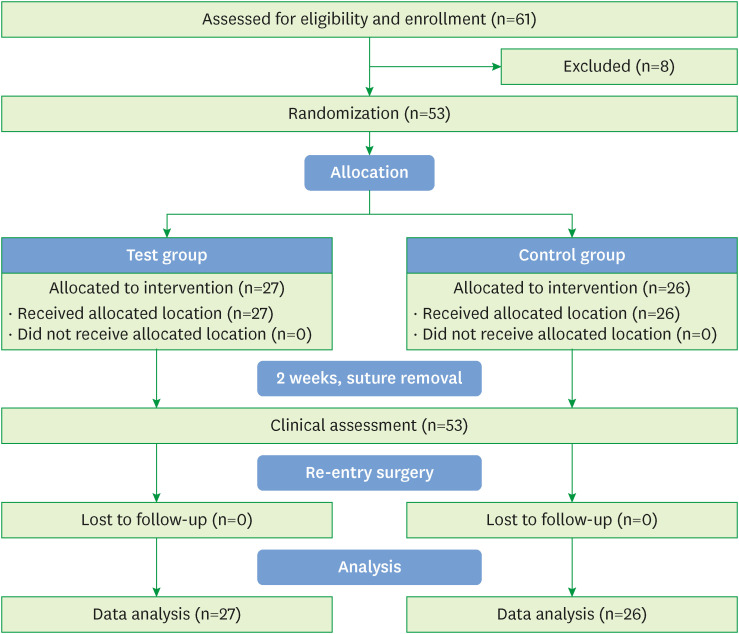
Of the 53 cases included, 27 were in the test group and 26 were in the control group. After a healing period of 18 weeks, the full and mean resolution of buccal dehiscence defects were 59.3% (n=16) and 71.3% in the test group and 42.3% (n=11) and 57.9% in the control group, respectively. There were no significant differences between the groups in terms of the change in mean horizontal bone augmentation (test group: -0.50±0.66 mm vs. control groups: -0.66±0.83 mm, =0.133), postoperative discomfort, or early wound healing. No adverse or fatal complications occurred in either group.
The GBR procedure with the newly developed BCP showed favorable clinical, radiographic, postoperative discomfort-related, and early wound healing outcomes for peri-implant dehiscence defects that were similar to those for DBBM.
Clinical Research Information Service Identifier: KCT0006428.
双相磷酸钙(BCP)是一种广泛用于骨再生的生物材料,包含合成羟基磷灰石(HA)和β-磷酸三钙(β-TCP),其比例可调节以控制降解速率。本研究的目的是评估与脱矿牛骨矿物质(DBBM)相比,使用新开发的由40%β-TCP和60%HA组成的BCP修复种植体周围骨缺损的临床和影像学益处。
这项前瞻性、多中心、平行、单盲随机对照试验在3家不同牙科医院的牙周病科进行。在种植手术联合引导骨再生(GBR)和再次手术之间测量临床(缺损宽度和高度)和影像学(水平骨增厚增加)参数的变化。还评估了术后不适(疼痛和肿胀的严重程度及持续时间)和早期软组织伤口愈合情况(裂开和炎症)。使用独立t检验和χ²检验比较BCP(试验)组和DBBM(对照)组的数据。
纳入的53例病例中,试验组27例,对照组26例。经过18周的愈合期后,试验组颊侧裂开缺损的完全和平均愈合率分别为59.3%(n = 16)和71.3%,对照组分别为42.3%(n = 11)和57.9%。两组在平均水平骨增量变化(试验组:-0.50±0.66 mm vs.对照组:-0.66±0.83 mm,P = 0.133)、术后不适或早期伤口愈合方面无显著差异。两组均未发生不良或致命并发症。
使用新开发的BCP进行GBR手术对种植体周围裂开缺损显示出良好的临床、影像学、术后不适相关及早期伤口愈合结果,与DBBM相似。
临床研究信息服务标识符:KCT0006428。