Department of Cardiology, Faculty of Medicine, University Hospital Cologne, Clinic III for Internal Medicine, University of Cologne, Kerpener Str. 62, 50937, Cologne, Germany.
Division of Cardiology, Pneumology, and Vascular Medicine, Department of Medicine, University Hospital Duesseldorf, Duesseldorf, Germany.
Clin Res Cardiol. 2024 Jan;113(1):107-115. doi: 10.1007/s00392-023-02278-1. Epub 2023 Jul 31.
Many patients in need for transcatheter aortic valve implantation (TAVI) present with an aortic annulus size larger than recommended by the manufacturer's instructions for use (IFU).
To investigate procedural and short-term safety and efficacy of TAVI in patients with extra-large annuli (ELA).
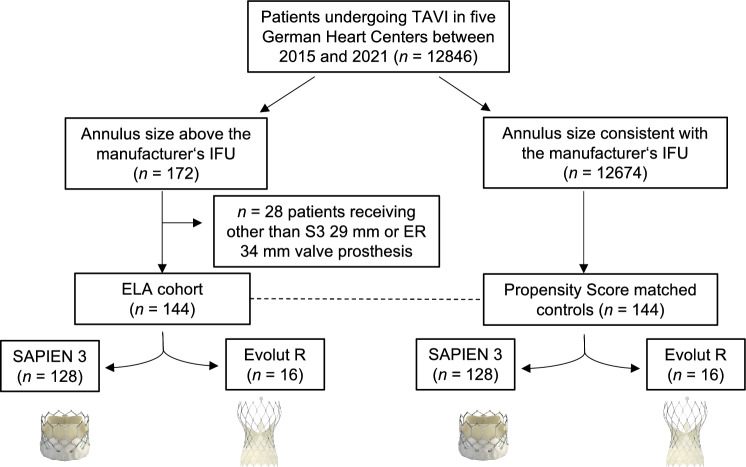
30-day clinical outcome and valve performance as defined by VARC 3 of 144 patients with an aortic annulus size exceeding the permitted range were compared to a propensity-score matched control cohort of patients with an aortic annulus size consistent with the IFU.
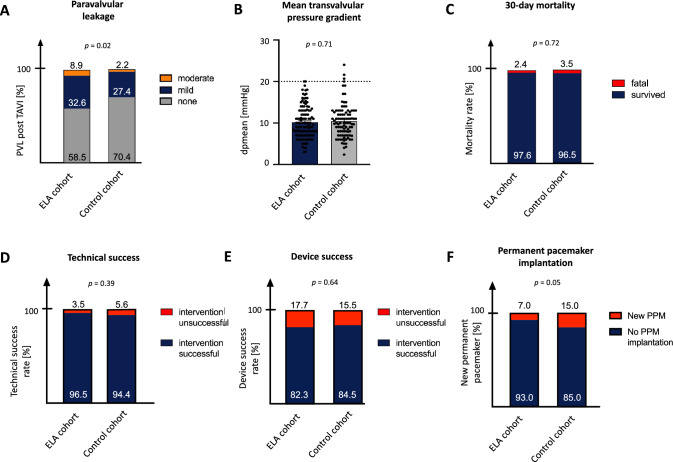
Area and perimeter was 730.4 ± 53.9 mm and 96.7 ± 6.5 mm in the ELA group. Technical (96.5% vs. 94.4%) and device success (82.3% vs. 84.5%) were comparable in patients with ELA (annulus area 730.4 ± 53.9 mm) and matched controls (annulus area 586.0 ± 48.2 mm). There was no significant difference in 30-day mortality rate, major intraprocedural complications, type 3 or 4 bleedings, major vascular complications, or stroke. Moderate paravalvular leakage (PVL) occurred more frequent in the ELA group (8.9% vs 2.2%; p = 0.02). The rate of new pacemaker implantation was 7.0% in the ELA cohort and 15.0% in the control cohort, respectively (p = 0.05).
Treatment of ELA patients with third-generation TAVI prostheses is feasible and safe, providing similar device success and complication rates as in matched controls with regular-sized aortic annulus. Post-interventional pacemaker implantation rates were low compared to the control group, yet incidence of moderate PVL remains problematic in ELA patients.
许多需要行经导管主动脉瓣置换术(TAVI)的患者主动脉瓣环尺寸大于制造商使用说明书(IFU)推荐的尺寸。
研究经导管主动脉瓣置换术(TAVI)在瓣环尺寸过大(ELA)患者中的应用的程序安全性和短期疗效。
比较 144 例主动脉瓣环尺寸超出允许范围的患者的 30 天临床转归和瓣叶功能(根据 VARC 3 定义)与主动脉瓣环尺寸符合 IFU 的倾向评分匹配对照组患者的结果。
ELA 组的瓣环面积和周长分别为 730.4±53.9mm 和 96.7±6.5mm。ELA 组(瓣环面积 730.4±53.9mm)和匹配对照组(瓣环面积 586.0±48.2mm)患者的技术成功率(96.5% vs. 94.4%)和器械成功率(82.3% vs. 84.5%)相当。30 天死亡率、主要术中并发症、3 型或 4 型出血、主要血管并发症或卒中无显著差异。ELA 组中度瓣周漏(PVL)更为常见(8.9% vs. 2.2%;p=0.02)。ELA 组新植入起搏器的发生率为 7.0%,对照组为 15.0%(p=0.05)。
使用第三代 TAVI 假体治疗 ELA 患者是可行和安全的,与主动脉瓣环尺寸正常的匹配对照组相比,提供了相似的器械成功率和并发症发生率。与对照组相比,术后起搏器植入率较低,但 ELA 患者中度 PVL 的发生率仍存在问题。