Yang Hui, Luo Ya-Mei, Ma Cai-Yi, Zhang Tian-Yu, Zhou Tao, Ren Xiao-Lei, He Xiao-Lin, Deng Ke-Jun, Yan Dan, Tang Hua, Lin Hao
School of Computer Science, Chengdu University of Information Technology, Chengdu, 610225, China.
School of Life Science and Technology, Center for Informational Biology, University of Electronic Science and Technology of China, Chengdu, 610054, China.
NPJ Digit Med. 2023 Jul 31;6(1):136. doi: 10.1038/s41746-023-00887-8.
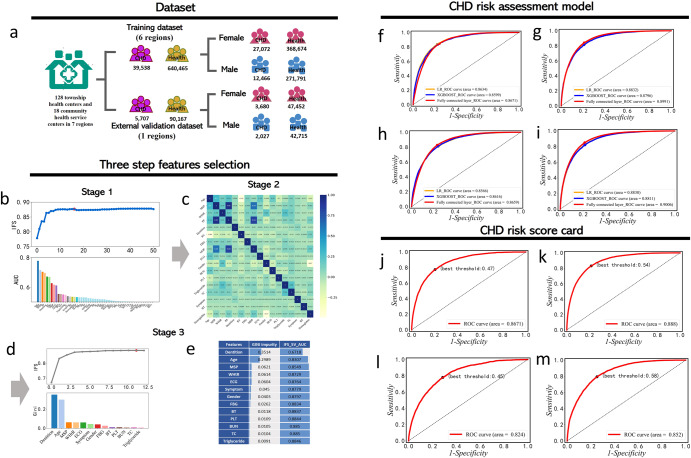
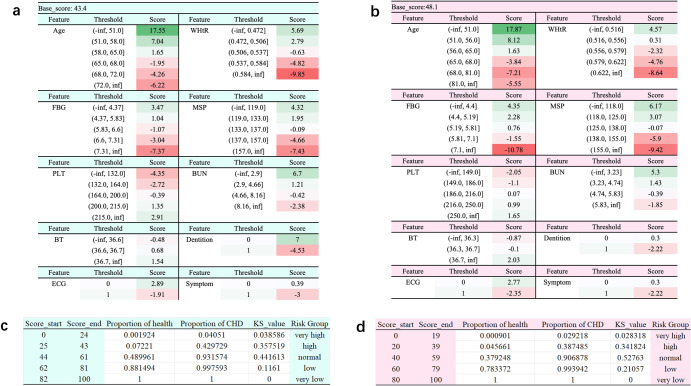
Large-scale screening for the risk of coronary heart disease (CHD) is crucial for its prevention and management. Physical examination data has the advantages of wide coverage, large capacity, and easy collection. Therefore, here we report a gender-specific cascading system for risk assessment of CHD based on physical examination data. The dataset consists of 39,538 CHD patients and 640,465 healthy individuals from the Luzhou Health Commission in Sichuan, China. Fifty physical examination characteristics were considered, and after feature screening, ten risk factors were identified. To facilitate large-scale CHD risk screening, a CHD risk model was developed using a fully connected network (FCN). For males, the model achieves AUCs of 0.8671 and 0.8659, respectively on the independent test set and the external validation set. For females, the AUCs of the model are 0.8991 and 0.9006, respectively on the independent test set and the external validation set. Furthermore, to enhance the convenience and flexibility of the model in clinical and real-life scenarios, we established a CHD risk scorecard base on logistic regression (LR). The results show that, for both males and females, the AUCs of the scorecard on the independent test set and the external verification set are only slightly lower (<0.05) than those of the corresponding prediction model, indicating that the scorecard construction does not result in a significant loss of information. To promote CHD personal lifestyle management, an online CHD risk assessment system has been established, which can be freely accessed at http://lin-group.cn/server/CHD/index.html .
大规模筛查冠心病(CHD)风险对其预防和管理至关重要。体格检查数据具有覆盖范围广、容量大且易于收集的优点。因此,在此我们报告一种基于体格检查数据的冠心病风险评估性别特异性级联系统。该数据集由来自中国四川泸州市卫生健康委员会的39538例冠心病患者和640465例健康个体组成。考虑了50项体格检查特征,经过特征筛选后,确定了10个风险因素。为便于大规模冠心病风险筛查,使用全连接网络(FCN)开发了冠心病风险模型。对于男性,该模型在独立测试集和外部验证集上的AUC分别为0.8671和0.8659。对于女性,该模型在独立测试集和外部验证集上的AUC分别为0.8991和0.9006。此外,为提高模型在临床和现实生活场景中的便利性和灵活性,我们基于逻辑回归(LR)建立了冠心病风险计分卡。结果表明,对于男性和女性,计分卡在独立测试集和外部验证集上的AUC仅略低于相应预测模型的AUC(<0.05),这表明计分卡构建不会导致信息的显著损失。为促进冠心病个人生活方式管理,已建立了一个在线冠心病风险评估系统,可通过http://lin-group.cn/server/CHD/index.html免费访问。