van Wamelen Daniel J, Leta Valentina, Chaudhuri K Ray, Jenner Peter
Department of Neuroimaging, Institute of Psychiatry, Psychology & Neuroscience, King's College London, London, United Kingdom.
Department of Basic & Clinical Neuroscience, Institute of Psychiatry, Psychology & Neuroscience, King's College London, London, United Kingdom.
Curr Neuropharmacol. 2024;22(10):1606-1620. doi: 10.2174/1570159X21666230731110709.
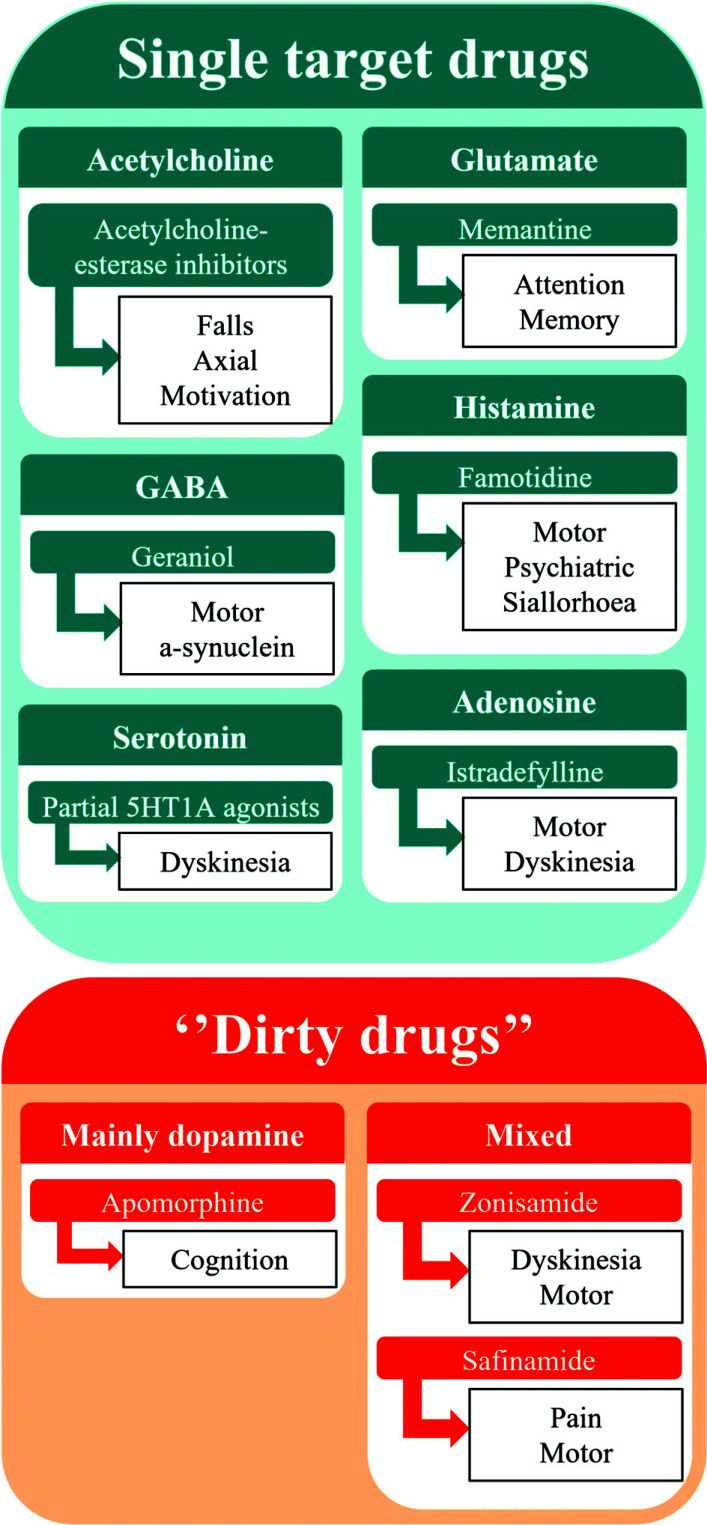
The symptomatic treatment of Parkinson's disease (PD) has been dominated by the use of dopaminergic medication, but significant unmet need remains, much of which is related to non-motor symptoms and the involvement of non-dopaminergic transmitter systems. As such, little has changed in the past decades that has led to milestone advances in therapy and significantly improved treatment paradigms and patient outcomes, particularly in relation to symptoms unresponsive to levodopa. This review has looked at how pharmacological approaches to treatment are likely to develop in the near and distant future and will focus on two areas: 1) novel non-dopaminergic pharmacological strategies to control motor symptoms; and 2) novel non-dopaminergic approaches for the treatment of non-motor symptoms. The overall objective of this review is to use a 'crystal ball' approach to the future of drug discovery in PD and move away from the more traditional dopamine-based treatments. Here, we discuss promising non-dopaminergic and 'dirty drugs' that have the potential to become new key players in the field of Parkinson's disease treatment.
帕金森病(PD)的对症治疗一直以使用多巴胺能药物为主,但仍存在大量未满足的需求,其中大部分与非运动症状以及非多巴胺能递质系统的参与有关。因此,在过去几十年里几乎没有发生什么变化,从而带来治疗上的里程碑式进展以及显著改善治疗模式和患者预后,特别是对于左旋多巴无反应的症状。本综述探讨了在近期和远期治疗的药理学方法可能如何发展,并将聚焦于两个领域:1)控制运动症状的新型非多巴胺能药理学策略;2)治疗非运动症状的新型非多巴胺能方法。本综述的总体目标是采用“水晶球”方法来展望帕金森病药物研发的未来,并摆脱更为传统的基于多巴胺的治疗方法。在此,我们讨论了有前景的非多巴胺能药物和“多靶点药物”,它们有可能成为帕金森病治疗领域的新关键参与者。