Department of Neurology, Inselspital, Bern University Hospital, University of Bern, Freiburgstrasse, CH-3010, Bern, Switzerland.
Department of Neurology and Stroke Centre, University Hospital Basel and University of Basel, Basel, Switzerland.
J Headache Pain. 2023 Aug 1;24(1):100. doi: 10.1186/s10194-023-01642-w.
Given the similar presentation of migraine aura and acute ischemic stroke, advancing patient age might change the characteristics of migraine with aura (MA) and be clinically important. Clinical data, however, are limited. Experimental studies indicate a decrease in the magnitude of cortical spreading depression (CSD), the pathophysiological correlate of migraine aura, with advancing age. Our study aimed to assess the influence of age on the clinical features of MA.
Three hundred and forty-three patients were interviewed using a structured questionnaire. The questions covered the headache characteristics and symptom types including the characteristics of the C-criterion, as defined by the International Classification of Headache Disorders 3 Edition. The association of age with MA characteristics was assessed.
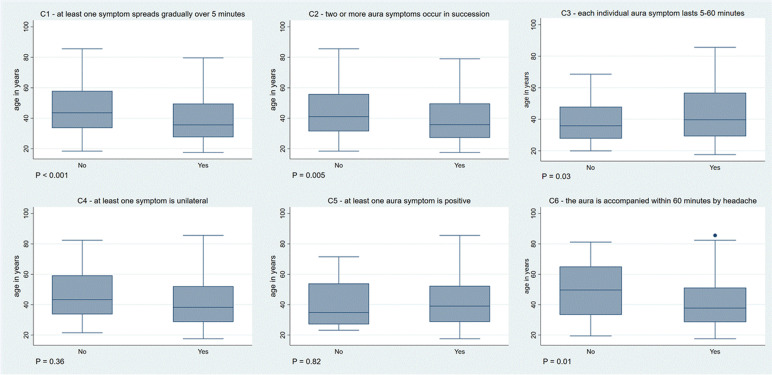
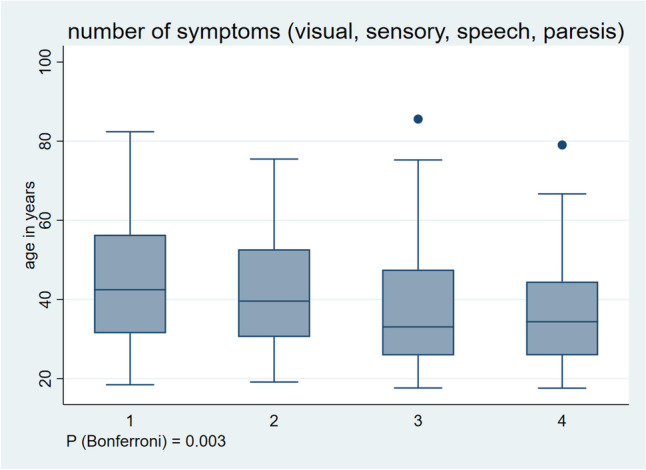
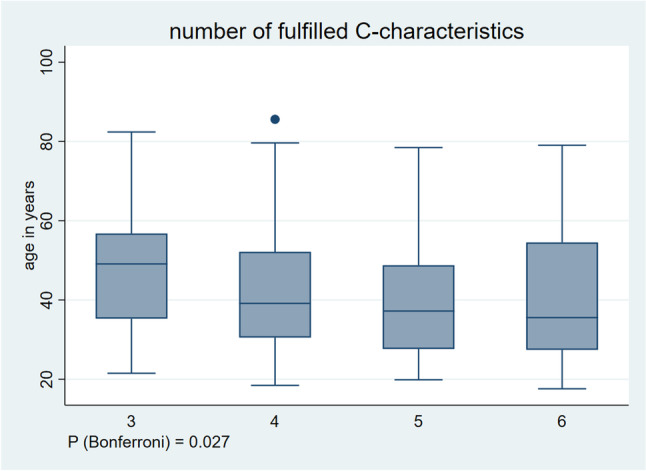
The median age was 29 (IQR 28-52) and 235 of the 343 patients were women (69%). Individual symptoms of the C-criterion such as gradual aura spreading over longer than 5 min (P < 0.001), two or more aura symptoms occurring in succession (P = 0.005), duration of at least one MA symptom for longer than 60 min (P = 0.004), and associated headache (P = 0.01) were more frequent in younger patients. The number of symptoms including the C-characteristics decreased with increasing age (P < 0.001). Patients with sensory (P < 0.001), motor (P = 0.004) and speech disturbance (P = 0.02) were younger, and older patients with headache had less photophobia (P = 0.04) and phonophobia (P = 0.03). Sensitivity analyses yielded similar results.
The frequency of typical characteristics of migraine aura and migraine headache including photophobia and phonophobia decreases with advancing patient age. This might have potentially difficult implications for the diagnosis of MA in the elderly.
鉴于偏头痛先兆和急性缺血性中风的表现相似,随着患者年龄的增长,偏头痛先兆(MA)的特征可能会发生变化,这具有重要的临床意义。然而,临床数据有限。实验研究表明,随着年龄的增长,皮质扩散性抑制(CSD)的幅度减小,CSD 是偏头痛先兆的病理生理学相关因素。本研究旨在评估年龄对 MA 临床特征的影响。
对 343 例患者进行了结构化问卷调查。问题涵盖了头痛特征和症状类型,包括国际头痛疾病分类第 3 版定义的 C 标准的特征。评估了年龄与 MA 特征之间的关系。
中位年龄为 29 岁(IQR 28-52),343 例患者中有 235 例为女性(69%)。C 标准的个别症状,如先兆逐渐扩散超过 5 分钟(P < 0.001)、两个或更多先兆症状连续出现(P = 0.005)、至少一个 MA 症状持续超过 60 分钟(P = 0.004)和伴随头痛(P = 0.01)在年轻患者中更为常见。包括 C 特征在内的症状数量随着年龄的增加而减少(P < 0.001)。有感觉(P < 0.001)、运动(P = 0.004)和言语障碍(P = 0.02)的患者更年轻,而头痛年龄较大的患者对光(P = 0.04)和声音(P = 0.03)更不敏感。敏感性分析得出了类似的结果。
随着患者年龄的增长,偏头痛先兆和偏头痛头痛的典型特征(包括畏光和畏声)的频率降低。这可能对老年人偏头痛先兆的诊断产生潜在的困难影响。