Gaffan Nicolas, Kpozehouen Alphonse, Degbey Cyriaque, Ahanhanzo Yolaine Glele, Paraïso Moussiliou Noël
Department of Epidemiology and Biostatistics, Regional Institute of Public Health, University of Abomey-Calavi, Ouidah, Benin.
Department of Environmental Health, Regional Institute of Public Health, University of Abomey-Calavi, Ouidah, Benin.
BMC Nutr. 2023 Aug 1;9(1):95. doi: 10.1186/s40795-023-00751-8.
Whether or not the Water, Sanitation and Hygiene (WASH) conditions in which children under five live determine their nutritional status is still under discussion. The work aimed to study the effects of household WASH conditions to which children under five are exposed on their nutritional status in Benin.
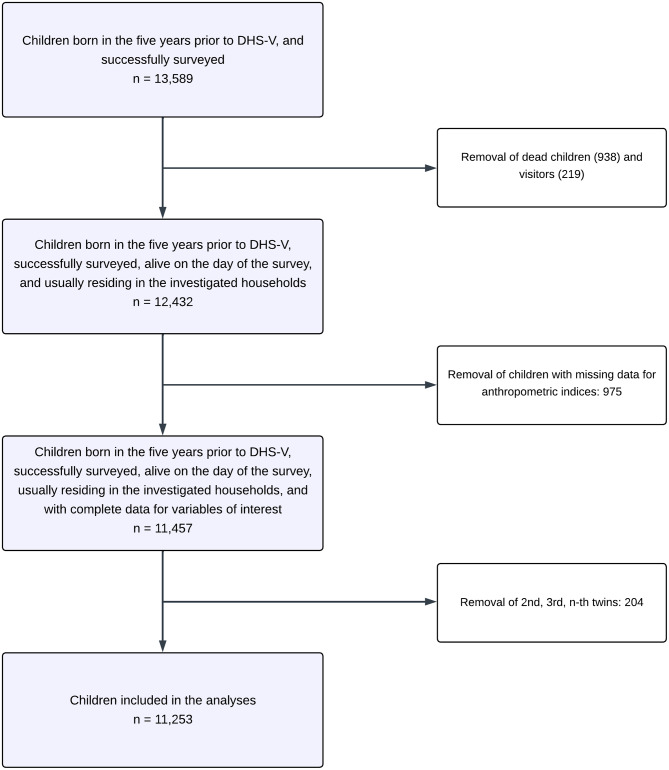
The study utilized a cross-sectional design and consisted of secondary analyses using datasets from the fifth Demographic and Health Survey (DHS-V) conducted in Benin. Stunting, wasting and underweight were the dependent variables. The WASH conditions in which children live were evaluated in the immediate environment, i.e., at the level of their households. After describing the study variables, the relationships between the dependent variables and the exposures were checked using multivariate logistic regression. Data analysis was performed with Stata 15 and took into account the survey's sampling design.
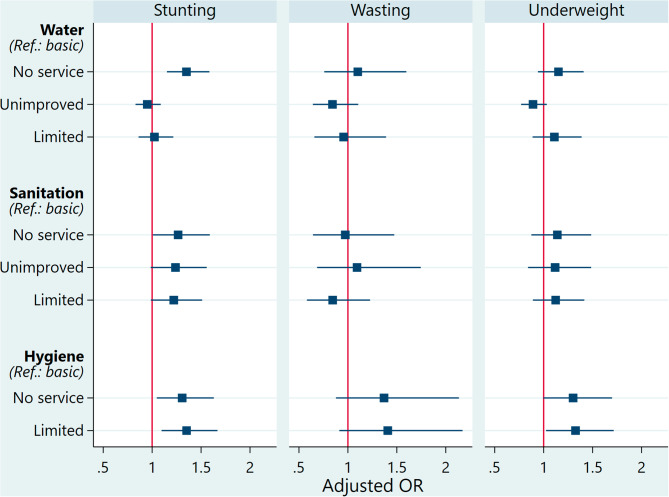
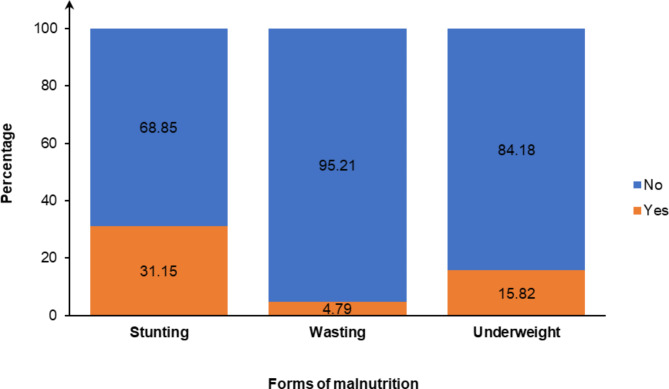
The prevalence of stunting, wasting and underweight was 31.15% (95% CI = 29.90-32.42), 4.79% (95% CI = 4.33-5.31) and 15.82% (95% CI = 14.92-16.76), respectively. The stunting odds were 1.35 (95% CI = 1.15-1.59) and 1.27 (95% CI = 1.01-1.59) times higher for children from households with no water and sanitation services, respectively, compared to children living in households with basic water and sanitation services. Children under five from households with no hygiene facilities and using limited hygiene services had 1.31 (95% CI = 1.05-1.63) and 1.35 (95% CI = 1.10-1.67) times the odds of being stunted, respectively, compared to children covered by basic hygiene facilities. There is no evidence of a significant relationship between household access to WASH and wasting in children under five. The odds of being underweight were 1.33 (95% CI = 1.02-1.72) times higher among children under five from households with limited hygiene facilities than among children from households with basic hygiene facilities.
Interventions to fight malnutrition in children under five should include a WASH dimension.
五岁以下儿童所处的水、环境卫生和个人卫生(WASH)条件是否决定其营养状况仍在讨论中。这项工作旨在研究五岁以下儿童所接触的家庭WASH条件对贝宁儿童营养状况的影响。
该研究采用横断面设计,包括对贝宁进行的第五次人口与健康调查(DHS-V)数据集的二次分析。发育迟缓、消瘦和体重不足是因变量。儿童生活的WASH条件在其直接环境中进行评估,即在家庭层面。在描述研究变量后,使用多变量逻辑回归检查因变量与暴露因素之间的关系。数据分析使用Stata 15进行,并考虑了调查的抽样设计。
发育迟缓、消瘦和体重不足的患病率分别为31.15%(95%CI = 29.90 - 32.42)、4.79%(95%CI = 4.33 - 5.31)和15.82%(95%CI = 14.92 - 16.76)。与生活在具备基本水和卫生设施家庭的儿童相比,来自没有水和卫生设施家庭的儿童发育迟缓几率分别高出1.35倍(95%CI = 1.15 - 1.59)和1.27倍(95%CI = 1.01 - 1.59)。与享有基本卫生设施的儿童相比,来自没有卫生设施且使用有限卫生服务家庭的五岁以下儿童发育迟缓几率分别高出1.31倍(95%CI = 1.05 - 1.63)和1.35倍(95%CI = 1.10 - 1.67)。没有证据表明家庭获得WASH与五岁以下儿童消瘦之间存在显著关系。与来自具备基本卫生设施家庭的儿童相比,来自卫生设施有限家庭的五岁以下儿童体重不足几率高出1.33倍(95%CI = 1.02 - 1.72)。
应对五岁以下儿童营养不良的干预措施应包括WASH方面。