Toro Carlos A, Hansen Jens, Siddiq Mustafa M, Johnson Kaitlin, Cao Jiqing, Pero Adriana, Iyengar Ravi, Cai Dongming, Cardozo Christopher P
Spinal Cord Damage Research Center, James J. Peters VA Medical Center, Bronx, New York, USA.
Department of Medicine, Icahn School of Medicine at Mount Sinai, New York, New York, USA.
Neurotrauma Rep. 2023 Jul 27;4(1):464-477. doi: 10.1089/neur.2023.0023. eCollection 2023.
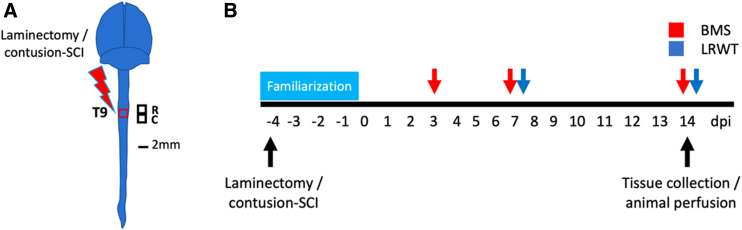
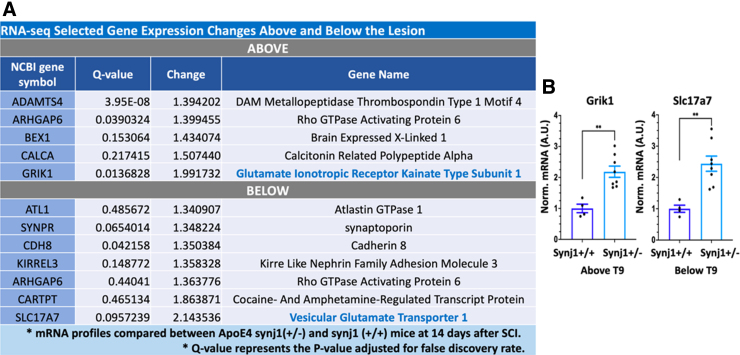
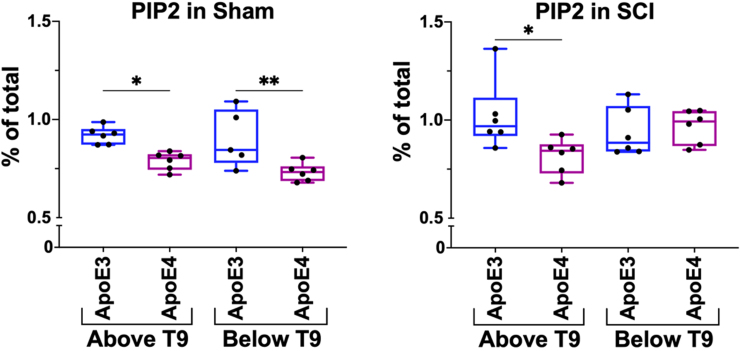
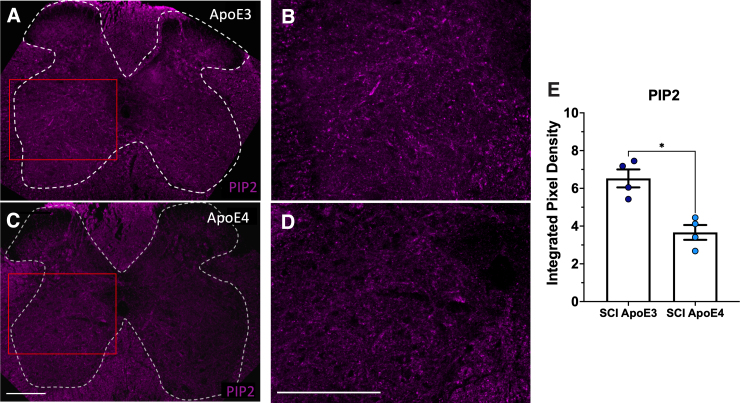
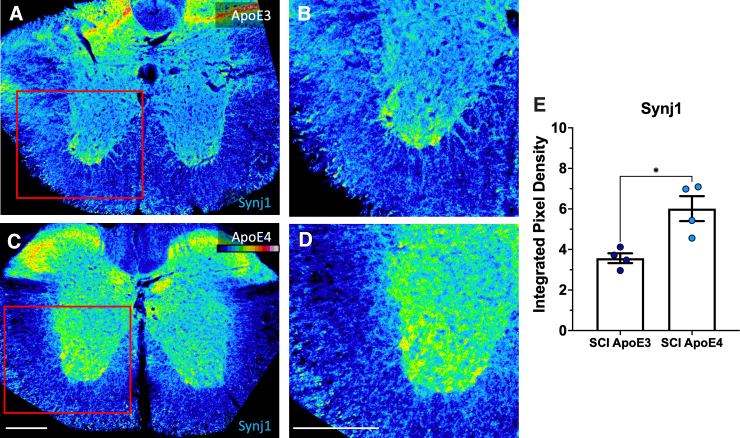
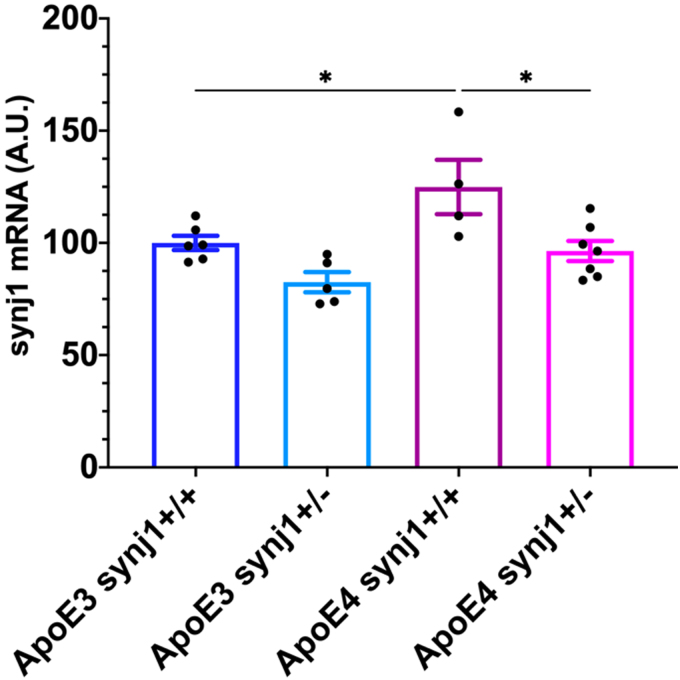
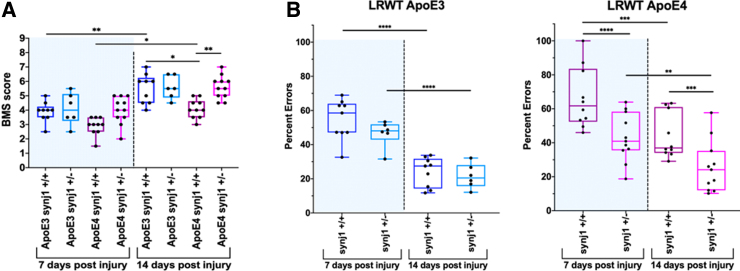
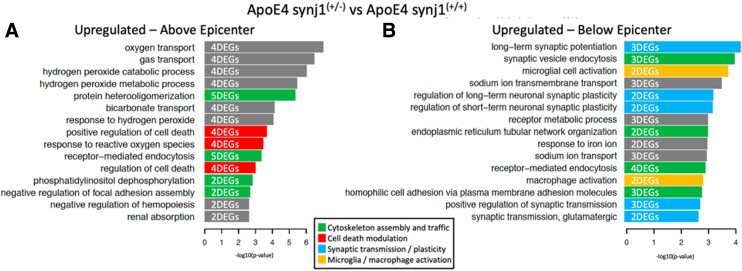
Apolipoprotein E epsilon 4 (ApoE4) is the second most common variant of ApoE, being present in ∼14% of the population. Clinical reports identify ApoE4 as a genetic risk factor for poor outcomes after traumatic spinal cord injury (SCI) and spinal cord diseases such as cervical myelopathy. To date, there is no intervention to promote recovery of function after SCI/spinal cord diseases that is specifically targeted at ApoE4-associated impairment. Studies in the human and mouse brain link ApoE4 to elevated levels of synaptojanin 1 (synj1), a lipid phosphatase that degrades phosphoinositol 4,5-bisphosphate (PIP) into inositol 4-monophosphate. Synj1 regulates rearrangements of the cytoskeleton as well as endocytosis and trafficking of synaptic vesicles. We report here that, as compared to ApoE3 mice, levels of synj1 messenger RNA and protein were elevated in spinal cords of healthy ApoE4 mice associated with lower PIP levels. Using a moderate-severity model of contusion SCI in mice, we found that genetic reduction of synj1 improved locomotor function recovery at 14 days after SCI in ApoE4 mice without altering spared white matter. Genetic reduction of synj1 did not alter locomotor recovery of ApoE3 mice after SCI. Bulk RNA sequencing revealed that at 14 days after SCI in ApoE4 mice, genetic reduction of synj1 upregulated genes involved in glutaminergic synaptic transmission just above and below the lesion. Overall, our findings provide evidence for a link between synj1 to poor outcomes after SCI in ApoE4 mice, up to 14 days post-injury, through mechanisms that may involve the function of excitatory glutaminergic neurons.
载脂蛋白Eε4(ApoE4)是ApoE的第二常见变体,约14%的人群中存在该变体。临床报告表明,ApoE4是创伤性脊髓损伤(SCI)和脊髓疾病(如颈椎病)后不良预后的遗传风险因素。迄今为止,尚无专门针对ApoE4相关损伤促进SCI/脊髓疾病后功能恢复的干预措施。在人类和小鼠大脑中的研究将ApoE4与突触素1(synj1)水平升高联系起来,突触素1是一种脂质磷酸酶,可将磷脂酰肌醇4,5-二磷酸(PIP)降解为肌醇4-单磷酸。Synj1调节细胞骨架的重排以及突触小泡的内吞作用和运输。我们在此报告,与ApoE3小鼠相比,健康ApoE4小鼠脊髓中synj1信使核糖核酸和蛋白质水平升高,同时PIP水平降低。使用小鼠中度严重程度的挫伤性SCI模型,我们发现synj1基因敲低可改善ApoE4小鼠SCI后14天的运动功能恢复,而不改变 spared白质。synj1基因敲低并未改变SCI后ApoE3小鼠的运动恢复。大量RNA测序显示,在ApoE4小鼠SCI后14天,synj1基因敲低上调了损伤部位上方和下方参与谷氨酸能突触传递的基因。总体而言,我们的研究结果为synj1与ApoE4小鼠SCI后不良预后之间的联系提供了证据,这种联系在损伤后14天内存在,其机制可能涉及兴奋性谷氨酸能神经元的功能。