Peters Gregory A, Goldberg Scott A, Hayes Jane M, Cash Rebecca E
Department of Emergency Medicine Harvard Medical School Boston Massachusetts USA.
Department of Emergency Medicine Brigham and Women's Hospital Boston Massachusetts USA.
J Am Coll Emerg Physicians Open. 2023 Jul 31;4(4):e13017. doi: 10.1002/emp2.13017. eCollection 2023 Aug.
We aimed to evaluate the differences in characteristics and illness/injury severity among patients who present to the emergency department (ED) via emergency medical services (EMS) compared to patients who present via other means.
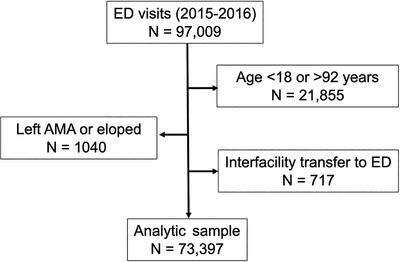
We analyzed a nationwide sample of ED visits from the 2015-2019 National Hospital Ambulatory Medical Care Survey. We excluded patients <18 or >92 years old, who eloped or left against medical advice, or who arrived via interfacility transport. Mode of presentation was dichotomized to those presenting to the ED via EMS versus any other mode of transportation. Using the appropriate survey sampling weights, we described patient characteristics and compared measures of illness/injury severity between groups using a multivariable logistic regression model.
An unweighted total of 73,397 ED visits, representing a weighted estimate of 528,083,416 ED visits in the United States during 2015-2019, included 18% arriving via EMS and 82% via other means. EMS patients were older, more often male, more often had multiple chronic medical conditions, and less often had private insurance. EMS patients had higher priority triage scores, consumed more resources in the ED, and had longer lengths of stay. Arrival by EMS was associated with higher odds of hospital admission (odds ratio [OR] 2.7, 95% confidence interval [CI] 2.4-2.9) and in-hospital mortality (OR 11.1, 95% CI 7.3-17.2).
Patients presenting via EMS had significantly different characteristics and outcomes than those presenting via other means. These important differences should be considered when comparing studies of all ED patients versus those who present via EMS.
我们旨在评估通过紧急医疗服务(EMS)送至急诊科(ED)的患者与通过其他方式就诊的患者在特征及疾病/损伤严重程度方面的差异。
我们分析了2015 - 2019年全国医院门诊医疗调查中的全国性急诊科就诊样本。我们排除了年龄小于18岁或大于92岁、擅自离院或拒绝医嘱离院的患者,以及通过机构间转运到达的患者。就诊方式分为通过EMS送至急诊科的患者与通过任何其他交通方式就诊的患者。使用适当的调查抽样权重,我们描述了患者特征,并使用多变量逻辑回归模型比较了两组之间的疾病/损伤严重程度指标。
在2015 - 2019年期间,美国未加权的急诊就诊总数为73,397次,加权估计为528,083,416次,其中18%通过EMS到达,82%通过其他方式。通过EMS就诊的患者年龄更大,男性比例更高,更常患有多种慢性疾病,且拥有私人保险的比例更低。通过EMS就诊的患者分诊优先级得分更高,在急诊科消耗的资源更多,住院时间更长。通过EMS到达与更高比例的住院率(优势比[OR] 2.7,95%置信区间[CI] 2.4 - 2.9)和院内死亡率(OR 11.1,95% CI 7.3 - 17.2)相关。
通过EMS就诊的患者与通过其他方式就诊的患者在特征和结局方面存在显著差异。在比较所有急诊科患者与通过EMS就诊患者的研究时,应考虑这些重要差异。