Department of Medical Gynecology, Affiliated Hospital of Jiangsu University, Zhenjiang, 212000, People's Republic of China.
Department of Medical Ultrasound, Affiliated Hospital of Nantong University, Nantong, 226006, People's Republic of China.
Sci Rep. 2023 Aug 2;13(1):12502. doi: 10.1038/s41598-023-39668-4.
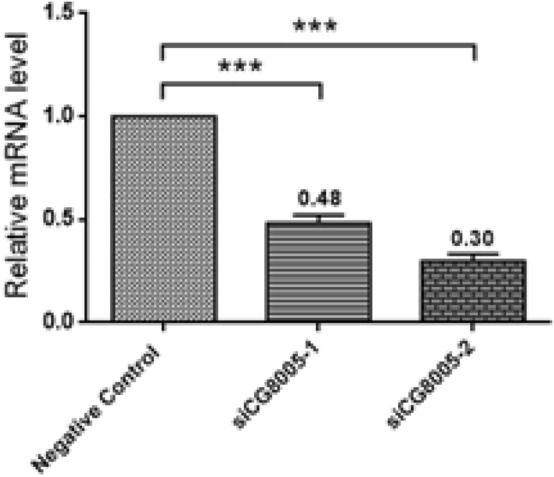
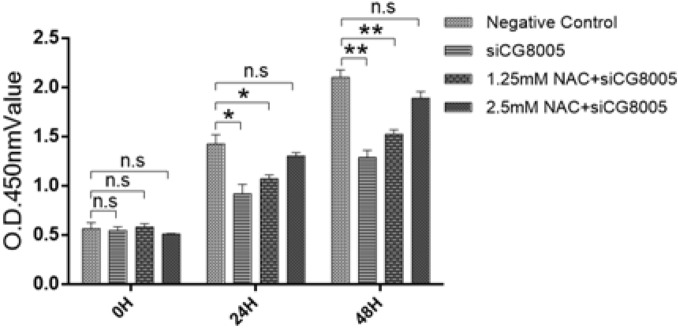
To investigate the effect of the antioxidant N-acetylcysteine (NAC) on the proliferation and apoptosis in CG8005 gene-interfering Drosophila S2 embryonic cells by scavenging intracellular reactive oxygen species (ROS). The interfering efficiency of CG8005 gene in Drosophila S2 embryonic cells was verified by real-time quantitative PCR (qRT-PCR). Different concentrations of NAC and phosphate buffered saline (PBS) were used to affect the Drosophila S2 embryonic cells. The growth state of Drosophila S2 embryonic cells was observed by light microscope. Two probes dihydroethidium (DHE) and 2,7-dichlorodihydrofluorescein-acetoacetate (DCFH-DA) were used to observe the ROS production in each group after immunofluorescence staining. TUNEL staining and flow cytometry were used to investigate the apoptosis level of Drosophila S2 embryos, and CCK-8 (Cell Counting Kit-8) was used to detect the cell viability of Drosophila S2 embryos. The knockdown efficiency of siCG8005-2 fragment was high and stable, which was verified by interference efficiency (P < 0.05). There was no significant change in the growth of Drosophila S2 embryonic cells after the treatment of NAC as compared to PBS group. Moreover, knockdowning CG8005 gene resulted in an increase in ROS and apoptosis in Drosophila S2 embryonic cells (P < 0.05) and a decrease in proliferation activity (P < 0.05). In addition, the pretreatment of antioxidant NAC could inhibit ROS production in Drosophila S2 embryonic cells (P < 0.05), reduce cell apoptosis (P < 0.05), and improve cell survival (P < 0.05). The CG8005 gene in Drosophila S2 embryonic cells could regulate the proliferation and apoptosis of S2 embryonic cells by disrupting the redox homeostasis, and antioxidant NAC could inhibit cell apoptosis and promotes cell proliferation by scavenging ROS in Drosophila S2 embryonic cells, which is expected to provide novel insights for the pathogenesis of male infertility and spermatogenesis.
为了通过清除细胞内活性氧(ROS)来研究抗氧化剂 N-乙酰半胱氨酸(NAC)对 CG8005 基因干扰的果蝇 S2 胚胎细胞增殖和凋亡的影响。通过实时定量 PCR(qRT-PCR)验证 CG8005 基因在果蝇 S2 胚胎细胞中的干扰效率。使用不同浓度的 NAC 和磷酸盐缓冲盐水(PBS)来影响果蝇 S2 胚胎细胞。通过光显微镜观察果蝇 S2 胚胎细胞的生长状态。使用二氢乙啶(DHE)和 2,7-二氯二氢荧光素-乙酰乙酸酯(DCFH-DA)两种探针进行免疫荧光染色后观察各组 ROS 的产生。TUNEL 染色和流式细胞术用于研究果蝇 S2 胚胎的凋亡水平,CCK-8(细胞计数试剂盒-8)用于检测果蝇 S2 胚胎的细胞活力。siCG8005-2 片段的敲低效率高且稳定,通过干扰效率验证(P<0.05)。与 PBS 组相比,NAC 处理后果蝇 S2 胚胎细胞的生长无明显变化。此外,敲低 CG8005 基因导致果蝇 S2 胚胎细胞中 ROS 和凋亡增加(P<0.05),增殖活性降低(P<0.05)。此外,抗氧化剂 NAC 的预处理可以抑制果蝇 S2 胚胎细胞中 ROS 的产生(P<0.05),减少细胞凋亡(P<0.05),并提高细胞存活率(P<0.05)。CG8005 基因可通过破坏氧化还原平衡来调节 S2 胚胎细胞的增殖和凋亡,抗氧化剂 NAC 可通过清除果蝇 S2 胚胎细胞中的 ROS 来抑制细胞凋亡并促进细胞增殖,这有望为男性不育和精子发生的发病机制提供新的见解。