College of Physical Education, Yangzhou University, Yangzhou, China.
School of Humanities and Education, Guangzhou Nanyang Polytechnic College, Guangzhou, China.
Front Endocrinol (Lausanne). 2023 Jul 14;14:1187325. doi: 10.3389/fendo.2023.1187325. eCollection 2023.
Neurodegenerative diseases often cause motor and cognitive deterioration that leads to postural instability and motor impairment, while aging-associated frailty frequently results in reduced muscle mass, balance, and mobility. These conditions increase the risk of falls and injuries in these populations. This study aimed to determine the effects of exercise on falls and consequent injuries among individuals with neurodegenerative diseases and frail aging people.
Electronic database searches were conducted in PubMed, Cochrane Library, SportDiscus, and Web of Science up to 1 January 2023. Randomized controlled trials that reported the effects of exercise on falls and fall-related injuries in neurodegenerative disease and frail aging people were eligible for inclusion. The intervention effects for falls, fractures, and injuries were evaluated by calculating the rate ratio (RaR) or risk ratio (RR) with 95% confidence interval (CI).
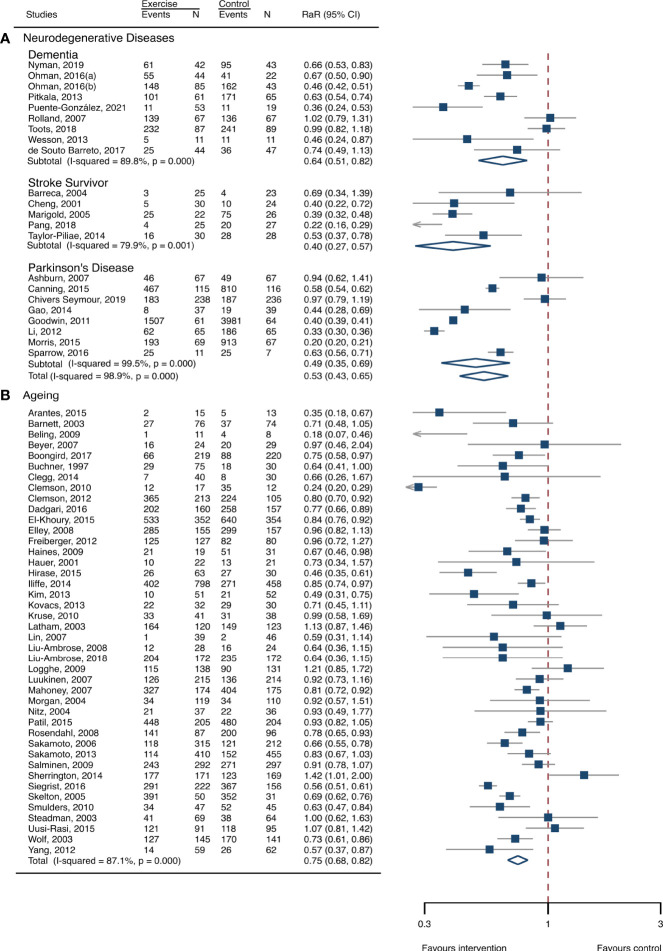
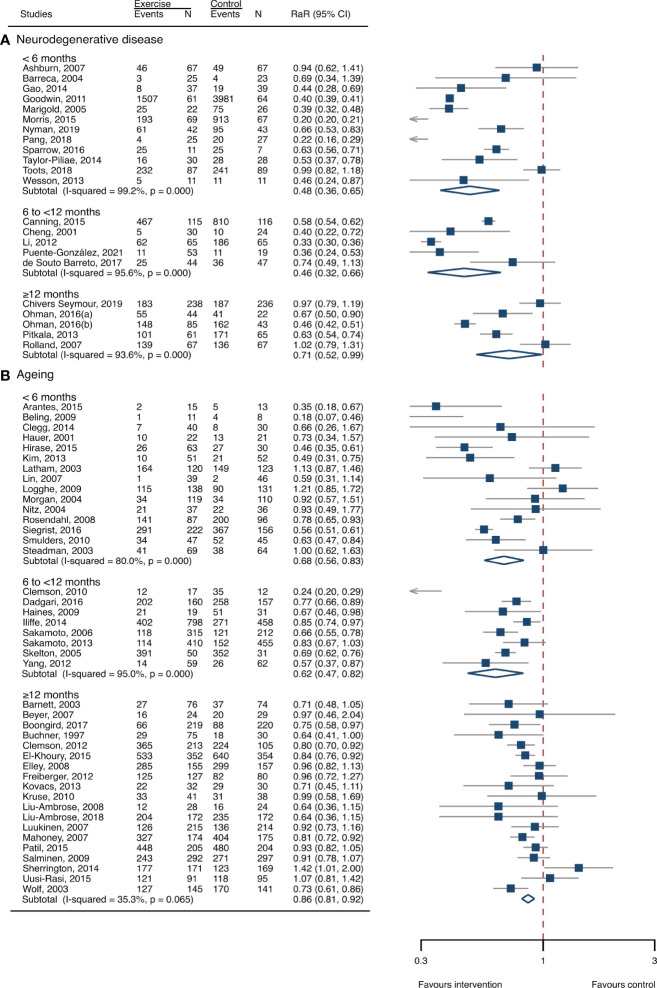
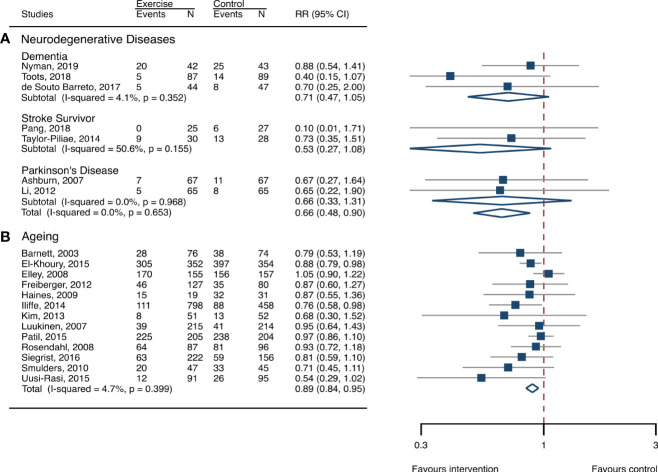
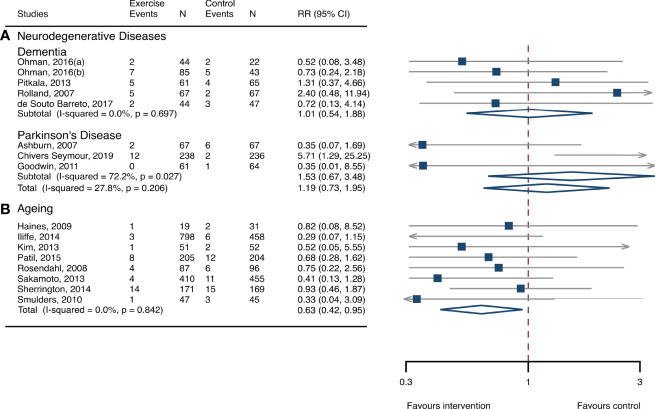
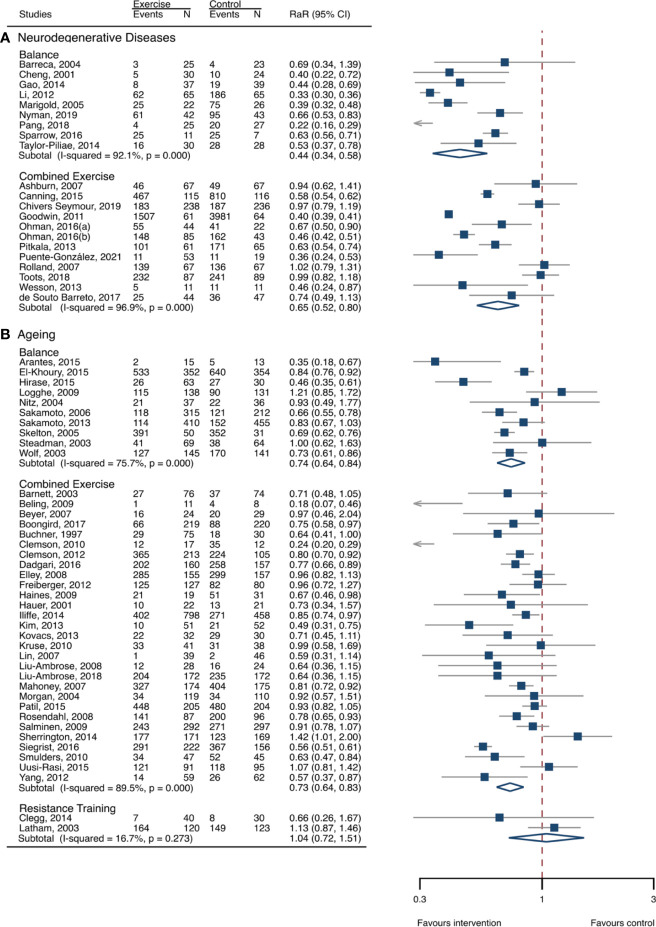
Sixty-four studies with 13,241 participants met the inclusion criteria. Exercise is effective in reducing falls for frail aging people (RaR, 0.75; 95% CI, 0.68-0.82) and participants with ND (0.53, 0.43-0.65) [dementia (0.64, 0.51-0.82), Parkinson's disease (0.49, 0.39-0.69), and stroke survivors (0.40, 0.27-0.57)]. Exercise also reduced fall-related injuries in ND patients (RR, 0.66; 95% CI, 0.48-0.90) and decreased fractures (0.63, 0.41-0.95) and fall-related injuries (0.89, 0.84-0.95) among frail aging people. For fall prevention, balance and combined exercise protocols are both effective, and either short-, moderate-, or long-term intervention duration is beneficial. More importantly, exercise only induced a very low injury rate per participant year (0.007%; 95% CI, 0-0.016) and show relatively good compliance with exercise (74.8; 95% CI, 69.7%-79.9%).
Exercise is effective in reducing neurodegenerative disease- and aging-associated falls and consequent injuries, suggesting that exercise is an effective and feasible strategy for the prevention of falls.
神经退行性疾病常导致运动和认知功能恶化,从而导致姿势不稳和运动障碍,而与衰老相关的虚弱常导致肌肉量、平衡和活动能力下降。这些情况会增加这些人群跌倒和受伤的风险。本研究旨在确定运动对神经退行性疾病和虚弱老年人跌倒及其相关伤害的影响。
对 PubMed、Cochrane 图书馆、SportDiscus 和 Web of Science 中的电子数据库进行了检索,检索时间截至 2023 年 1 月 1 日。纳入报告运动对神经退行性疾病和虚弱老年人跌倒和跌倒相关伤害影响的随机对照试验。通过计算率比(RaR)或风险比(RR)及其 95%置信区间(CI)来评估跌倒、骨折和伤害的干预效果。
64 项研究共纳入 13241 名参与者,符合纳入标准。运动对虚弱老年人(RaR,0.75;95%CI,0.68-0.82)和神经退行性疾病患者(0.53,0.43-0.65)[痴呆(0.64,0.51-0.82)、帕金森病(0.49,0.39-0.69)和中风幸存者(0.40,0.27-0.57)]均有效降低跌倒发生率。运动还降低了神经退行性疾病患者的跌倒相关伤害(RR,0.66;95%CI,0.48-0.90)以及虚弱老年人的骨折(0.63,0.41-0.95)和跌倒相关伤害(0.89,0.84-0.95)发生率。预防跌倒方面,平衡和综合运动方案均有效,且短期、中期或长期干预时间均有益。更重要的是,运动仅导致每位参与者每年非常低的受伤率(0.007%;95%CI,0-0.016),且对运动的依从性相对较好(74.8%;95%CI,69.7%-79.9%)。
运动可有效降低神经退行性疾病和衰老相关的跌倒及其相关伤害,提示运动是预防跌倒的有效且可行的策略。