Bhardwaj Pooja, Mishra Shailendra Kumar, Behera Sthita Pragnya, Zaman Kamran, Kant Rajni, Singh Rajeev
Indian Council of Medical Research (ICMR) - Regional Medical Research Center Gorakhpur, BRD Medical College Campus, Gorakhpur-273013, U.P., India.
EXCLI J. 2023 Jun 1;22:451-465. doi: 10.17179/excli2023-6098. eCollection 2023.
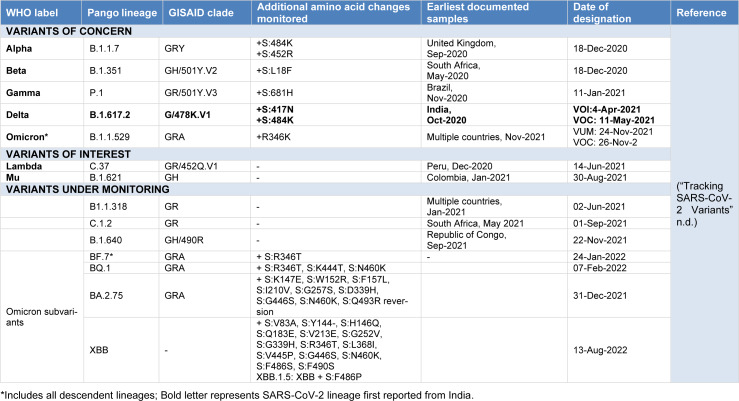
SARS-CoV-2 has mutated rapidly since its first case report in Wuhan, China, leading to the emergence of an indefinite number of variants. India has witnessed three waves of the COVID-19 pandemic. The country saw its first wave of SARS-CoV-2 illness from late January 2020 to February 2021. With a peak surge of cases in mid-September 2020, India recorded more than 11 million cases and a death toll of more than 0.165 million at this time. India faced a brutal second wave driven by the emergence of highly infectious SARS-CoV-2 variants B.1.617.2 (Delta variant) and the third wave with the leading cause of BA.2 (Omicron variant), which has led to an unprecedented rise in COVID-19 cases in the country. On September 14, 2022, India recorded a cumulative 44.51 million cases of COVID-19 with more than 0.528 million deaths. The discovery of common circulating mutants is facilitated by genome sequencing. The changes in the Spike surface glycoprotein recombinant binding domains served as the critical alterations, resulting in enhanced infectivity and transmissibility, with severe clinical effects. Further, the predominant mutation in the SARS-CoV-2 spike protein; the D614G strains served as a model for vaccine development. The mutation of the Wuhan strain to the Variant of Concern led to a significant increase in SARS-CoV-2 infections. In addition, there was a shift in the age group affected by SARS-CoV-2 variant infection. The current review summarized the COVID-19 pandemic's Variant of Concern and the advent of SARS-CoV-2 in India.
自中国武汉首次报告首例病例以来,严重急性呼吸综合征冠状病毒2(SARS-CoV-2)迅速变异,导致出现了数量不定的变种。印度经历了三波新冠疫情。该国在2020年1月下旬至2021年2月期间出现了第一波SARS-CoV-2疫情。2020年9月中旬病例激增达到峰值,此时印度记录了超过1100万例病例,死亡人数超过16.5万。印度面临由高传染性的SARS-CoV-2变种B.1.617.2(德尔塔变种)引发的残酷第二波疫情,以及由BA.2(奥密克戎变种)为主因的第三波疫情,这导致该国新冠病例前所未有的增加。2022年9月14日,印度累计新冠病例达4451万例,死亡人数超过52.8万。基因组测序有助于发现常见的流行突变体。刺突表面糖蛋白重组结合域的变化是关键改变,导致传染性和传播性增强,并产生严重临床影响。此外,SARS-CoV-2刺突蛋白中的主要突变;D614G毒株成为疫苗研发的模型。武汉毒株向关注变种的突变导致SARS-CoV-2感染显著增加。此外,受SARS-CoV-2变种感染的年龄组也发生了变化。本综述总结了印度新冠疫情的关注变种以及SARS-CoV-2的出现情况。