Li Yanju, Wang Feiqing, Pan Chengyun, Zhang Jing, Zhang Qian, Ban Lingying, Song Lingling, Wang Jishi, He Zhixu, Zeng Xiaojing, Tang Dongxin, Liu Yang
Department of Hematology Oncology, Affiliated Hospital of Guizhou Medical University, Guiyang, China.
Clinical Medical Research Center, The First Affiliated Hospital of Guizhou University of Traditional Chinese Medicine, Guiyang, China.
Front Med (Lausanne). 2023 Jul 18;10:1193830. doi: 10.3389/fmed.2023.1193830. eCollection 2023.
Ultrasound (US) has gained popularity in the evaluation of haemophilic joint diseases because it enables the imaging of soft-tissue lesions in the joints and bone-cartilage lesions. We aimed to determine the correlation between US evaluations and clinical assessments performed using HJHS 2.1 and to evaluate their respective characteristics in assessing early haemophilic arthropathy.
A total of 178 joints (32 knees, 85 elbows, and 61 ankles) in 45 haemophilia A patients (median age, 10 years; range, 6-15) were assessed using US and HJHS 2.1. Ultrasonographic scoring was performed in consensus assessments by one imager by using the US scores.
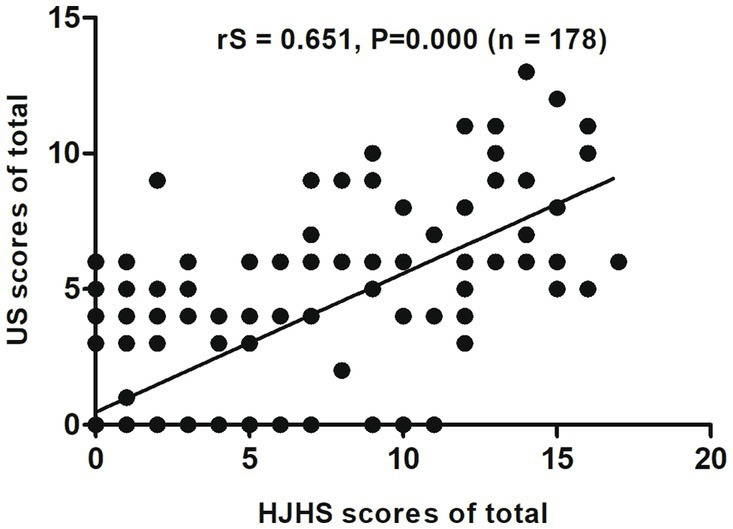
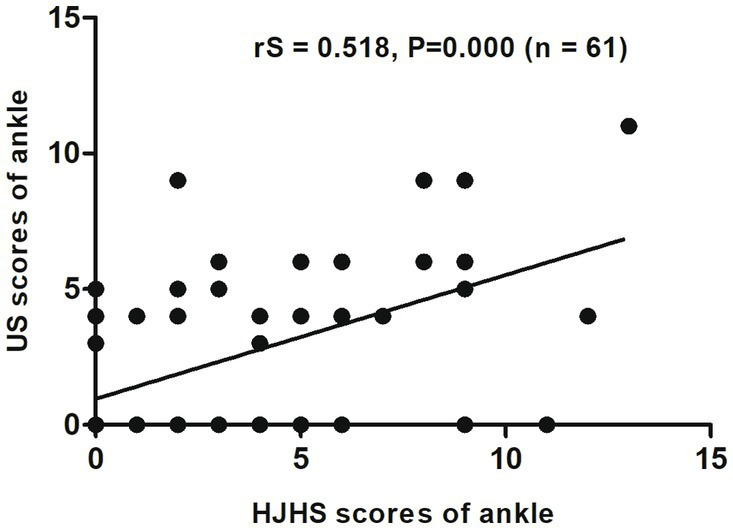
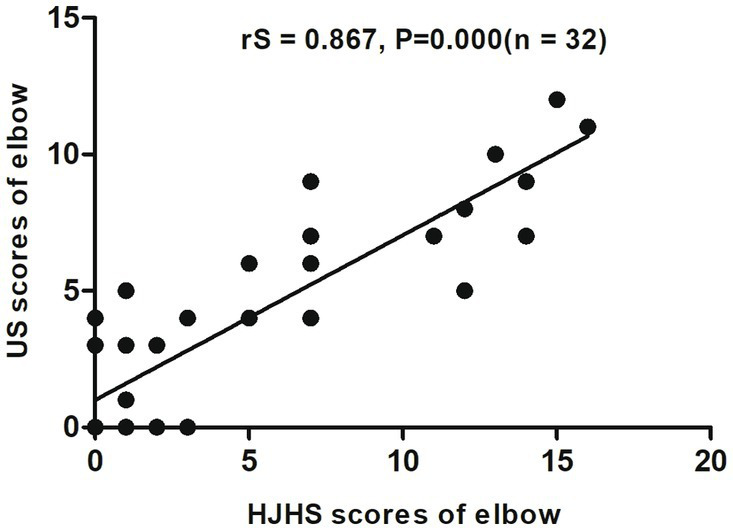
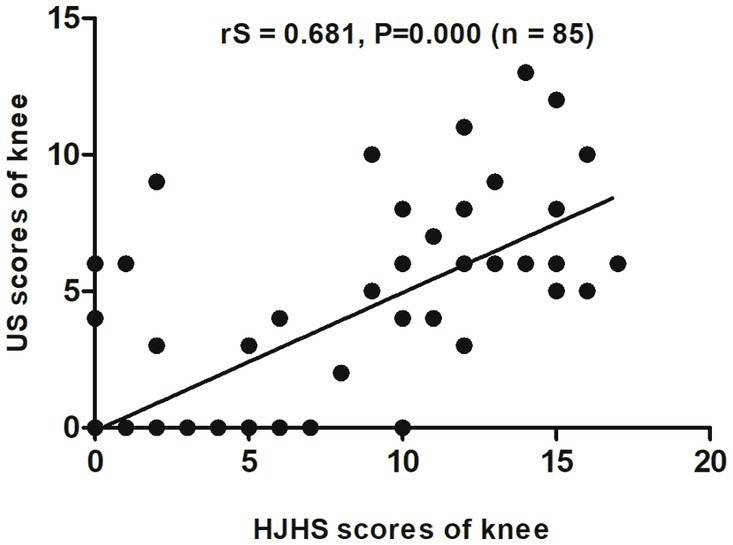
The total HJHS 2.1 and US scores showed a strong correlation (rS=0.651, =0.000, CI: 0.553-0.763), with an excellent correlation for the elbows (rS=0.867, =0.000, CI: 0.709-0.941) and a substantial correlation for the knees (rS=0.681, =0.000, CI: 0.527-0.797). The correlation for the ankles was relatively moderate (rS=0.518, P=0.000, CI: 0.308-0.705). Nine subjects (15.5%) without abnormalities, as indicated by HJHS 2.1, showed haemophilic arthropathy in US scoring. All nine joints showed moderate (1/9) to severe (8/9) synovial thickening in the ankle (5/9) and elbow joints (4/9). In contrast, 50 joints (50.5%) showed normal US scores and abnormal changes as indicated by HJHS 2.1. S scores correlated well with HJHS 2.1 for overall and individual joints.
US could identify some early pathological changes in joints showing normal clinical findings, but still cannot replace the HJHS; however, it can serve as an imaging examination complementing HJHS 2.
超声(US)在血友病性关节疾病评估中越来越受欢迎,因为它能够对关节内的软组织病变和骨软骨病变进行成像。我们旨在确定超声评估与使用HJHS 2.1进行的临床评估之间的相关性,并评估它们在评估早期血友病性关节病方面各自的特征。
对45例甲型血友病患者(中位年龄10岁;范围6 - 15岁)的178个关节(32个膝关节、85个肘关节和61个踝关节)进行了超声和HJHS 2.1评估。由一名成像人员通过超声评分进行超声检查的共识评估。
HJHS 2.1总分与超声总分显示出强相关性(rS = 0.651,P = 0.000,CI:0.553 - 0.763),肘关节相关性极佳(rS = 0.867,P = 0.000,CI:0.709 - 0.941),膝关节相关性显著(rS = 0.681,P = 0.000,CI:0.527 - 0.797)。踝关节的相关性相对中等(rS = 0.518,P = 0.000,CI:0.308 - 0.705)。9名根据HJHS 2.1显示无异常的受试者(15.5%)在超声评分中显示有血友病性关节病。所有9个关节在踝关节(5/9)和肘关节(4/9)中显示出中度(1/9)至重度(8/9)的滑膜增厚。相反,50个关节(50.5%)超声评分正常,但根据HJHS 2.1显示有异常变化。总体和各个关节的超声评分与HJHS 2.1相关性良好。
超声可以识别临床检查结果正常的关节中的一些早期病理变化,但仍不能替代HJHS;然而,它可以作为补充HJHS 2的成像检查。