a. Guangdong Key Laboratory of Pathogen Detection for Emerging Infectious Disease Response, b. Workstation for Emerging Infectious Disease Control and Prevention, Guangdong Center for Disease Control and Prevention, Guangzhou, 511430, China.
School of Public Health, Southern Medical University, Guangzhou, 510515, China.
J Epidemiol Glob Health. 2023 Sep;13(3):539-546. doi: 10.1007/s44197-023-00134-z. Epub 2023 Aug 3.
Since the Non-pharmaceutical Intervention (NPI) by COVID-19 emerged, influenza activity has been somewhat altered.
The aim of this study was to explore changes in influenza activities in the context of COVID-19 based on the sentinel hospitals/units in Guangdong, southern China.
The surveillance data in influenza-like illness (ILI) were collected from 21 cities in Guangdong between September 2017 and August 2021, while 43 hospitals/units were selected to analyze the predominant types of influenza, population characteristics, and seasonal features by three methods (the concentration ratio, the seasonal index, and the circulation distribution), based on a descriptive epidemiological approach.
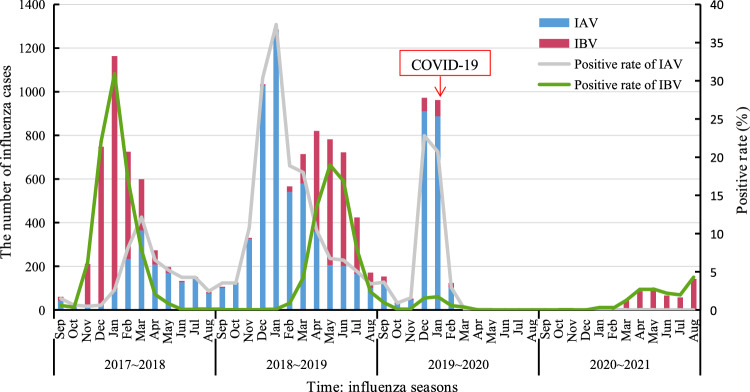
During the four consecutive influenza seasons, a total of 157345 ILIs were tested, of which 9.05% were positive for influenza virus (n = 14238), with the highest positive rates for both IAV (13.20%) and IBV (5.41%) in the 2018-2019 season. After the emergence of COVID-19, influenza cases decreased near to zero from March 2020 till March 2021, and the dominant type of influenza virus changed from IAV to IBV. The highest positive rate of influenza existed in the age-group of 5 ~ < 15 years in each season for IAV (P < 0.001), which was consistent with that for IBV (P < 0.001). The highest annual positive rates for IBV emerged in eastern Guangdong, while the highest annual positive rates of IAV in different seasons existed in different regions. Furthermore, compared with the epidemic period (ranged from December to June) during 2017-2019, the period ended three months early (March 2020) in 2019-2020, and started by five months behind (April 2021) during 2020-2021.
The highest positive rates in 5 ~ < 15 age-group suggested the susceptible in this age-group mostly had infected with infected B/Victoria. Influenced by the emergence of COVID-19 and NPI responses, the epidemic patterns and trends of influenza activities have changed in Guangdong, 2017-2021.
自 COVID-19 出现非药物干预(NPI)以来,流感活动已发生一定变化。
本研究旨在探讨中国南方广东省哨点医院/单位 COVID-19 背景下流感活动的变化。
2017 年 9 月至 2021 年 8 月,收集广东省 21 个城市的流感样病例(ILI)监测数据,选择 43 家医院/单位,采用集中比、季节指数和循环分布三种方法分析流感主要类型、人群特征和季节性特征。
连续 4 个流感季节共检测 ILI 157345 例,流感病毒阳性率为 9.05%(n=14238),其中 2018-2019 年甲型流感病毒(IAV)和乙型流感病毒(IBV)阳性率最高,分别为 13.20%和 5.41%。COVID-19 出现后,2020 年 3 月至 2021 年 3 月,流感病例接近零,流感病毒优势类型由 IAV 变为 IBV。各季节 IAV 阳性率最高的年龄组为 5~<15 岁(P<0.001),与 IBV 一致(P<0.001)。IBV 年阳性率最高的地区在粤东,不同季节 IAV 的年阳性率最高的地区不同。此外,与 2017-2019 年流行期(12 月至 6 月)相比,2019-2020 年流行期提前三个月结束(2020 年 3 月),2020-2021 年流行期推迟五个月开始(2021 年 4 月)。
5~<15 岁年龄组的最高阳性率表明该年龄组易感者多感染 B/Victoria。受 COVID-19 出现和 NPI 反应的影响,2017-2021 年广东省流感活动的流行模式和趋势发生了变化。